
Long-standing domestic public blockchain NEO sees feud between two co-founders, with opaque finances as the core reason

It's unexpected to see even the long-standing domestic public chain having such a day. What's even more lamentable is that the domestic top AI projects Manus, Kimi, and Minimax have had consecutive heavyweight news for two days in a row. Either they were acquired for tens of billions of dollars, or they received billions in financing. However, the long-standing public chain has surprisingly started to have a falling out.
Currently, it seems that the two co-founders of the NEO public chain established in 2014, Zhang Zhongwen (Erik Zhang) and Da Hongfei, have basically completely fallen out, and they are still continuously bickering on Weibo. Based on the statements of both parties and public information online, an attempt has been made to figure out what exactly happened between the two founders of this long-standing public chain.
Financial Black Box
In fact, Zhang Zhongwen had already left NEO a few years ago, which he also confirmed on his own Twitter, and then officially returned in September this year. The catalyst for this falling out was in November when, according to community sources and public records, Zhang Zhongwen, as the technical core, encountered obstacles when seeking to obtain a detailed financial report and fund flow of the Neo Foundation.
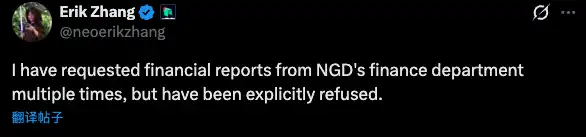
Following this, Zhang Zhongwen accused the Neo Foundation of long-term opaque operation, with the asset situation resembling a "black box." He pointed out that Da Hongfei had long been in sole control of the Foundation's assets other than NEO/GAS tokens, and there was a lack of a comprehensive, auditable disclosure mechanism.
In today's back-and-forth between the two sides, we also discovered the reason why Zhang Zhongwen had left before. He said that Da Hongfei had approached him alone, saying that the two of them were inefficient in managing NEO, so he chose to temporarily step down from the management team in order to "increase efficiency." However, he found that Da Hongfei was using NEO's resources to develop an independent public chain project, EON. This also prompted his return and involvement in Foundation governance.
In a community discussion in November, Zhang Zhongwen had previously stated that NEO had relied on hackathons to create a "false prosperity" before, with no real users, and many hackathon projects disappeared after winning awards.
Escalation of Conflict
In December, Zhang Zhongwen publicly released a statement demanding that Da Hongfei fulfill his commitment to financial disclosure starting from December 9. Even more explosively, Zhang Zhongwen unilaterally announced that, according to a previous verbal agreement between the two, starting from January 1, 2026, Da Hongfei would no longer be involved in NEO MainNet affairs but would instead focus on the NeoX sidechain and the development and operation of the new project SpoonOS.
Da Hongfei promptly responded, stating that Zhang Zhongwen effectively controlled the vast majority of the funds in the NEO ecosystem (including core assets NEO and GAS tokens) and dominated the voting rights of consensus nodes. He also accused Zhang Zhongwen of delaying the transfer of funds to the Foundation's multisig address for years under various pretexts (such as waiting for the N3 migration to complete).
Dahongfei has committed to releasing the year-end financial report for 2025 in the first quarter of 2026 and will provide a preview of the data in advance.
You may also like
In the era of AI, what is left of Bitcoin?
NeoSoul announced plans to integrate with the OKX Agentic Wallet, promoting AI agents' participation in the on-chain economy
Raising interest rates to protect STRC and selling coins to maintain credit, this time the strategy has chosen the two most expensive paths
Why Is Bitcoin Lagging Stocks in 2026? AI Stocks, ETF Outflows, and the Nasdaq Rally Explained
Morning Report | Samsung announces a 265.5 trillion won investment plan, focusing on semiconductor and AI computing power data centers; Vitalik publishes an article detailing the entire technology tree behind the confusion protocol (iO) mainline
What you bought on CEX is really not US stocks: Analyzing the 94% liquidation monopoly and the evaporation of equity under a five-layer pipeline
In such a crowded cross-border payment arena, where is the next stop for the future?
Why Is Bitcoin Down in 2026? What We Can Learn From 2022
The large models in the United States are moving towards closure in the name of security
From the white-haired stock god to the billionaire fund mogul, the smart people shorting Nvidia are all getting rich using the same framework
Morning Report | CoinEx becomes a key hub for Iran to evade sanctions, involving over $3.8 billion in funds; Kalshi seeks a new round of financing, with a valuation potentially rising to $40 billion
Global Launch: As predictions become the most scarce asset in the AI era, Manadia is defining the next generation of the value internet
Why do cryptocurrency projects always like to change their names?
Who is footing the bill for the $64 billion accounting frenzy?
I never expected that the first application of AI x Crypto would be in security auditing
What is your view on Binance's competitive advantages?
ETH has entered a non-consensus phase, and the turning point is approaching!
The shift in the cloud of the air: from despising stablecoins a year ago to the high-profile entry of capital today
In the era of AI, what is left of Bitcoin?
NeoSoul announced plans to integrate with the OKX Agentic Wallet, promoting AI agents' participation in the on-chain economy
Raising interest rates to protect STRC and selling coins to maintain credit, this time the strategy has chosen the two most expensive paths
Why Is Bitcoin Lagging Stocks in 2026? AI Stocks, ETF Outflows, and the Nasdaq Rally Explained
Morning Report | Samsung announces a 265.5 trillion won investment plan, focusing on semiconductor and AI computing power data centers; Vitalik publishes an article detailing the entire technology tree behind the confusion protocol (iO) mainline
What you bought on CEX is really not US stocks: Analyzing the 94% liquidation monopoly and the evaporation of equity under a five-layer pipeline