
Google, Circle, Stripe Flock Together to Let AI Spend Money: Payment Giants' Joys and Worries in 2026 Q1

 Prefer us on Google




Author | Kaori
Editor | Sleepy.md
In the first three months of 2026, players in the payment space had a fulfilling time.
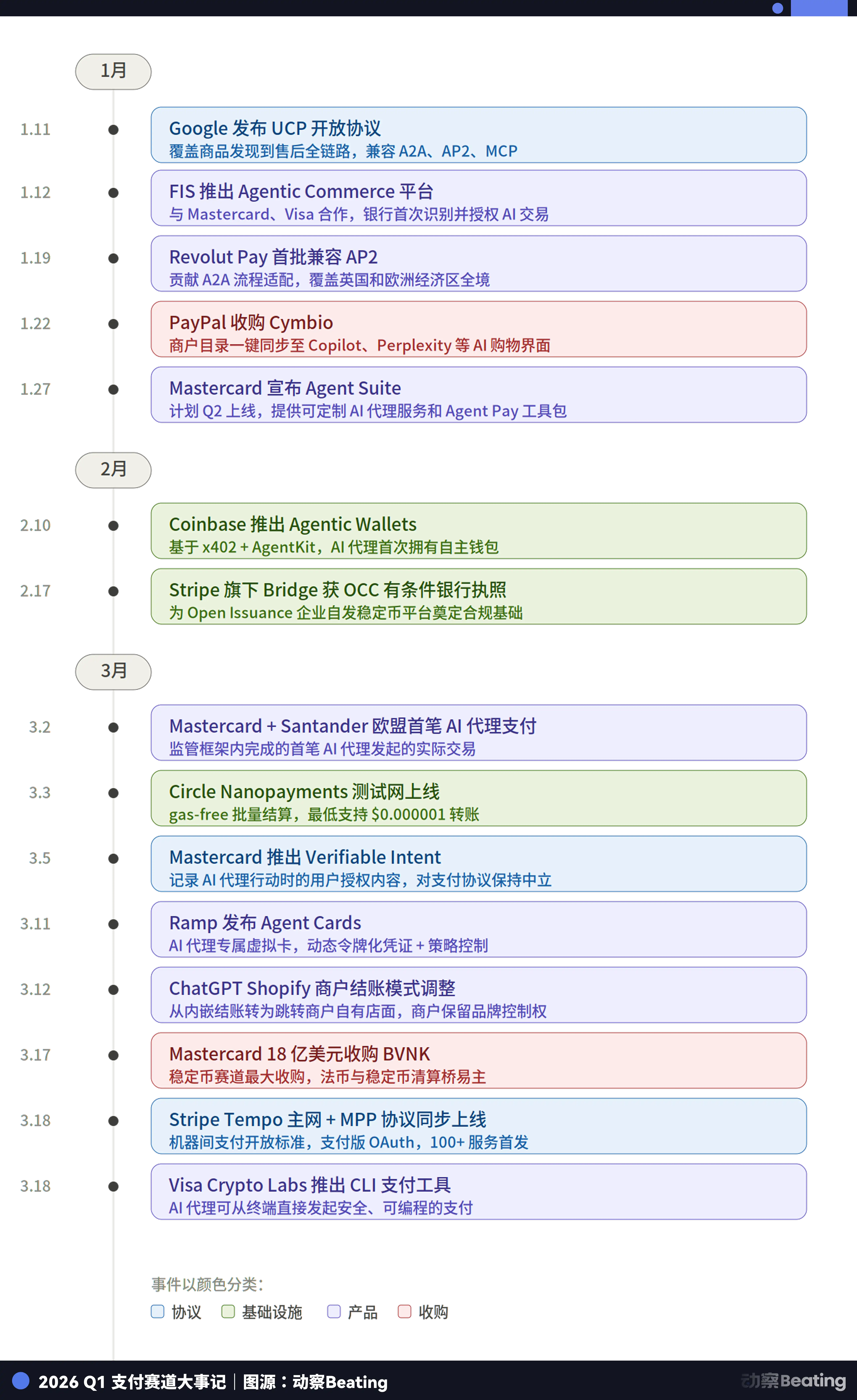
On January 11, Google unveiled the Universal Commerce Protocol (UCP) at the National Retail Federation Conference in the U.S., attempting to define a common language for AI Agent commerce. In the same week, Revolut announced being among the first EU payment methods compatible with Google AP2, PayPal revealed the acquisition of the merchant directory sync company Cymbio, and Mastercard launched the Agent Suite.
In February, Coinbase officially introduced Agentic Wallets, enabling AI Agents to have their own wallets for autonomous spending, earning, and trading of crypto assets. The x402 protocol deeply integrated with the Google ecosystem has already processed over 50 million transactions.
March saw a flurry of activity. Circle released Nanopayments, Ramp launched Agent Cards, Mastercard publicly announced the acquisition of stablecoin infrastructure firm BVNK for up to $1.8 billion, and the mainnet of Tempo, nurtured by Stripe and Paradigm, went live alongside the unveiling of the Machine Payments Protocol (MPP).
Within these three months, a dozen significant moves took place, with a mix of joy and concern. These events may seem disparate, but they all point to the same structural shift: when the cost of machine-to-machine transactions approaches zero, the true enemy of payment giants is no longer each other but zero-cost itself.
Key Events Recap
In the Zero-Cost Era, No One Dominates
Just six months ago, we were debating who would legislate for AI Agents. Stripe's ACP, Google's AP2, Mastercard's Agent Pay—these three paths pursued their own agendas, vying for the authority to define the same proposition.
Now, this war has essentially ended, not because one side won, but because everyone realized that there will be no single winner.
Google's recent introduction of UCP integrates all mainstream standards, responsible for searches and commercial transactions within the Gemini ecosystem. Stripe's MPP, launched with Tempo, also supports Mastercard and Visa system integration, facilitating autonomous machine-to-machine payments. Mastercard's Agent Pay handles auditable authorization for high-value transactions.
It used to be a turf war, now it's a turf delineation. The provisional nature of the protocol layer landscape means that the decisive competition has moved elsewhere.
Let's look at a set of data released by Enterprise Onchain. Over the past 9 months, the AI Agent has completed 140 million transactions, totaling $43 million, with 98.6% using USDC. The average amount per transaction is $0.31, and the AI Agent with purchasing power has surpassed 400,000.
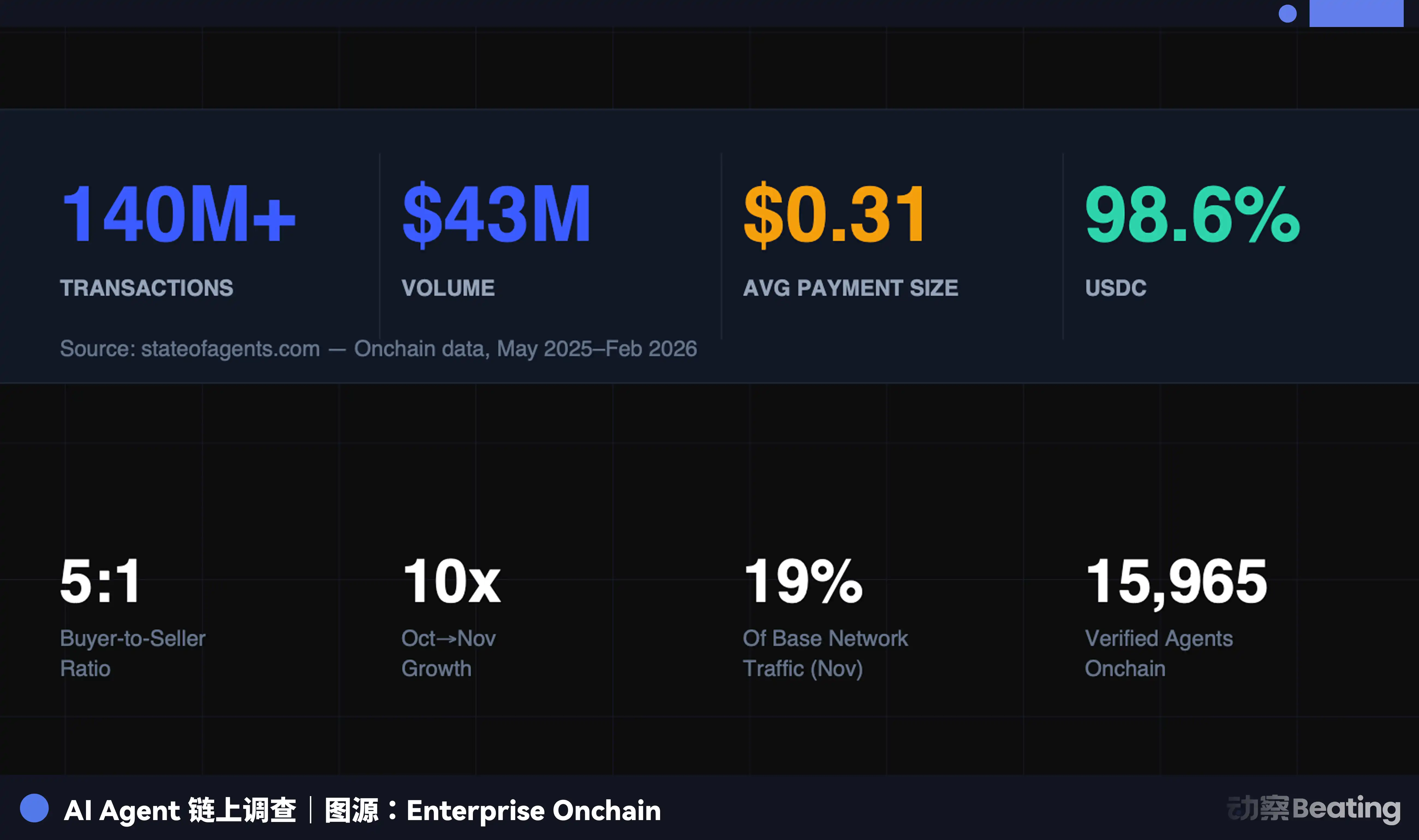
Let's unpack the significance of these numbers.
First, machine-autonomous transactions. 140 million transactions with no human intervention, bank approval, or credit card verification. Code to code, protocol to protocol, processes that once required human signatures, reconciliation, and settlement are now autonomously executed by machines.
Second, extremely small transaction amounts. With an average transaction amount of $0.31, most of these payments are microtransactions in scenarios such as API calls, computational resource purchases, and data access. Under the traditional payment system, such transactions would never occur as the minimum transaction fee on any card network would exceed the transaction's value.
Third, approaching zero cost. In conjunction with the x402 protocol, payments are directly embedded in HTTP requests. Circle Nanopayments aggregate tens of thousands of small payments off-chain and periodically batch settle on-chain, reducing developers' single transaction gas fees to zero and shifting the on-chain settlement costs to Circle in the batch settlement layer.
Transactions between machines, no checkout pages, no payment gateways, no intermediaries — this is the source of anxiety.
Of course, zero cost currently only applies to the specific scenario of machine-to-machine microtransactions. Stablecoins are not truly free; on the Ethereum mainnet, the gas fee for a small stablecoin transaction may exceed 20% of the transaction value, which is why Stripe created Tempo to address this issue.
On the consumer payment front, card networks still hold an advantage that stablecoins cannot replicate: unified consumer protection, consistent user experience, and the card's abstract layer with flexible routing capabilities at the underlying level.
However, this does not change the essence of anxiety. In the high-frequency machine-to-machine microtransaction scenario, zero cost is already a reality, and this gap is rapidly widening. Deloitte predicts that the global Agent market will reach $45 billion by 2030. This is a whole new transaction world, tearing open a massive gap on the fringes of traditional payments.
Responses from Giants: From Toll Collecting to Bridge Building
Faced with the threat of zero-cost, traditional payment giants have adopted different response strategies, but they share a common underlying logic: if they cannot charge fees in machine-to-machine micropayment scenarios, then they will control the bridge between old and new systems to collect fees there.
Visa's strategy is one of absorption rather than confrontation. USDC settlement has officially launched in the U.S., with crypto-friendly banks such as Cross River Bank and Lead Bank starting to use it. Visa Direct supports stablecoin preloading and direct payments.
In other words, you can use stablecoins, but please use my pipeline. Visa has also participated in the development of MPP, extending the protocol to card payment scenarios, which is a typical move of joining if you can't beat them.
Mastercard spent $1.8 billion to acquire BVNK, acquiring the bridge between fiat and stablecoins. BVNK supports fiat-stablecoin conversions on all major blockchain networks in over 130 countries, which is crucial infrastructure for the AI Agent payment era.
Mastercard's Chief Product Officer Jorn Lambert's response to the threat of stablecoins to card business was very direct: there is no issue with the card business, and the acquisition is to expand into new areas such as remittances. However, the deeper logic is that as stablecoin transaction volumes rapidly increase, controlling the clearing bridge between fiat and stablecoins means controlling the chokepoint of value flow.
Stripe has the greatest ambition. It has its own blockchain Tempo, its own MPP protocol, and a platform called Open Issuance that allows businesses to issue their own stablecoins and share reserve income, which is the epitome of vertical integration.
The combination of Tempo + MPP + Open Issuance means that Stripe is no longer just a payment processor; it is becoming an infrastructure operator for the AI Agent payment era.

PayPal took a different path. The acquisition of Cymbio was not to control the payment pipeline but to control the distribution of merchant catalogs. Cymbio's core capability is Store Sync technology, which allows a merchant's product catalog to be synchronized across multiple AI shopping surfaces with a single click, meaning that small and medium-sized merchants no longer need to adapt to each AI platform separately.
When AI agents replace humans in discovering products, whether a merchant's product catalog can be seen by AI becomes a matter of life and death. PayPal is betting that in the Agent Commerce era, being discovered by an agent is in itself valuable.
An interesting intermediate state is Ramp Agent Cards, which provides a virtual card to an AI Agent that still follows the Visa card network rails, but each transaction is dynamically authorized without exposing actual card information, essentially transforming corporate expense cards into Agent wallets.
Whether this is a continuation of traditional payments or a stopgap measure during a transition period remains unclear. If the dominant form of machine-to-machine transactions ultimately moves towards the stablecoin-native path, then Agent Cards may represent the last opportunity for the traditional card networks to be relevant in the new era.
The New Era: How to Make Money?
One question has remained unanswered. In the zero-cost track, transactions themselves do not generate fees. So, who makes money?
Circle's Nanopayments rely on infrastructure service fees, Stripe's Open Issuance relies on reserve fund earnings, and Mastercard, after acquiring BVNK, profits from the conversion service between fiat and stablecoins.
All three fee models share a common characteristic: shifting the fee point from the transaction itself to the conditions under which the transaction takes place. Essentially, this is closer to infrastructure rent rather than a transaction tax.
This marks a fundamental shift in business models. Over the past fifty years, the moat of payment networks has been network effects. The more merchants, the more willing consumers are to use it; the more consumers, the more merchants need to onboard, and this flywheel profits from the commission rights brought by scale.
In the world of machine-to-machine transactions, this flywheel has failed. Machines only need a stable, programmable, low-cost settlement layer, and whoever can provide this becomes the new infrastructure provider.
The survival of payment giants is not a big issue. What remains truly unresolved is where the power shifts to in an industry that has relied on commission to maintain control, once commission loses its relevance.
Disclaimer: This content is provided for general branding and informational purposes only and doesn't constitute financial, investment, legal, or tax advice. Any events, rewards, online events, or related information mentioned herein should not be considered a recommendation, solicitation, or invitation to purchase, sell, trade, or otherwise deal in any crypto assets or to use any services. Crypto assets are highly volatile and may result in loss. WEEX services and online events may not be available in all regions and are subject to applicable laws, regulations, and eligibility requirements. You are responsible for ensuring that your use of WEEX services complies with local laws and for carefully assessing the risks before participating in any crypto-related activities.
You may also like

Walsh's 'Unified Front': Aiming for Rate Cuts?

Ethereum vs Solana Whitepaper Comparison (2026)
French Tech: AI and Quantum on the Rise, Crypto Absent

Home Robot NEO Grows "Dexterous Hands": How Do Hands Become the API to the Physical World?

What is SCEX? The Cryptocurrency Exchange for Vietnam's Market by Sacombank

Major Update for ChatGPT: Cross-Platform Functionality, One-Click Website Creation, and Lower Costs

BTC Challenges 64,000 After Breaking 63,000, Market Trading 'Manageable Risks'

As the Bubble Bursts, Who Dominates Attention in the AI Era? A 2026 Guide to Influential AI KOLs in China and the UK

Old Money in Crypto Shifts: Paradigm Raises $1.2 Billion, Half Bet on AI and Robotics

Bitdeer unveils $36M Nevada factory to shake up Bitcoin mining

Perplexity Fine-Tuned a Chinese AI Model to Match Claude Opus 4.8 at One-Third the Cost

Bank of Korea defends bank-first stablecoin plan amid bill deadlock
JPMorgan says bitcoin's main risk isn't Strategy, but blockchain adoption that doesn't benefit public chains and tokens
Fear & Greed Index Today: What Extreme Fear Means for Crypto, Stocks and Gold
Labour MPs Push to Make UK Crypto Donation Ban Permanent

Supreme Court ruling expanding Trump's authority over federal agencies raises questions for SEC, CFTC as crypto rulemaking advances

'Bottom building in progress': Analysts say bitcoin holder capitulation signals late-stage bear market

A Comprehensive Analysis: Starting from 1996, Who is Laying the Foundation for the Next Generation of Capital Markets
Luke Dashjr, the Biggest Anti-Spammer of Bitcoin, Inscribed Phrases on the Network in 2011

Whales bought 270,000 BTC while ETFs bled $7 billion. One side is wrong

The crypto IPO class of 2025-26 is down as much as 89%. Autopsy of a listing boom
Robinhood Chain Mining Guide: A Comprehensive Tutorial from Cross-Chain to Memecoin
BitGo CEO says single-digit percentages of bitcoin's supply are 'probably right' for large holders amid Strategy's sale

Beyond Private Keys: How to Safeguard the Security Boundaries of Web3 from Wallets, L2 to Supply Chains?

Vanguard Enters the Market, Opening a New Crypto Gateway for 50 Million Traditional Investors

Why the OUSD Alliance of 150 Companies Still Cannot Shake USDT and USDC?
Citigroup Analysis: Is There Still 47% Upside for Nvidia? Can Rubin and CPO Deliver?

WEEX API Fast Connect: Turn Every Sign-In Into a Live Trader in Under 10 Seconds
WEEX API Fast Connect is a one-click OAuth authorization system that lets your users link their WEEX account without ever touching an API key. Frictionless onboarding, faster conversions, higher retention — built for WEEX Broker partners.
Bitcoin's dwindling exchange reserves don't pack the same bullish punch anymore

From Le Mans to the Rollercoaster: Carl Moon Takes On Portimão
Crypto world renowned KOL and racing driver Carl Moon, backed by WEEX, heads to the Ferrari Challenge Portugal round at the Algarve International Circuit, July 16–19, fresh off a podium finish at Le Mans. Here's why this race is one to watch.
Fast execution. Split-second accuracy. Security that never blinks. That's WEEX — and that's exactly how Carl races.
Walsh's 'Unified Front': Aiming for Rate Cuts?
Ethereum vs Solana Whitepaper Comparison (2026)
French Tech: AI and Quantum on the Rise, Crypto Absent
Home Robot NEO Grows "Dexterous Hands": How Do Hands Become the API to the Physical World?
What is SCEX? The Cryptocurrency Exchange for Vietnam's Market by Sacombank
Major Update for ChatGPT: Cross-Platform Functionality, One-Click Website Creation, and Lower Costs

Contents
Latest articles



Latest coin listings on WEEX


