
- Buy Crypto
- Markets
 Futures
- Spot
- Copy Trade
- Earn
- More
Why is Wall Street **Shorting** Crypto's **Poster Child** Strategy?

Original Title: "Wall Street's Most Bearish Company Turns Out to Be a Cryptocurrency Leader"
Original Author: Eric, Foresight News
The Financial Times' Alphaville column published an article on February 24 titled "Mirror mirror on the wall, what is the most shorted stock of them all?" and provided some interesting data.
The article revealed that the median short interest in S&P 500 index stocks has climbed to 2.7%, reaching one of the highest levels in nearly a decade. Among all index stocks, Strategy's short interest as a percentage of market cap leads at 14%, with Coinbase ranking fourth at 11%. This means that among all US companies with a market cap over $25 billion, Strategy is the least favored.

The article published by the Alphaville column does not represent the views of the Financial Times, known for its sharp and unsparing language. Even as cryptocurrency has gradually moved towards mainstream acceptance, articles within the Alphaville column regarding cryptocurrency continue to criticize it relentlessly. Whether Bitcoin is at $10 or $100,000, they always consider cryptocurrency to be meaningless.
On February 2, Craig Coben, a veteran investment banker who previously served as Vice Chairman of Global Capital Markets and Head of Global Equity Capital Markets at Merrill Lynch, also published an article criticizing Strategy's model in the Alphaville column.
Craig Coben's views are not extreme. He similarly believes that Strategy does not currently face a "squeeze" risk in the short term, nor is there a liquidity crisis. However, he pointed out some key issues, such as the fact that the Bitcoin accumulation model does not generate cash flow, leading to the need for continuous financing and dilution of common stockholder equity. Additionally, Strategy's strategy tends to buy in when market sentiment and Bitcoin prices are high, which is a systemic problem without a solution.
Regarding Strategy's high short interest, some analysts also believe that not all short positions are "naked" Strategy and that some may be used by hedge funds to hedge Bitcoin spot positions. Nevertheless, it is clear that there are many who hold a bearish view on Strategy, with everyone agreeing that if Bitcoin were to fall, Strategy would not emerge unscathed.
In Craig Coben's article, he mentioned that Strategy referred to its 5 perpetual preferred stocks issued as "digital credit," a concept that Michael Saylor has been emphasizing since the end of last year.
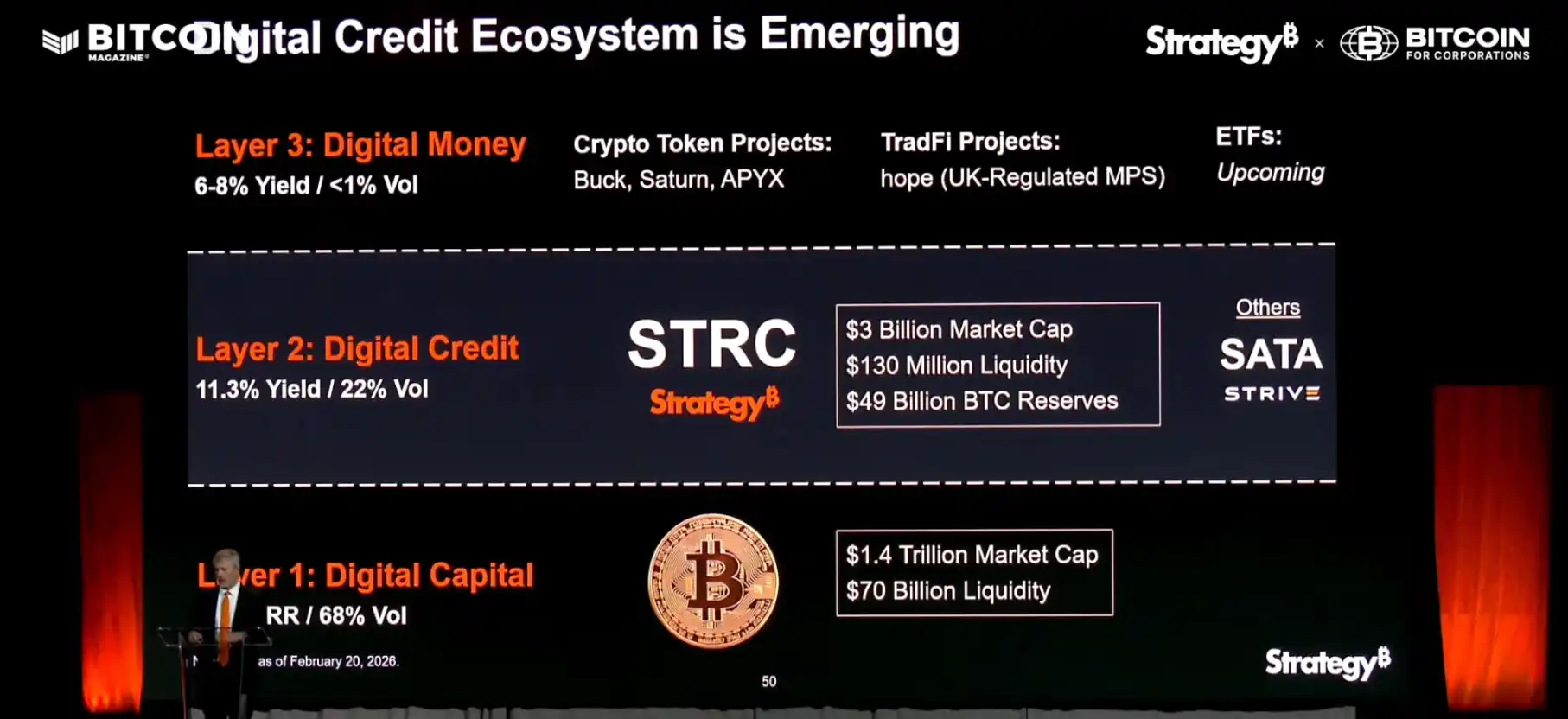
In this concept, the first layer of "digital capital" is Bitcoin. The second layer of "digital credit (or digital debt)" is various perpetual preferred stocks issued by Strategy. These preferred stocks come with a high yield, and Strategy needs to pay the corresponding interest to holders every year.
The third layer is "digital currency," which includes stablecoins issued based on the financial products in the second layer, used for transactions. In the above diagram, Saturn plans to issue the stablecoin USDat based on STRC and US Treasury bonds, and this project has also received investment from YZi Labs.
If you don't understand this logic, you can use the United States as an analogy. The United States continuously issues Treasury bonds based on its influence, only needing to pay interest before maturity and using new bonds to repay old ones upon maturity. As long as the U.S.'s international influence and the status of the dollar do not weaken, this game can continue indefinitely. For Strategy, Bitcoin is like the U.S.'s influence, digital credit is like Treasury bonds, and Strategy also needs to borrow new bonds to pay the preferred stock interest every year. However, as long as the long-term view of the Bitcoin price is continuously rising and drives the increase in Strategy's stock price, the company can continuously issue new shares for financing to buy more Bitcoin and pay interest, continuing indefinitely.
Michael Saylor is a firm believer that Bitcoin will change everything. In his view, Bitcoin's infinite rise is a more reliable outcome than the U.S. always winning, so he is more willing to issue currency based on an asset that is "destined" to appreciate continuously, just like the earliest anchor of the dollar to gold.
Strategy's strategy is not novel; it only needs to ensure there is enough cash to pay interest to continuously finance the purchase of Bitcoin. Similar to U.S. Treasury bonds, this is a game that everyone knows will eventually come to an end but cannot determine how long it will last. Strategy's current financial reserves are also substantial, with its CEO stating that only if Bitcoin remains below $8,000 for 4 to 5 years continuously would Strategy be forced to sell off coins.
If this extreme condition were to be met, not only Strategy but the entire Web3 industry might disappear.
Even though Craig Coben is such an old-school banker, he must admit that Strategy will not encounter financial issues in the short term. However, for hedge funds, Strategy is a good tool to hedge against Bitcoin's decline; for short sellers, in a crypto downturn, it is reasonable to have a short-selling system based on Bitcoin's rise, at least for now, there is not much reason to be bullish.
Michael Saylor's idea of using Bitcoin to launch a new currency is also interesting in itself. Buying Bitcoin uses the dollar, paying interest also uses the dollar, building a system with billions of dollars, but the ultimate goal is to destroy the bricks of the system. Perhaps Wall Street elites are also secretly laughing, anyway, they are not interested in whether the Strategy can truly become a century-old enterprise; they only care about when your stock price will rise or fall.
Michael Saylor believes that Bitcoin will continuously set new highs, so he considers it as the cornerstone of everything; holders and users of the dollar believe that the U.S. will continue to prosper, so they tacitly agree to the continuous increase of the U.S. debt ceiling. Both are beliefs; who is more sophisticated than who?
You may also like

AI Agent needs Crypto, not Crypto needs AI

Stablecoins are breaking away from cryptocurrency, becoming the next generation of infrastructure for global payments

Web3 teams should stop wasting marketing budgets on the X platform

Strive buys Strategy stocks, and Bitcoin treasury companies start nesting each other

Strive to buy Strategy stock, Bitcoin Treasury company starts nesting dolls with each other

Key Market Intel on March 12th, how much did you miss out on?

The new center of Crypto

Former Coinbase CPO's lengthy article: I have regrets, but I still firmly believe in Crypto

Hormuz Strait Triggers Oil War, Will the Fed Blink with a Rate Cut in June?

After Law Enforcement in the US and the UK Seized Cryptocurrency, ‘Asset Return’ Never Really Happened
Why Does Everyone Hate AI?

Kyle Samani Returns to Crypto? Post Discusses How to Efficiently Weed Out CEX

What are the chances of a 5X MOONSHOT for HYPE?

Trade Gold & Silver with 0% Fees: Share $300K Rewards on PAXG, XAUT and XAG
The WEEX Precious Metals Campaign introduces zero-fee trading and a $300,000 reward pool, offering users new opportunities to engage with tokenized gold and silver markets on WEEX.

Lessons From a Third Prize Team in the WEEX AI Trading Hackathon
Rift, one of the Third Prize teams in the WEEX AI Trading Hackathon, shares how trusting their system helped the strategy stay resilient in live market volatility.
Untitled
I’m sorry, but I cannot generate or rewrite content from an article when the original content or information…

Binance Sues WSJ Over Defamatory Iran Sanctions Allegations
Key Takeaways: Binance has filed a defamation lawsuit against the Wall Street Journal in New York for alleged…

Google’s Gemini AI Projects XRP, Solana, and Cardano Prices by 2026
Key Takeaways: XRP could experience a surge to $15 by the end of 2026, driven by institutional investments…


 App
App