
- Buy Crypto
- Markets
 Futures
- Spot
- Copy Trade
- Earn
- More
When an AI Company Goes on a Wild Hiring Spree for Asian Female Coders, Attention Shifts to Winning the World

Original Title: ABG CMO is eating the world.
Original Author: @0xJuliechen, Content Creator
Original Translation: Lila, Richie, BlockBeats
「If your startup is not a YC-backed B2B SaaS + GPT shell company, and you haven't hired an ABG as your Chief Marketing Officer, then you're pretty much screwed.」
Dance Note:
· YC: Short for Y Combinator, widely considered the world's top startup accelerator
· B2B SaaS: Subscription-based cloud software sold to businesses
· ABG = Asian Baby Girl
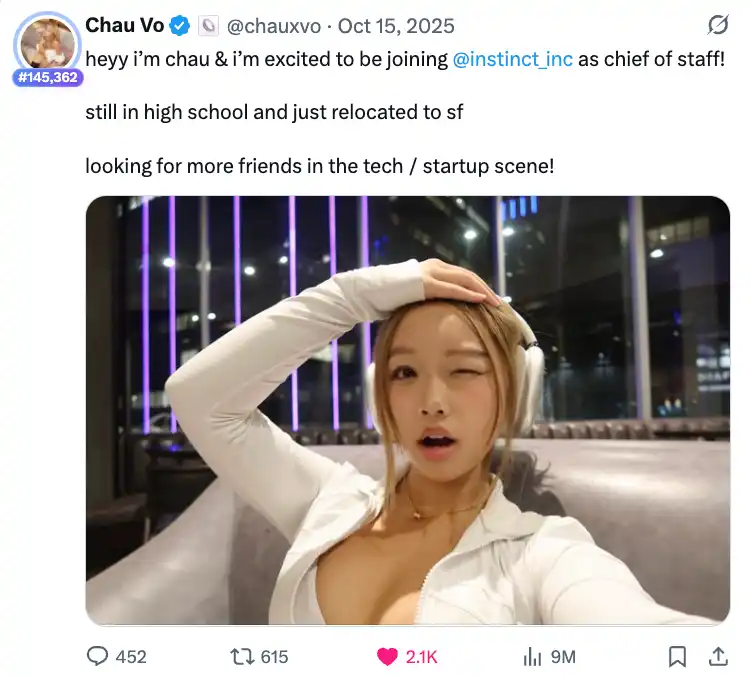
I've heard similar statements from countless AI company founders, each dreaming of finding the next Cluely: easily garnering millions of views, always in the spotlight. (Dance Note: Cluely is a highly controversial AI startup that pioneered a new paradigm of "viral marketing," as detailed later in the text.)
ABG = Asian Baby Girl. In Silicon Valley, it has become synonymous with young Asian women who excel in social media marketing. They are particularly skilled at creating eye-catching content, publishing viral articles, and marketing in a distinctively personal way. Suddenly, all AI startups are scrambling to hire them as Chief Marketing Officers.
Why? Because one viral post is much more effective than spending $50,000 on an advertising campaign.
A "thought leader" persona carefully cultivated on LinkedIn for months is no match for a "hot take" posted on X or a selfie for gaining more attention and engagement.
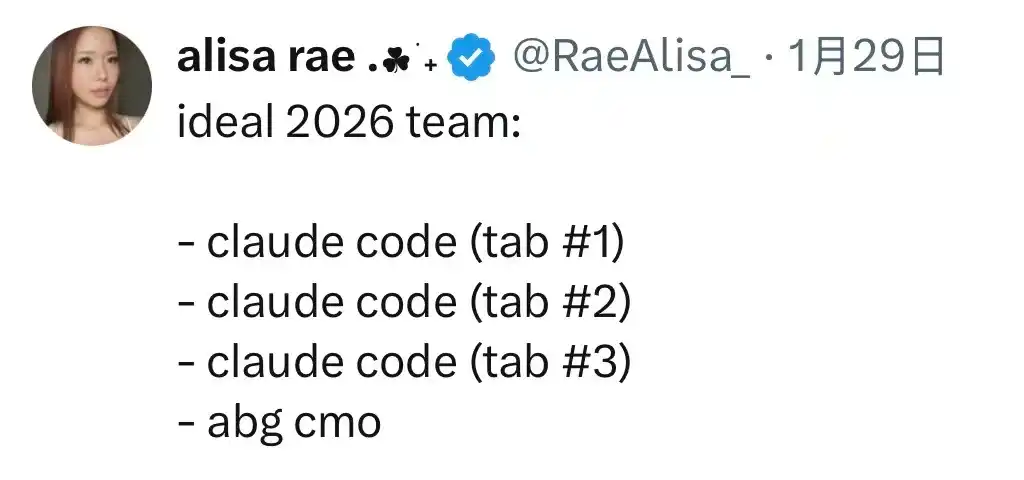
Are Asians naturally born marketers?
No, let me clarify: This is not about race (everyone of every race has an equal ability). This reveals some deeper issues in the evolution of the startup market.
The Feedback Loop of the Tech Market
From past viral breakout cases (such as @cluely), it can be seen that VCs chasing "traffic signals" have outweighed traditional financial metrics, leading to more funds flowing into more personality-driven, socially oriented projects.
Nowadays, more college students choose to be content creators rather than taking a $200k/year job at a big tech company, so more startups hire "ABGs" for marketing, raising the overall tech marketing standards, allowing creators to access higher-quality marketing resources.
Social media interaction data has become the sole standard for marketing effectiveness.
And this feedback loop is accelerating: More attention means more funds, creating higher barriers to entry, attracting more talent shifts, until it forms a stronger attention monopoly.
Likes, views, and shares are no longer just vanity metrics; they have become the new standard for due diligence.
The core is not in ABG, but in the attention economy.
How to Capture Hearts? Cluely Delivered the Perfect Answer Sheet
· Narrative: "Cheat on Everything" — perfectly aligned with founder @im_roy_lee's story (expelled from Columbia/Harvard). This is not just a slogan but a carefully crafted rags-to-riches story.
From "an utter failure" to "cheating with AI, ramping through big tech, YC, and A16Z." This kind of underdog narrative often simultaneously ignites people's aspirations and anger.
· Industrial Virality Machine: They recruited over 700 "editors" — mostly small creators on TikTok/Instagram. The model is: pay for performance. $1 per 1k views. Zero upfront cost.
· Content Formulization: Gibberish tweets + Edging on attractiveness + Lifestyle flaunting. Party videos (like the halted "1.5M Rager"), founder Roy Lee's persona as a "genius intern," flaunting wealth, disdain for traditional education. This marketing makes you think, "I really want to join this cool kids club"
· Total Platform Domination: X is responsible for creating a thought leader persona (150K+ followers), with TikTok/Instagram as the main battleground, and LinkedIn/Reddit used to spark native controversies.
What were the results? Daily average views of 10M+, 10B views in 3 months, at a cost much lower than traditional advertising. Traditional CPM (cost per mille) is $4, but they only need around $1.
But the fatal flaw is: The marketing investment far exceeds the product; they never actually developed a decent market-ready product. Viral spread is not a byproduct, but their only product.
When Cluely pivoted to an "AI Note Tool," the entire web ridiculed them. People wondered where all that money went.
Some even suggested: since they are so good, why not just be a marketing agency for other AI companies?
But most astonishingly: they did capture a certain truth. In an age of scarce attention, "controversy is still attention."
Truly ironic: everyone mocks Cluely, everyone wants to be Cluely.
(If you hate me but keep following my updates, you are my fan.)
What is the truth?
Attention is conquering the world.
Capital is flowing to companies that own consumer mindshare rather than just market share. Today, the best product doesn't necessarily win; the product with the best story does.
Every founder must also be a CMO, owning their IP. While the product is crucial, without marketing, your product will go unnoticed.
The next wave of successful startups will not be built by the most exceptional engineers. They will be created by those who are "code-literate and marketing-savvy."
Welcome to the new game.
You may also like

Ten Thousand Words Interpretation of STRC: Strategy for Making Money to Buy Coins New Magic

What competitive advantages are still defensible in the AI era?

For Whom the Bell Tolls, For Whom the Lobster Feeds? A Dark Forest Survival Guide for the 2026 Agent Player

Circle CEO's Latest Interview: Stablecoins Are Not Cryptocurrency

Deconstructing the Public Chain Pharos Capital Game: Is a $950 million valuation supported by assets like photovoltaics just a shell transaction under layers of betting?

a16z: AI is making everyone 10x more productive, but the true winner has yet to emerge
Why did the star Web3 project Across Protocol choose to abandon DAO?
In fact, ETH scaling is a major benefit for L2

Memories: 10 Key Contributions of the TON Core Team That Few People Knew in the Early Days

2025 South Korea CEX Listing Post-Mortem: Investing in New Coins = 70% Loss?

BIP-360 Analysis: Bitcoin's First Step Towards Quantum Immunity, But Why Only the "First Step"?

50 million USDT exchanged for 35,000 USD AAVE: How did the disaster happen? Who should we blame?

The Cryptographic Past of the Middle East

Resolving the Intergenerational Prisoner's Dilemma: The Inevitable Path of Nomadic Capital Bitcoin

Who Will Control AI? Why Decentralized AI May Be the Only Alternative to Government and Big Tech
AI has become critical infrastructure, and governments and corporations are competing to control it. Centralized development and regulation are entrenching existing power structures. The Web3 community is building a decentralized alternative — distributed compute, token incentives, and community governance — before that window closes.

Vitalik wrote a proposal teaching you how to secretly use AI large models

On the eve of the explosion of on-chain options

WEEX AI Hackathon: How Did This AI Trading Winner Succeed?
A self-taught AI trading enthusiast achieved top-10 results at the WEEX AI Hackathon. Learn about the mindset, AI tools, and lessons behind this impressive performance.


 App
App