
 Buy Crypto
- Markets
 Futures
- Spot
- Copy Trade
- Earn
- More
Wall Street Continues to Sell Off, How Low Will Bitcoin Go?

During the first week of November, the sentiment in the crypto space was very bearish.
Bitcoin had dropped to a new low below the "10.11" flash crash, failing to hold the $100,000 milestone and even dropping below $99,000, marking a new low for the past six months, while Ethereum hit a low of $3,000.
The total amount of liquidations in the past 24 hours exceeded $2 billion, with long positions losing $1.63 billion and short positions being liquidated for $400 million.
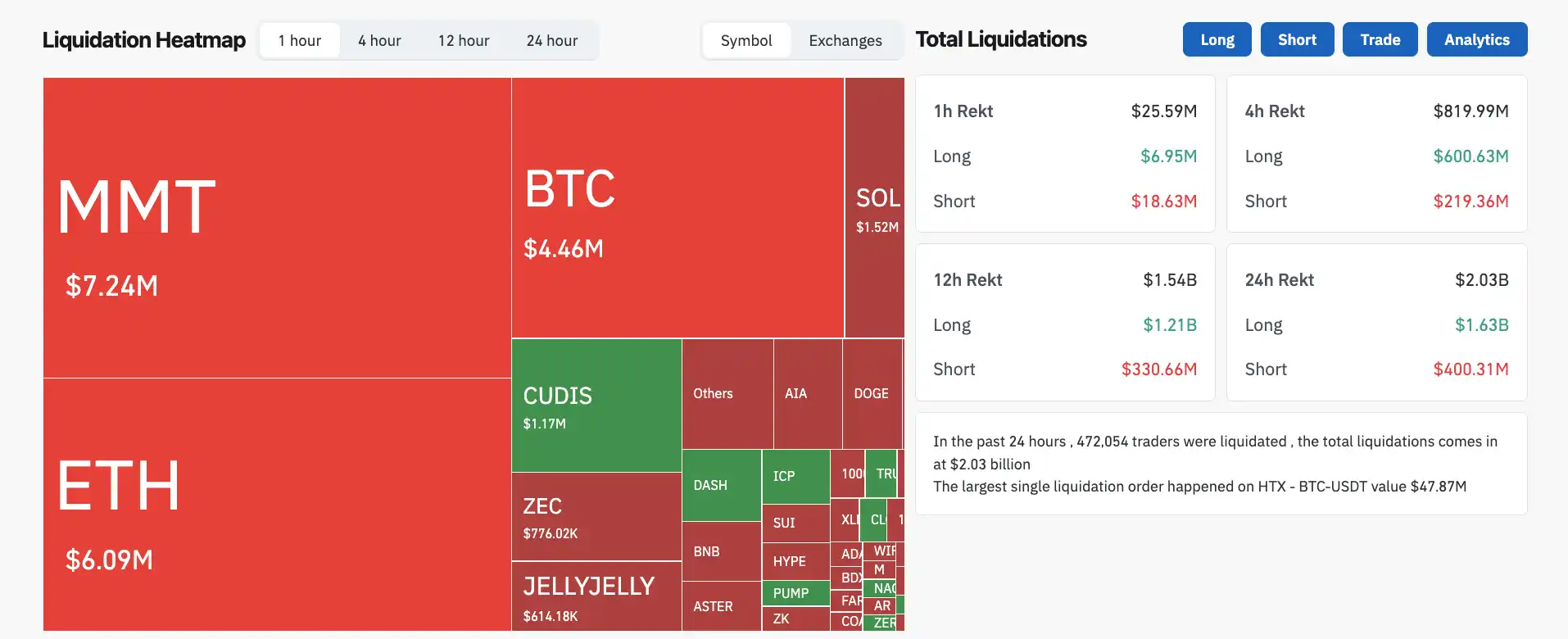
Data Source: CoinGlass
The most tragic event was a long position for BTC-USDT on the HTX trading platform, which was liquidated for $47.87 million, ranking first in the global liquidation list.
There must be some reasons behind the drop, which we will analyze in hindsight.
Industry News
For two consecutive days, there were incidents in the industry. On November 3, the well-known and long-standing DeFi project Balancer was hacked for $116 million due to a code vulnerability. Balancer is part of DeFi infrastructure and is even older than Uniswap, so such a significant code issue has dealt a heavy blow to the industry.
On November 4, a yield farming platform named Stream Finance pulled an exit scam, claiming a loss of $93 million. However, the community is unsure of the cause as the platform did not provide any details, leading to speculation that it was related to the flash crash on "10.11".
The crypto space is so small; we lost another $200 million in just two days.
Macro Perspective
If we take a look at the global capital markets, on November 4, markets worldwide experienced a downturn, including new highs in Japanese and South Korean stocks, as well as pre-market declines in U.S. stocks.
Firstly, there was news of interest rate cuts. In the Fed's speech last Wednesday, the probability of a rate cut in December seemed to have increased once again, indicating that there is no urgent need for a rate cut.
Additionally, there has been a net outflow in ETFs. Last week, Bitcoin's U.S. ETF saw a net outflow of $802 million, followed by another net outflow of $180 million on Monday, November 3rd.
Another event on November 5 is the U.S. Supreme Court holding oral arguments on "tariff trial," examining the legality of Trump's global tariffs. The uncertainty lies in the possibility that if the final ruling goes against Trump, the tariffs may be lifted, leading to further policy adjustments.
The U.S. federal government "shutdown" has entered its 35th day, tying the record for the longest shutdown in U.S. history. The government closure has led institutions to hedge high-risk assets, triggering a sell-off.
Spot ETF Continues to Bleed
The bleeding of ETFs is actually more severe than imagined.
From October 29 to November 3, IBIT, the world's largest Bitcoin spot ETF with a 45% market share owned by BlackRock, saw a cumulative net outflow of $715 million in four trading days, accounting for over half of the total $1.34 billion outflow in the U.S. Bitcoin ETF market.
Looking at the entire week from October 28 to November 3, IBIT saw a net outflow of $403 million, accounting for 50.4% of the market's $799 million outflow, with a single-day outflow of $149 million on October 31, setting a record for the highest daily outflow in the industry.
On November 4, BlackRock's Coinbase Prime custody address also saw on-chain transfers of 2043 BTC and 22,681 ETH, leading the market to speculate that ETF holders were still selling off crypto assets.
Although IBIT's current assets under management remain between $950 million and $1 billion, holding approximately 800,000 BTC (3.8% of the total circulation), the outflow over four days corresponds to around 5,800 BTC, accounting for 0.7% of its holdings.
Despite the relatively small percentage, this is a leading player in the industry, with a significant demonstration effect.
Looking at other major Bitcoin spot ETFs, the top five are BlackRock's IBIT, Fidelity's FBTC, Grayscale's GBTC, Bitwise's BITB, and ARK's collaboration with 21Shares, ARKB.
Fidelity's FBTC saw a net outflow of $180 million during the same period, accounting for 0.7% of its size, which is considered mild. Grayscale's GBTC has seen a slowdown in redemptions after a fee reduction, with outflows of $97 million this week. The relatively smaller BITB and ARKB saw weekly changes around $50 million.
This wave of redemptions is fundamentally a result of a sudden drop in investor risk appetite, in line with macro high interest rate expectations and the Bitcoin technical breakdown.
Even On-Chain Long-Term Holders Are Cashing Out Like Crazy
What's even fiercer than an ETF is actually the OG players on-chain.
Over the past 30 days (October 5 to November 4), those wallet addresses holding coins for over 155 days, commonly known as "Long-Term Holders" (LTH), have collectively sold around 405K BTC, accounting for 2% of the circulation, translating to over $42 billion cashed out based on the average price of $105K during the period.
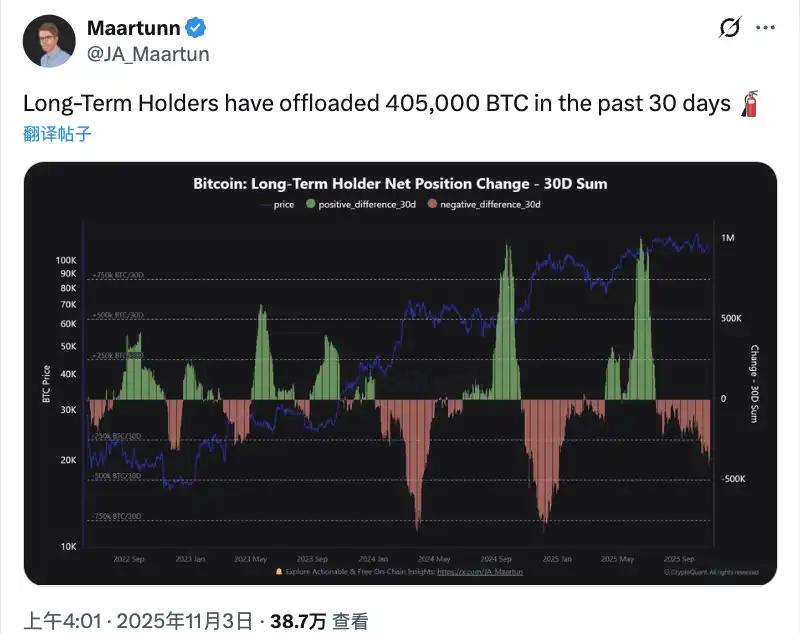
This group of people still holds roughly between 14.4M to 14.6M BTC, representing 74% of the total circulation, and still remains the largest supply side of the market. The issue is that their selling pace perfectly matches the price trend: after Bitcoin hit a historic high of $126K on October 6, profit-taking accelerated significantly; on the "Black Wednesday" (November 10), there was an outflow of 52K BTC in a single day; from late October to early November, combined with four consecutive net outflows from ETFs, daily average sell-offs were all above 18K BTC.
From on-chain data, it can be seen that the main force driving the price down are the wallets holding 10 to 1000 BTC, the "mid-tier holders," who bought in six months to one year ago and are now sitting on around 150% unrealized gains. On the other hand, the whales holding over 1000 BTC are actually slightly increasing their holdings, indicating that the top players are not bearish, and it is only the mid-sized profit-taking holders cashing out.
Comparing historically, in March 2024, LTHs sold 5.05% in a single month, leading to a 16% drop in Bitcoin's price; in December last year, they sold 5.2%, resulting in a 21% drop. This time, the October sell-off was 2.2%, with only a 4% drop, which can be considered relatively mild.
But with both ETF and on-chain bleeding simultaneously, the combination of these two forces is just too much for the market to handle.
Assessment of the Bottom of the Downtrend
Glassnode has published a market observation stating that the market continues to struggle above the short-term holding cost level (around $113K), which is a critical zone for the showdown between bulls and bears. If it fails to reclaim this level, it may further drop to the realized price of active investors (around $88K).
CryptoQuant CEO Ki Young Ju expressed in a series of on-chain data last night that the average cost of Bitcoin wallets is $55.9K, implying that holders are averaging about 93% profit. On-chain capital inflows remain strong. The inability of the price to rise is due to weak demand.
The CEO of 10x Research, Markus Thielen, stated that Bitcoin is approaching the support line since the crash on October 10. If it falls below $107,000, it may test $100,000.
Chinese crypto KOL Ban Mu Xia publicly stated today that "the traditional 4-year cycle bull market has ended, and Bitcoin will gradually fall to $84,000, then experience several months of complex fluctuations, followed by a surge to $240,000 following the stock market bubble in late next year and early the year after."
Currently, the only good news seems to be that historically, Bitcoin has seen an average increase in November.
You may also like

60 Essential Skills, Workflows, and Open Source Projects, the Ultimate Claude Advancement Checklist

SpaceX to Raise $75 Billion | Rewire News Nightly

PUMP Valuation Breakdown: On-chain Data Disproves the "Fake Volume" Theory, Where Does the Real Discount Come From?

Tiger Research: What AI services do cryptocurrency companies offer?

The war not only drives up oil prices but also causes Circle's stock price to soar

When agents become consumers, who will rewrite the underlying logic of internet commerce?

AI Agents in Action Summit: March 31, Hong Kong Cyberport, focusing on the deep waters of AI implementation

29 Days In, What Are America’s Options on Iran?

Flash Crash Down 97%+ with Ongoing Unlocking, WLD Completes $65 Million Off-chain Funding: Who Is Still Buying?

Bitcoin for Real Estate? Fannie Mae Teams Up with Coinbase to Launch Crypto Mortgage
Tether Hires Big Four Auditor, USDT Enters First Attestation Phase

Google AI Paper Destroys $900B Storage Stock, Accused of Faking Experiment
Evaporate $2 Trillion, U.S. Stocks See Worst Start in 4 Years, Why is the Market Bearish?

The speed at which AI discovers vulnerabilities has surpassed the speed at which it patches vulnerabilities.

AI Crypto Trading Bot Explained: Aurora's Multi-Factor Strategy in WEEX Hackathon
Aurora demonstrates how structured, multi-agent AI Trading systems can deliver more adaptive and resilient performance in the WEEX AI Trading Hackathon.

Cyber Taoist Fortune Teller: Fake Taoist, AI Fortune Telling, and Northeastern Metaphysics History

Bloomberg: Stablecoin Payments Emerge as Crypto VC's Newest Favorite Thing
BeatSwap is evolving towards a full-stack Web3 infrastructure, covering the entire lifecycle of IP rights.
BeatSwap, a global Web3 Intellectual Property (IP) infrastructure project, is attempting to overcome the current fragmentation limitations of the Web3 ecosystem, building a full-stack system that covers the entire lifecycle of IP rights.
Currently, most Web3 projects are still in the stage of functional fragmentation, often focusing only on a single aspect, such as IP asset tokenization, transaction functionality, or a simple incentive model. This structural dispersion has become a key bottleneck hindering the industry's scale application.
BeatSwap's approach is more integrated, integrating multiple core modules into the same system, including:
· IP authentication and on-chain registration
· Authorization-based revenue sharing mechanism
· User-engagement-driven incentive system
· Transaction and liquidity infrastructure
Through the above integration, the platform builds an end-to-end closed-loop path, allowing IP rights to complete a full cycle of "creation, use, and monetization" within the same ecosystem.
BeatSwap is not limited to existing crypto users but is attempting to take the global music industry as a starting point, actively creating new market demand. Its core strategies include:
Exploring and incubating music creators (Artist discovery)
Building a fan community
Igniting IP-centric content consumption demand
The current global music industry is valued at around $260 billion, with over 2 billion digital music users. This means that the potential market corresponding to the tokenization and financialization of IP far exceeds the traditional crypto user base.
In this context, BeatSwap positions itself at the intersection of "real-world content demand" and "on-chain infrastructure," attempting to bridge the structural gap between content production and financial flow.
BeatSwap's upcoming core product "Space" is scheduled to launch in the second quarter of 2026. This product is defined as the SocialFi layer in the ecosystem, aiming to directly connect creators with users and achieve deep integration with other platform modules.
Key designs include:
A fan-centric interactive mechanism
Exposure and distribution logic based on $BTX staking
User paths connected to DeFi and liquidity structures
Thus, a complete user behavior loop is formed within the platform: Discovery → Participation → Consumption → Rewards → Trading
$BTX is designed to be a core utility asset within the ecosystem, rather than just a simple incentive token, with its value directly tied to platform activity and IP use cases.
Main features include:
· Yield distribution based on on-chain authorized actions
· Value reflection based on IP usage and user engagement dynamics
· Support for staking and DeFi participation mechanisms
· Value growth driven by ecosystem expansion
With the increased frequency of IP use, the utility and value support of $BTX will enhance simultaneously, helping alleviate the "disconnect between value and utility" issue present in traditional Web3 token models to some extent.
Currently, $BTX has been listed on several mainstream exchanges, including:
Binance Alpha
Gate
MEXC
OKX Boost
As the launch of "Space" approaches, BeatSwap is actively pursuing more exchange listings to further enhance liquidity and global accessibility, laying a foundation for future market expansion.
BeatSwap's goal is no longer limited to the traditional Web3 narrative but aims to target over 2 billion digital music users and a trillion KRW-scale content market.
By integrating content creators, users, capital, and liquidity into a blockchain framework centered around IP rights, BeatSwap is striving to build a next-generation infrastructure focused on "IP tokenization."
BeatSwap integrates IP authentication, authorization distribution, incentive mechanism, transaction system, and market construction to establish a unified structure that bridges the full lifecycle path of IP rights.
With the launch of the Q2 2026 "Space," the project is expected to become a key infrastructure connecting content and finance in the IP-RWA (Real World Assets) track.


 App
App