
The Possibility of a Fed Chair Bringing a Wild Bull Run


In the prediction market Polymarket, the probability of Hassett being elected as the new Federal Reserve Chair has risen to 86%, far ahead of other possible candidates for the position.
As expected, Kevin Hassett will most likely be the next Federal Reserve Chair, Trump's favorite.
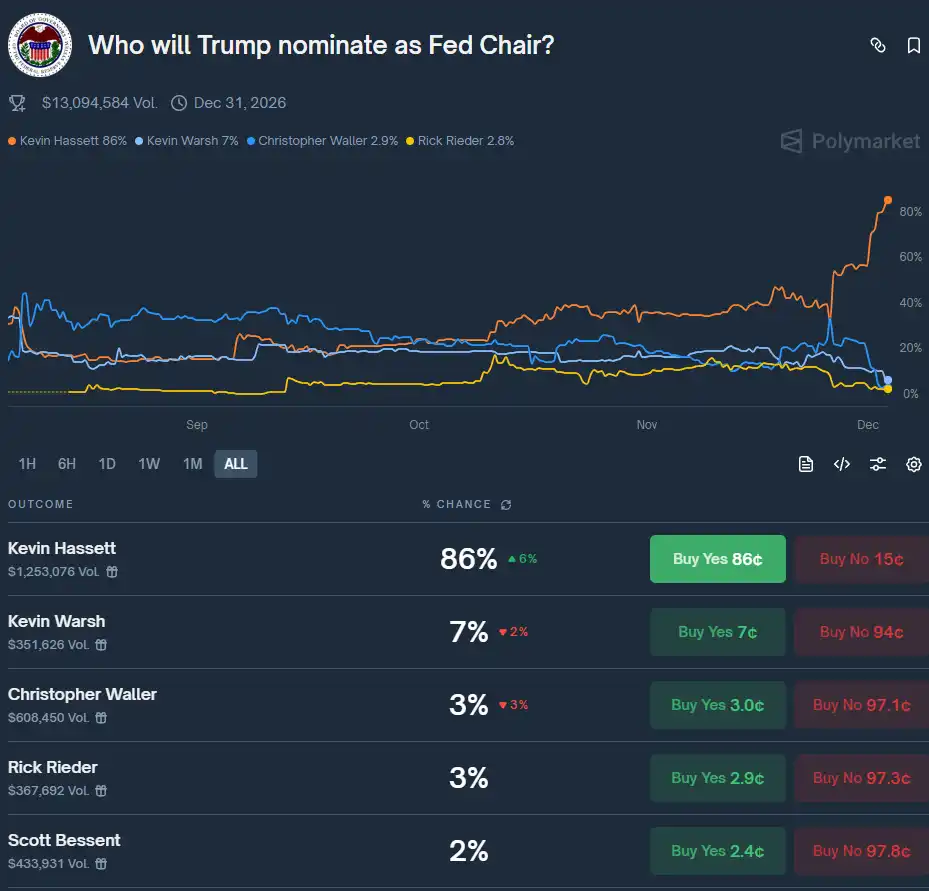
The actions of the Federal Reserve have always been a key factor impacting the cryptocurrency market. So, if Hassett eventually becomes the new Federal Reserve Chair as expected by the market, what kind of impact can be expected on the market?
Accelerated Interest Rate Cuts
In late November, Hassett mentioned that pausing interest rate cuts at that time would be "a very bad time" because the government shutdown had already dragged down fourth-quarter economic growth. He projected that the government shutdown would cause a 1.5 percentage point decline in fourth-quarter Gross Domestic Product (GDP). Additionally, he noted that the September Consumer Price Index (CPI) showed better-than-expected inflation performance.
Earlier on November 13, Hassett stated that he expected a 1.5% GDP decline in the fourth quarter due to the government shutdown. He couldn't see many reasons not to cut interest rates.
Therefore, if Hassett becomes the new Federal Reserve Chair, it is expected that he will advocate for faster rate cuts, potentially lowering the federal funds rate to below 3%, even approaching 1%, to stimulate economic growth and employment.
This is also what Trump wants to see.
Resuming QE (Quantitative Easing)
On December 1, the Federal Reserve officially ended its Quantitative Tightening (QT) policy, marking the end of the balance sheet reduction process that began in 2022. Although some believe that the effects may not be seen until early next year, the expectation of loose liquidity is gradually materializing.
Hassett may be more tolerant of inflation, seeing the 2% inflation target as a flexible upper limit rather than a strict anchor. The focus would be on employment and GDP growth, reducing the "gradual" decision-making based on data and shifting to a more proactive pro-growth intervention.
In September of this year, during an interview with Fox Business, Hassett stated that the U.S. is experiencing a supply-side boom, in an economy without real inflation, the current rates are hindering economic growth and job creation. He also mentioned that the U.S. is expected to achieve 4% GDP growth.
The viewpoint prioritizing economic growth over inflation control, making it expected for the Federal Reserve under Powell's leadership to restart QE.
Impact on Bitcoin
Every Federal Reserve Chair candidate, whether they directly address the crypto topic or not, will have a structural impact on the cryptocurrency industry. Powell has more than just a passing association with the industry – openly holding Coinbase stock worth millions and serving on Coinbase's advisory board.
Moreover, he participated in an internal White House working group on digital asset policy, pushing for regulatory frameworks that leave room for innovation and seeing crypto tech as a significant variable shaping future economic structures. He once stated that Bitcoin would "rewrite financial rules."
Powell's crypto background could reduce regulatory uncertainty, drive institutional adoption, and lead the Fed to explore crypto integration. This could enhance Bitcoin's legitimacy and liquidity, potentially propelling prices to new highs.
Many traders are bullish on the market post-Powell's appointment, believing that the bull market will start then, expecting this to happen by mid-next year, making the latter half of '26 a focal point for the crypto industry.
You may also like

The other side of Musk's trillion-dollar fortune: 85% cannot be sold

The U.S. government prohibits foreigners from using Fable 5, Anthropic issues a rebuttal

Citibank releases "2030 Asset Tokenization Market Outlook": 6 major trends may create a $8.2 trillion market

The trillion-dollar valuation test: Are the three major super IPOs a celebration for tech stocks or a nightmare for the crypto market?

Morning Report | Digital Asset completes $355 million financing led by a16z Crypto; Meta completes operational separation from Manus

a16z Crypto Partner: Cash flow is the moat

Cryptocurrency market makers collectively seek change as it becomes increasingly difficult to make money

How TradeXYZ, xStocks, and Alpaca break down the SpaceX IPO into three different strategies
$75 billion in risk asset redistribution: How will SpaceX's IPO affect U.S. stocks and Bitcoin?

Why Is BlackRock Investing $5 Billion in the SpaceX IPO?
Morning News | CME Group launches Nasdaq Cryptocurrency Index futures; Asset management giant Janus Henderson strategically invests in Ethena

Bitcoin Layer 2 Network Botanix: Why Did We Choose to Dissolve?

Why did Oracle deliver the strongest financial report in history, yet its stock price fell?
When the P2P illicit funds from ten years ago turned into 60,000 bitcoins
Dialogue with OmenX Founder: Why does the prediction market need an evolution from "spot" to "derivatives"?
Galaxy in-depth report: Is Solana still worth paying attention to?
Young people in South Korea make a "final effort" in the epic bull market
The pricing controversy of Trade.xyz exposes the fatal weakness of Pre-IPO perpetual contracts
The other side of Musk's trillion-dollar fortune: 85% cannot be sold
The U.S. government prohibits foreigners from using Fable 5, Anthropic issues a rebuttal
Citibank releases "2030 Asset Tokenization Market Outlook": 6 major trends may create a $8.2 trillion market
The trillion-dollar valuation test: Are the three major super IPOs a celebration for tech stocks or a nightmare for the crypto market?
Morning Report | Digital Asset completes $355 million financing led by a16z Crypto; Meta completes operational separation from Manus
a16z Crypto Partner: Cash flow is the moat


