
The DAO Makes a Comeback Ten Years Later, Establishes $220 Million Security Fund


Original Article Title: "The Most Epic Hack in Ethereum History Leads to $220 Million Security Safety Net"
Original Article Author: KarenZ, Foresight News
In Ethereum's development history, nothing has been more iconic than the 2016 "The DAO" event. It was not only the most epic crowdfunding project in Ethereum's history, but also the protagonist of the hack that led to the Ethereum community split and the birth of "Ethereum Classic (ETC)."
A decade later, the name that once almost destroyed Ethereum—The DAO—is making a comeback in a different way, launching "TheDAO Security Fund" to convert the remaining over 75,109 Ether (worth over $220 million) from the event into a long-term fund focused on Ethereum security development.
Historical Retrospective: A Crowdfunding Myth Turned Ecosystem Crisis
Let's rewind to 2016. Back then, The DAO set a crowdfunding record with a fundraising amount of $150 million, attracting up to 14% of the Ethereum supply.
The vision of this decentralized autonomous organization excited the entire crypto ecosystem, but soon encountered a catastrophic attack. A hacker exploited a recursive call vulnerability in the smart contract to steal a large amount of funds, prompting the Ethereum community to make a highly controversial decision—to implement a hard fork to recover the stolen assets. This move also directly led to a split in community ideology, giving birth to Ethereum Classic (ETC).
However, fund recovery was never straightforward. While the hard fork resolved the redemption issue of the standard DAO tokens, it could not address all edge cases. As a result, a group of senior Ethereum community members voluntarily formed the "TheDAO Curator Multisig Wallet" to take on the responsibility of addressing these complex legacy issues.
TheDAO Security Fund Emerges
Griff Green, former The DAO community manager and now co-founder of Giveth, was one of the key members of the "TheDAO Management Multisig Wallet" back then. According to an official announcement, as early as August 2016, these core administrators clearly stated an important intention: if the legacy funds of these edge cases remained unclaimed after January 31, 2017, they would be used to support Ethereum smart contract security development.
Subsequently, these funds quietly "slept" for nearly a decade. Griff Green said in an interview with Unchained, "As of today in 2026, we have never touched this fund, and the rise in Ethereum's price has significantly increased its value. It's a dramatic turn—what was once 'leftover funds' is now worth far more than The DAO's initial $150 million crowdfunding total."
The DAO Fund Goal: Safeguarding Ethereum Security
According to the official announcement, TheDAO Security Fund's funds mainly come from two parts, totaling over 75,109 ETH (worth $220 million):
· Around 70,500 ETH in the ExtraBalance contract, which can still be claimed by eligible individuals.
· Around 4,600 ETH and some DAO tokens in TheDAO Curator Multisig, worth around $13.5 million, with no clear claimants.
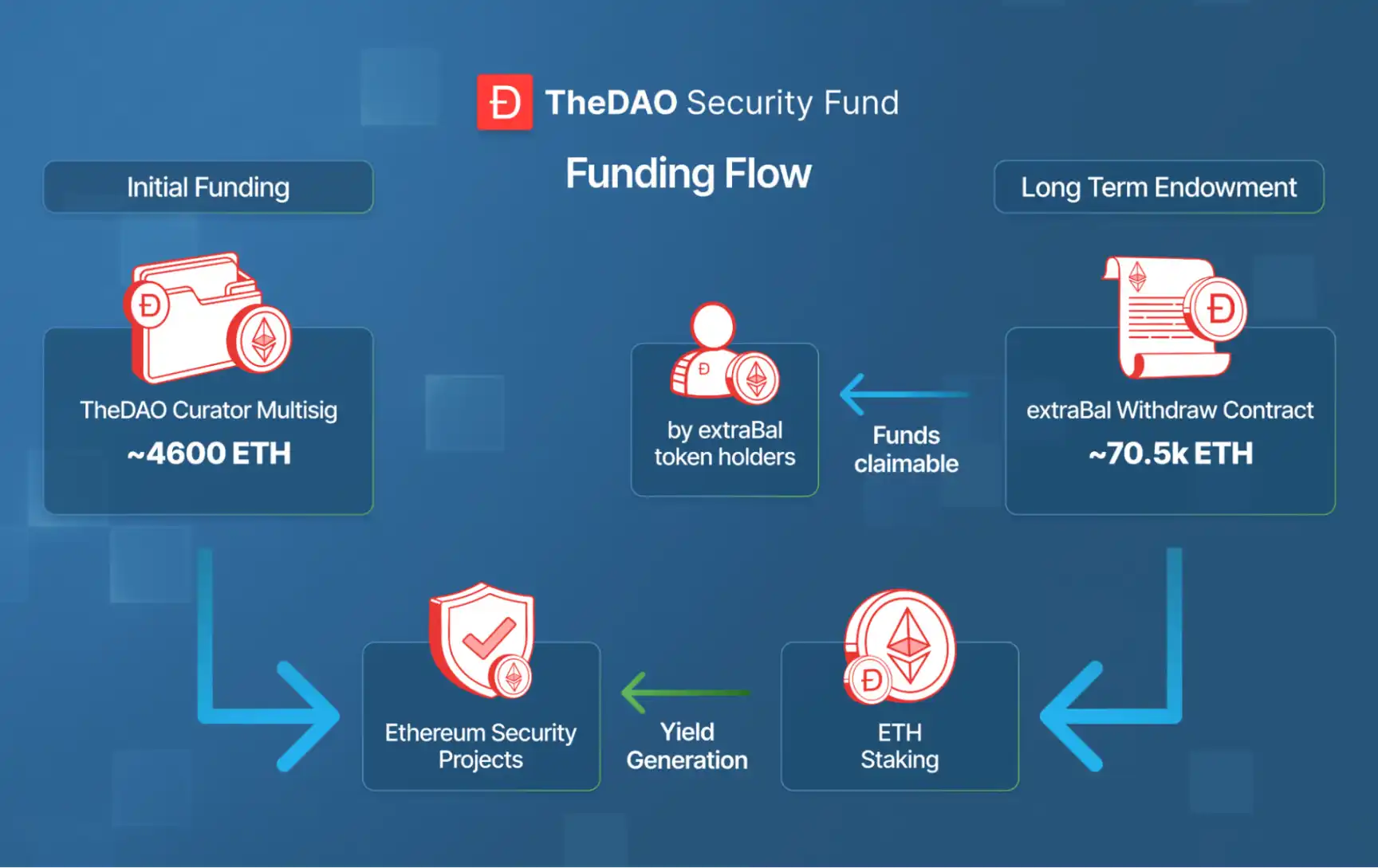
TheDAO Security Fund's fund operation and usage plan are clearly defined: 69,420 ETH withdrawn from the ExtraBalance contract will be staked to form a perpetual donation fund through staking rewards, providing long-term financial support for Ethereum security development; the staking rewards will be combined with the 4,600 ETH in TheDAO Curator Multisig to fund various Ethereum security-related projects. Meanwhile, a portion of the ExtraBalance withdrawal contract will retain some ETH to ensure legitimate claimants' rights are not affected.
In terms of funding scope, the core goal of TheDAO Security Fund is very clear—to prioritize Ethereum's overall ecosystem security, covering the full spectrum of security development scenarios: from wallet user experience optimization, smart contract security audits, to security incident emergency response, Ethereum core protocol security upgrades, and security protection for Layer 2 networks and cross-chain bridge ecosystems. All efforts to enhance Ethereum's security posture are included in the fund's funding scope.
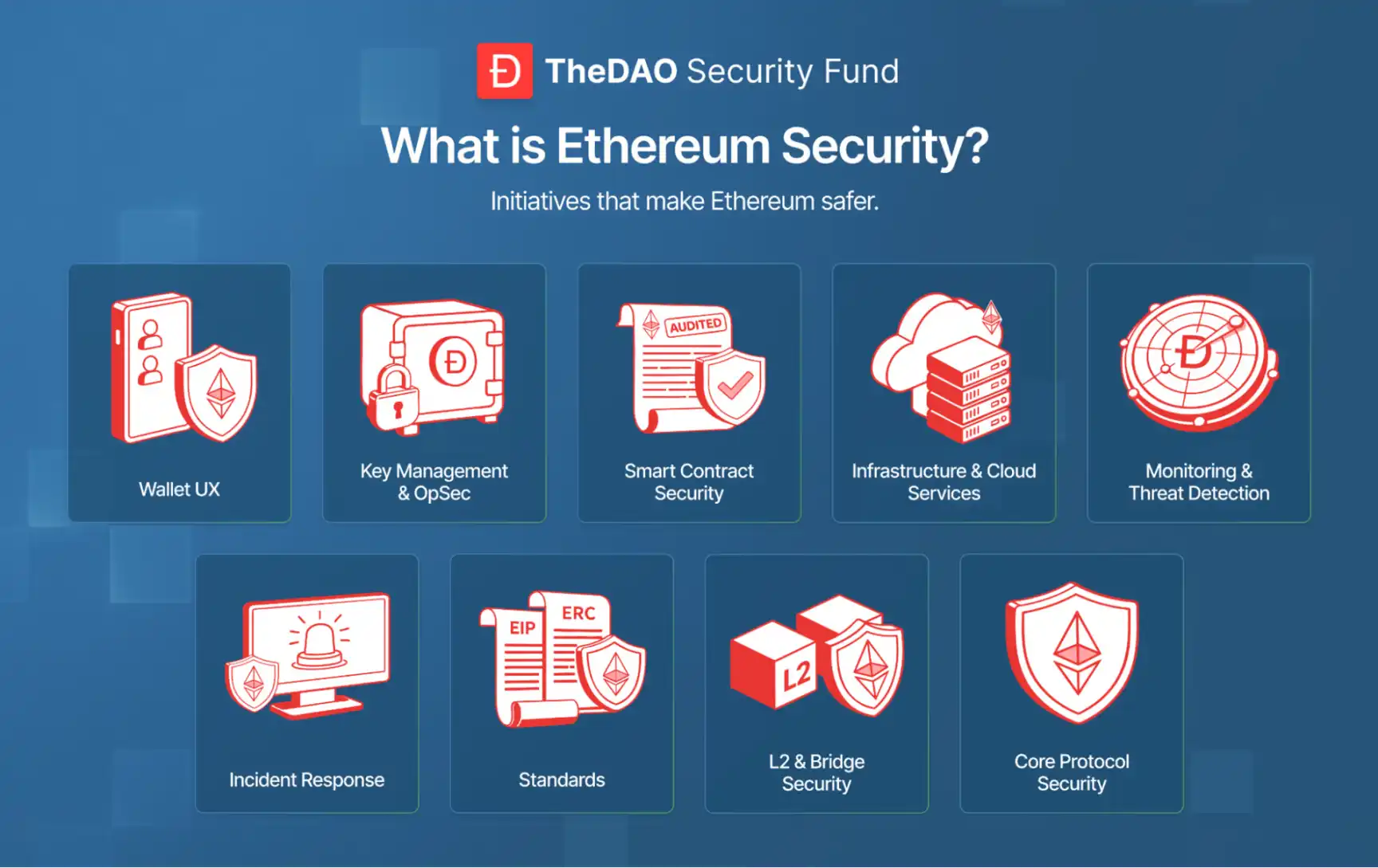
Furthermore, the fund will rely on the optimization directions and opportunities in the current security field outlined by the Ethereum Foundation's Trillion Dollar Security, combined with ongoing communication with ecosystem partners, to determine the specific scope and focus of each round of funding.
In terms of fund allocation mechanisms, TheDAO Security Fund adheres to the principles of open and bottom-up governance. It will employ diverse methods such as quadratic funding, retrospective funding, and sorting by Request for Proposals (RFP) to conduct funding rounds, allowing ecosystem participants to collectively participate in fund allocation decisions.
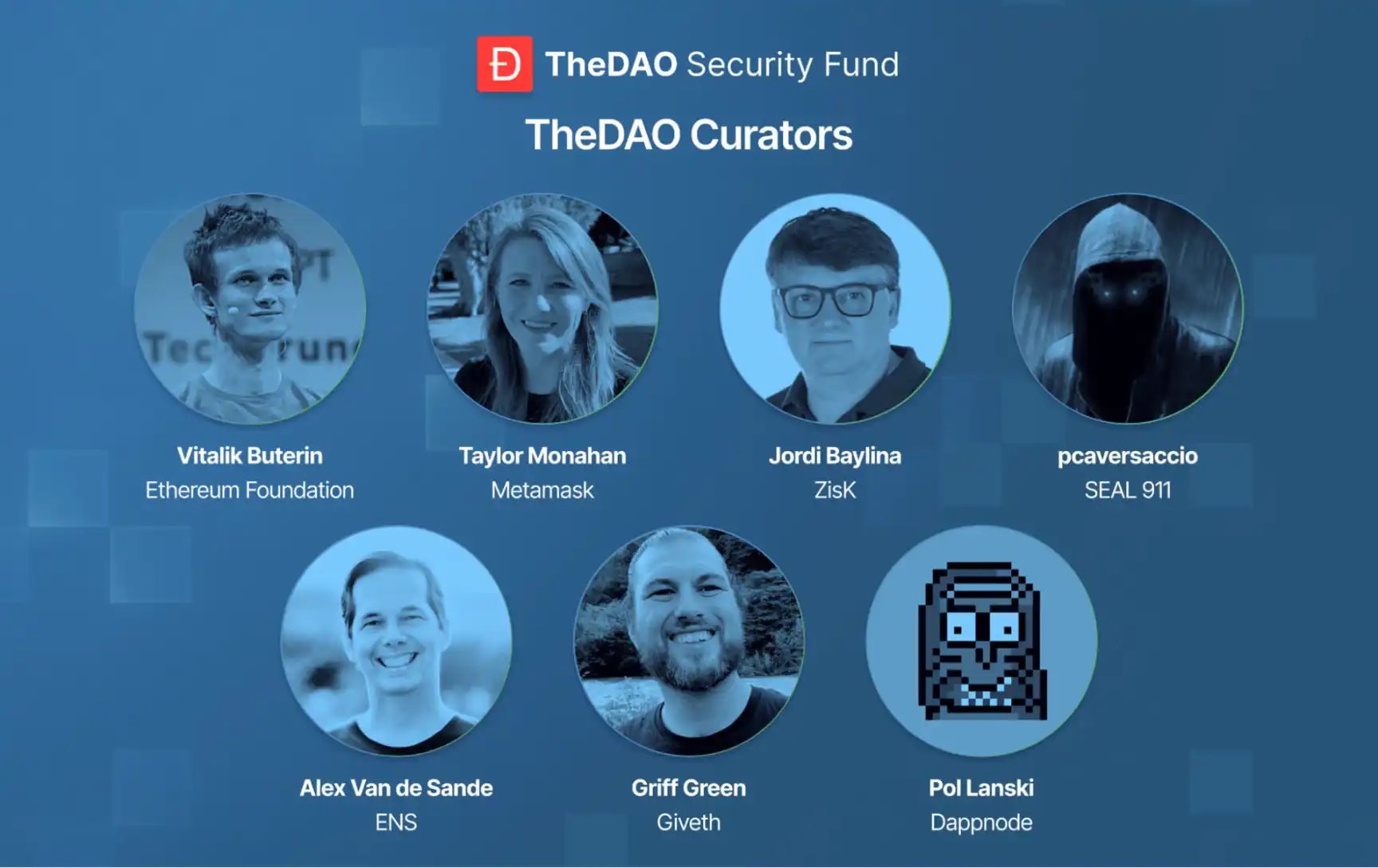
Currently, the fund has formed a professional Curator team to provide expert guidance and supervision for fund operation and funding decisions. Team members are experienced practitioners and security experts in the crypto ecosystem, including Ethereum founder Vitalik, MetaMask security engineer Taylor Monahan, Zisk, Giveth co-founder Jordi Baylina, security expert pcaversaccio, ENS co-founder Alex Van de Sande, and Dappnode CEO Pol Lanski.
Conclusion
TheDAO Security Fund is not without controversy, with the core debate still revolving around two key issues: the "legitimacy of use" of these remaining funds for the security fund and the "decentralization level" of the fund's governance.
Whether this substantial asset should be considered as "private property" belonging to all original token holders or has been identified as unclaimed property used for the "public good" is still a point of contention.
These controversies not only continue the Ethereum community's ideological divide sparked by The DAO incident in 2016 but also reflect the deep-seated governance contradictions in the current crypto ecosystem. Balancing decentralization principles with operational efficiency and asset disposal compliance remains a topic that the entire industry needs to continuously explore.
Setting aside the controversy, from the crowdfunding myth and ecosystem crisis of 2016 to the security fund and ecosystem guardianship of 2026, the decade-long cycle of The DAO itself is a microcosm of Ethereum's ecosystem development. It has witnessed Ethereum's journey from infancy to maturity and confirmed the resilience of the crypto ecosystem and the power of community.
Sources:
<1>https://en.wikipedia.org/wiki/The_DAO
<2>https://www.gemini.com/cryptopedia/the-dao-hack-makerdao
<3>https://unchainedcrypto.com/exclusive-thedao-to-become-new-220-million-ethereum-security-fund/
<4>https://paragraph.com/@thedao.fund/thedao-security-fund-activating-75000-eth-for-ethereum-security
<5>https://medium.com/curator-multisig-phf-official-channel/thedao-curator-multisig-a-decade-later-572796549d70
You may also like
The large models in the United States are moving towards closure in the name of security
From the white-haired stock god to the billionaire fund mogul, the smart people shorting Nvidia are all getting rich using the same framework
Morning Report | CoinEx becomes a key hub for Iran to evade sanctions, involving over $3.8 billion in funds; Kalshi seeks a new round of financing, with a valuation potentially rising to $40 billion
Global Launch: As predictions become the most scarce asset in the AI era, Manadia is defining the next generation of the value internet
Why do cryptocurrency projects always like to change their names?
Who is footing the bill for the $64 billion accounting frenzy?
I never expected that the first application of AI x Crypto would be in security auditing
What is your view on Binance's competitive advantages?
ETH has entered a non-consensus phase, and the turning point is approaching!
The shift in the cloud of the air: from despising stablecoins a year ago to the high-profile entry of capital today
The survival dilemma of small and medium exchanges behind the withdrawal anomalies exposed by AscendEX
Why Is Bitcoin Falling Below $60K? 5 Key Market Drivers Explained
Bitcoin has dropped sharply amid ETF outflows, Strategy stock weakness, AI stock rallies, and changing Fed expectations. Explore the key forces driving BTC’s latest correction and what traders should watch next.
Bitcoin vs. Gold in 2026: Which Asset Performs Better in Different Markets?
The cryptocurrency industry has entered the "Show Me" era: merely relying on vision is no longer enough
Morning News | The draft amendment to the People's Bank of China Law aims to clarify the legal status of digital renminbi; South Korea will transfer about 40 unregistered virtual asset service providers to law enforcement agencies
Interpreting the Ethereum Foundation's new structure: Reaffirming self-sovereignty amid institutional trends
Former SpaceX engineer reconstructs the financial execution system using first principles
Tidal Investment: We still have a positive outlook on the AI industry chain, but the reasons have changed
The large models in the United States are moving towards closure in the name of security
From the white-haired stock god to the billionaire fund mogul, the smart people shorting Nvidia are all getting rich using the same framework
Morning Report | CoinEx becomes a key hub for Iran to evade sanctions, involving over $3.8 billion in funds; Kalshi seeks a new round of financing, with a valuation potentially rising to $40 billion
Global Launch: As predictions become the most scarce asset in the AI era, Manadia is defining the next generation of the value internet
Why do cryptocurrency projects always like to change their names?
Who is footing the bill for the $64 billion accounting frenzy?


