
- Buy Crypto
- Markets
 Futures
- Spot
- Copy Trade
- Earn
- More
The creator who once posted a meme and won Elon Musk's $1 million prize

Original Title: "Creator Who Took Away $1 Million from X, Once Shilled a Memecoin"
Original Author: Eric, Foresight News
On February 4, 2025, Beijing Time, X announced the results of its $1 million creator prize competition launched two weeks ago. The event was only open to U.S. users, and participants were required to write an original article of at least 1000 words. The article with the highest "Home Timeline" reading by X's paid users would take home the million-dollar prize.
With the example of "How to Completely Change Your Life in One Day" which garnered 170 million views, many speculated that the winning article would likely be a similar self-help piece. However, the answer was both surprising and expected.
Writing Articles to Make Money Rather Than Trading Coins
Creator X, now a millionaire through a single article, under the account name Beaver, wrote the article "Deloitte, a $74 billion cancer metastasized across America," which received 45 million views.
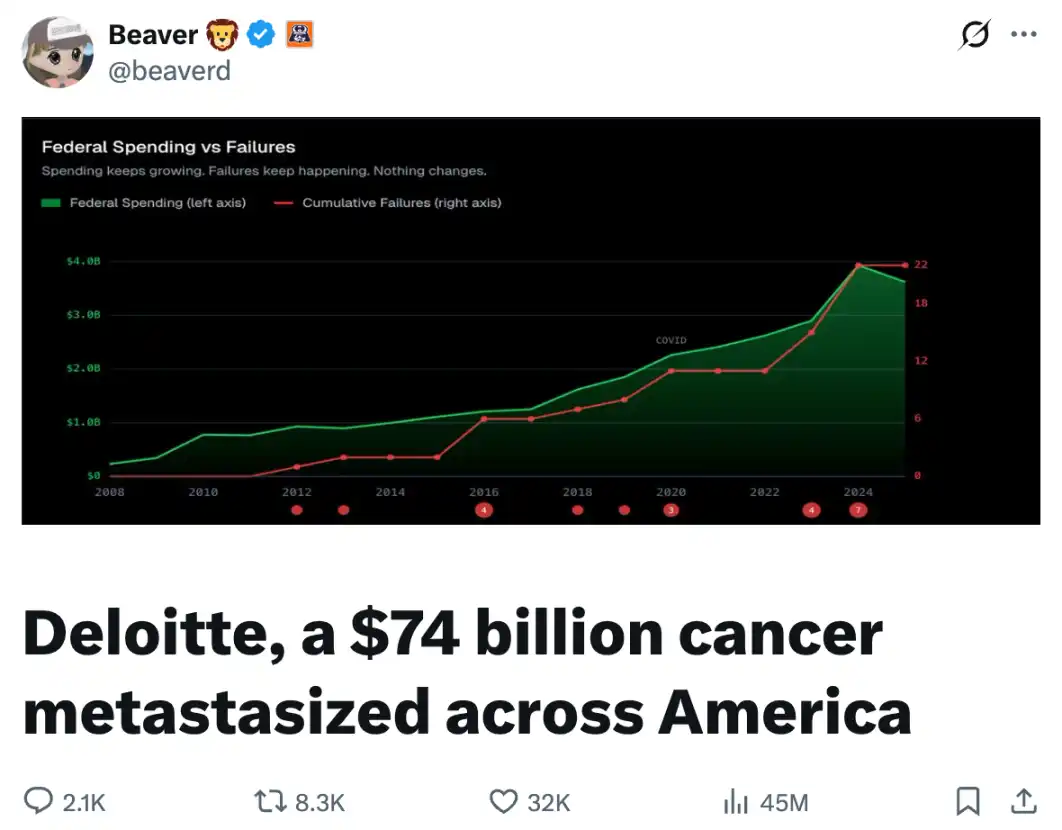
The winning article was an in-depth investigative report exposing scandals within the U.S. government. Through analysis of public documents such as federal contracts, state contracts, documented default events, lawsuits, audits, and more, the author uncovered a history of "government-business collusion" involving hundreds of billions of dollars: Over the past 20 years, Deloitte has been awarded a total of $40 billion in federal and state government contracts. However, the various systems it developed, including the unemployment claims system, either ended up embezzled of billions due to system vulnerabilities or were abandoned after multiple budget increases.
In summary, $40 billion spent by the government on systems resulted in a total loss of $34 billion. More alarmingly, there has been extensive employee movement between Deloitte and the U.S. government, allowing Deloitte to infiltrate all aspects of the government, "like cancer cells spreading through the bloodstream," continuously siphoning taxpayers' money without traceable origins or eradication.
A look at Beaver's account reveals its main theme to be "concern for the country and the people," with topics almost entirely related to government, politics, and livelihood. In addition, Beaver launched a website called SomaliScan, which compiles public data on government budgets, expenditures, federal grants, workforce, and includes a range of politically related information such as political donations. The conclusion about the corrupt relationship between Deloitte and the government was derived from analyzing this data.
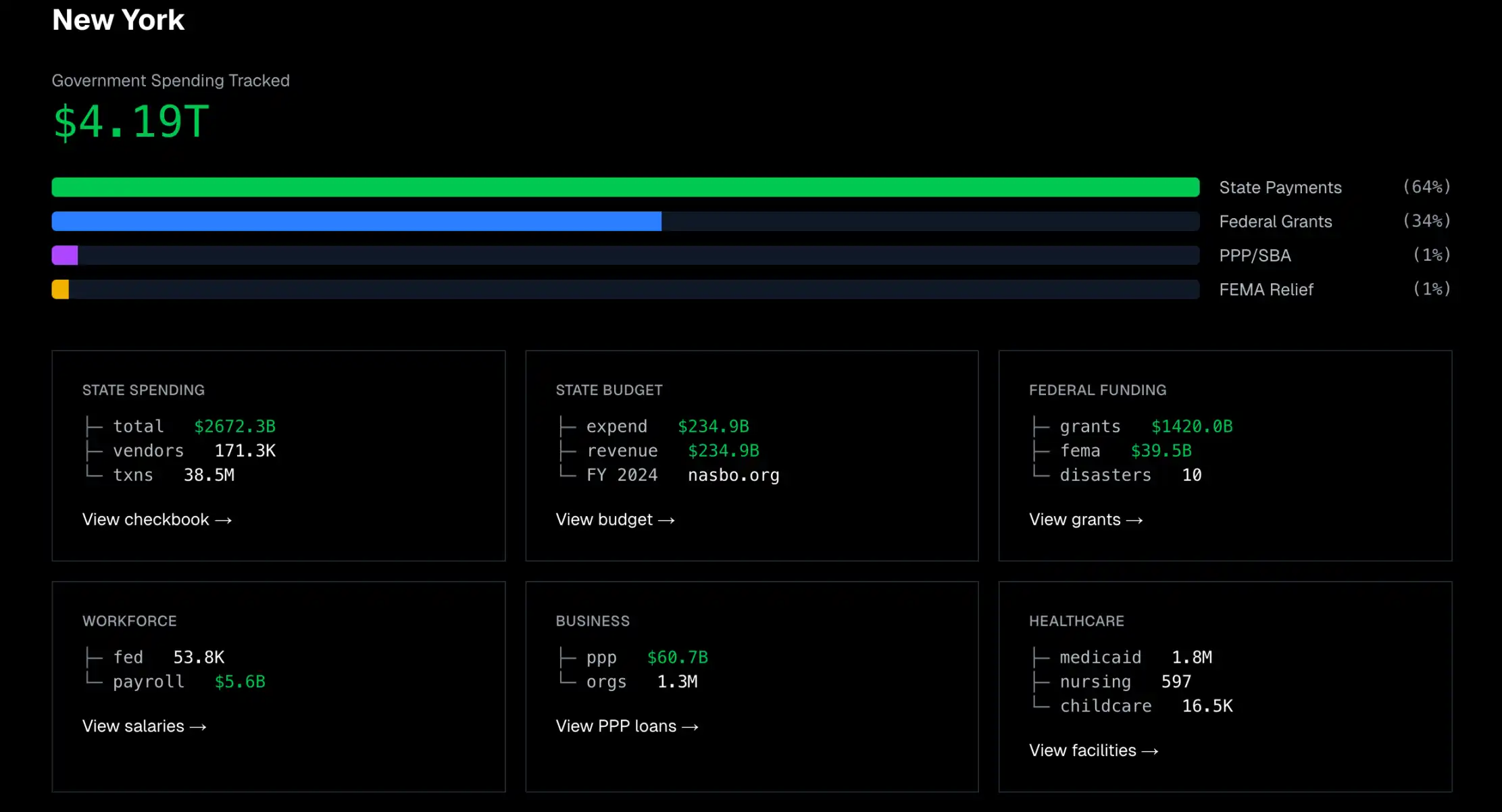
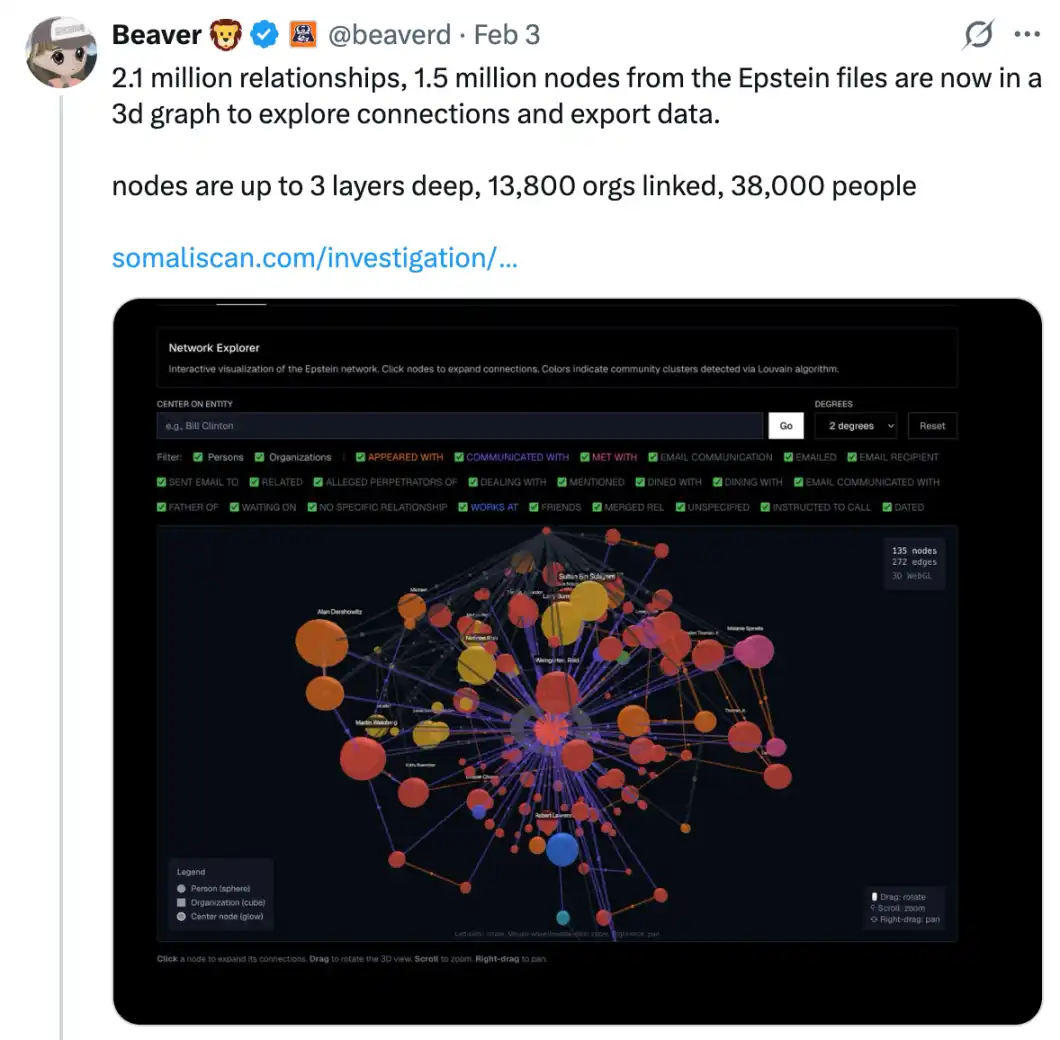
On February 3, just as Beaver had teased, the contents of the massive "Epstein Files" were curated into a complex relationship map on the website.
Interestingly, this political commentator had issued a meme token, SS (9NrkmoqwF1rBjsfKZvn7ngCy6zqvb8A6A5RfTvR2pump), for the website on January 2 this year. BlockBeats reminds users: Meme coin trading is highly volatile, heavily reliant on market sentiment and hype, with no actual value or use case. Investors should be mindful of the risks.
This token initially had a lackluster performance but saw a phase-high on January 28 after Beaver's article gained tens of millions of views. It surged again at the time of the award announcement today. Compared to SS's dismal performance and the $1 million prize, this may be a rare example where we can hardly find "writing articles is more profitable than trading coins."
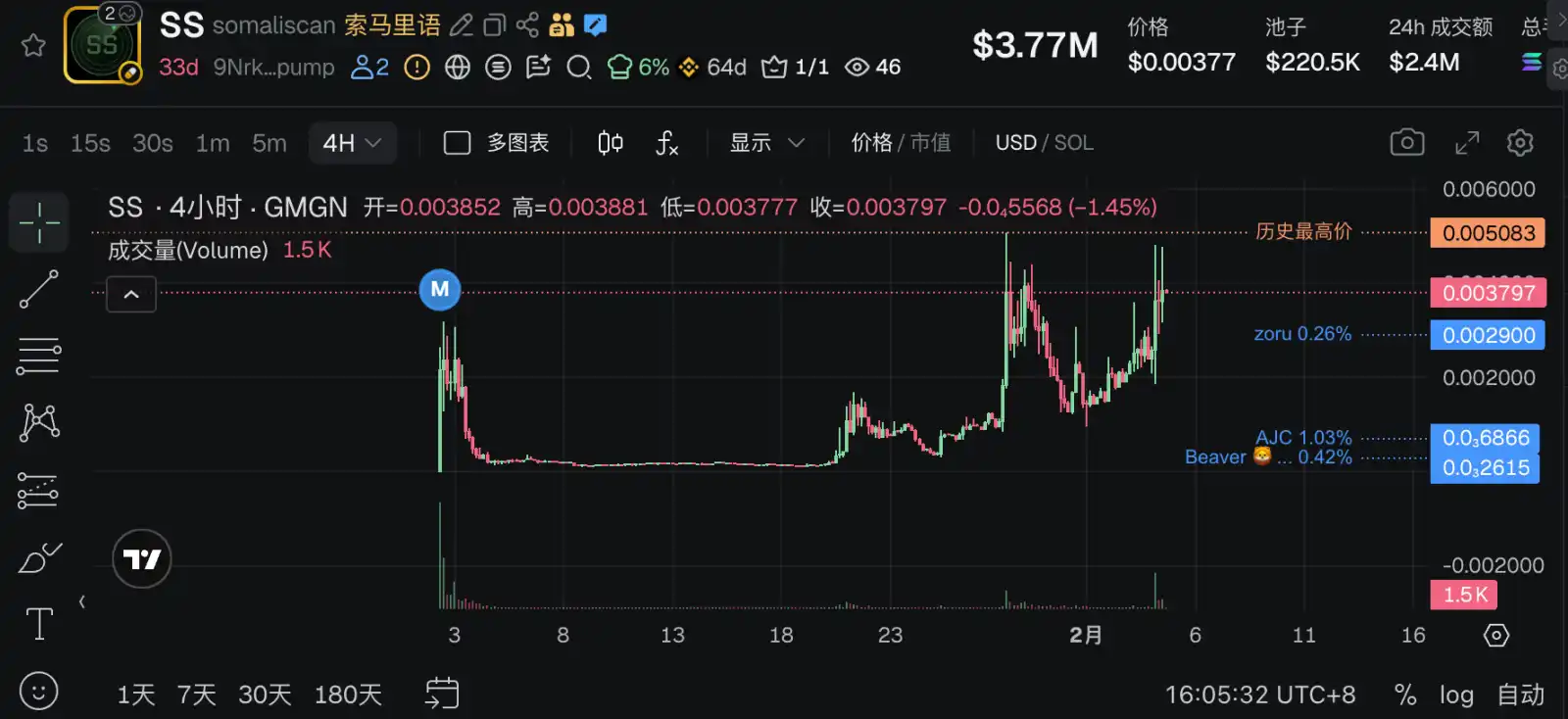
Beaver had previously stated on January 25 that all the prize money from this competition would be used to buy SS. 10% of the total SS supply was reserved for the hackathon, 20% was locked up, and Beaver only kept 4.5%.
It is certain that Beaver is not a "crypto person," and the market value of less than $4 million also indicates that this meme coin is not very popular. Those willing to spend real money to buy SS are most likely supporters of Beaver and SomaliScan. It is worth mentioning that the SomaliScan website also has donation channels supporting Bitcoin, Ethereum, SOL, and XMR donations. If you enjoy watching excitement and don't mind getting involved, you can support this "democracy fighter" who dares to expose US government scandals.
Netizens' Common Topics: Politics, Money, and Emotions
There are three enduring topics on the Chinese internet: political trends, economic situations/how to make money, and personal emotions.
This X-launched event exclusively for US users, the top three happened to correspond to these three points:
· The champion article "Deloitte, a $740 Billion Value that has Spread to Cancer Across the United States" tells the story of US government corruption;
· The runner-up article "Detailed Explanation of President Trump's Tariff Strategy: Step-by-Step Guide on How to Operate" provides an investment plan for adapting to the changes in Trump's tariff policy through analysis.
· Third Place (Official Favorite) article "Complete Guide: How to Achieve Extreme Focus," another soulful self-improvement piece from Daniel Koe.
Even the highly viewed Chinese articles on X cannot escape these topics.

If you read these articles carefully, you will find that they are not particularly fancy in their wording, mostly stating facts and reasoning, meeting the emotional or practical needs of readers. For creators, the conclusion is also very simple: at least on the X platform, if you want to get more exposure, either tell an unknown new story, whether about yourself or societal issues; or provide a detailed "how-to guide," whether on making money, adjusting mindset, or even, as shown in the image above, how to find a specific video ID.
You may also like

Memories: 10 Key Contributions of the TON Core Team That Few People Knew in the Early Days

2025 South Korea CEX Listing Post-Mortem: Investing in New Coins = 70% Loss?

BIP-360 Analysis: Bitcoin's First Step Towards Quantum Immunity, But Why Only the "First Step"?

50 million USDT exchanged for 35,000 USD AAVE: How did the disaster happen? Who should we blame?

The Cryptographic Past of the Middle East

Resolving the Intergenerational Prisoner's Dilemma: The Inevitable Path of Nomadic Capital Bitcoin

Who Will Control AI? Why Decentralized AI May Be the Only Alternative to Government and Big Tech
AI has become critical infrastructure, and governments and corporations are competing to control it. Centralized development and regulation are entrenching existing power structures. The Web3 community is building a decentralized alternative — distributed compute, token incentives, and community governance — before that window closes.

Vitalik wrote a proposal teaching you how to secretly use AI large models

On the eve of the explosion of on-chain options

WEEX AI Hackathon: How Did This AI Trading Winner Succeed?
A self-taught AI trading enthusiast achieved top-10 results at the WEEX AI Hackathon. Learn about the mindset, AI tools, and lessons behind this impressive performance.

One Balance to Rule Them All: Gravitas' On-Chain Prime Broker Ambition

That person who cashed out at the NFT peak is now selling a new shovel in the OpenClaw craze

Inter-generational Prisoner's Dilemma Resolution: The Nomadic Capital and Bitcoin's Inevitable Path

Upstream and downstream are starting to fight, all for the sake of everyone being able to "Lobster"
Circle and Mastercard Announce Partnership, the Next Stage for the Crypto Industry Belongs to Payments

From 5 Mao per kWh of Chinese electricity to a $45 API export: Tokens are rewriting currency units

Why is OpenAI playing catch-up to Claude Code instead?



 App
App