
 Buy Crypto
- Markets
 Futures
- Spot
- Copy Trade
- Earn
- More
Tether's Latest Investment Landscape, Crypto Track Still Mainstream

Original Article Title: Tether Investments: What a $100B stablecoin empire does with its profits
Original Article Author: Bennett Tomlin, protos
Original Article Translation: Dancing Workman, BlockBeats
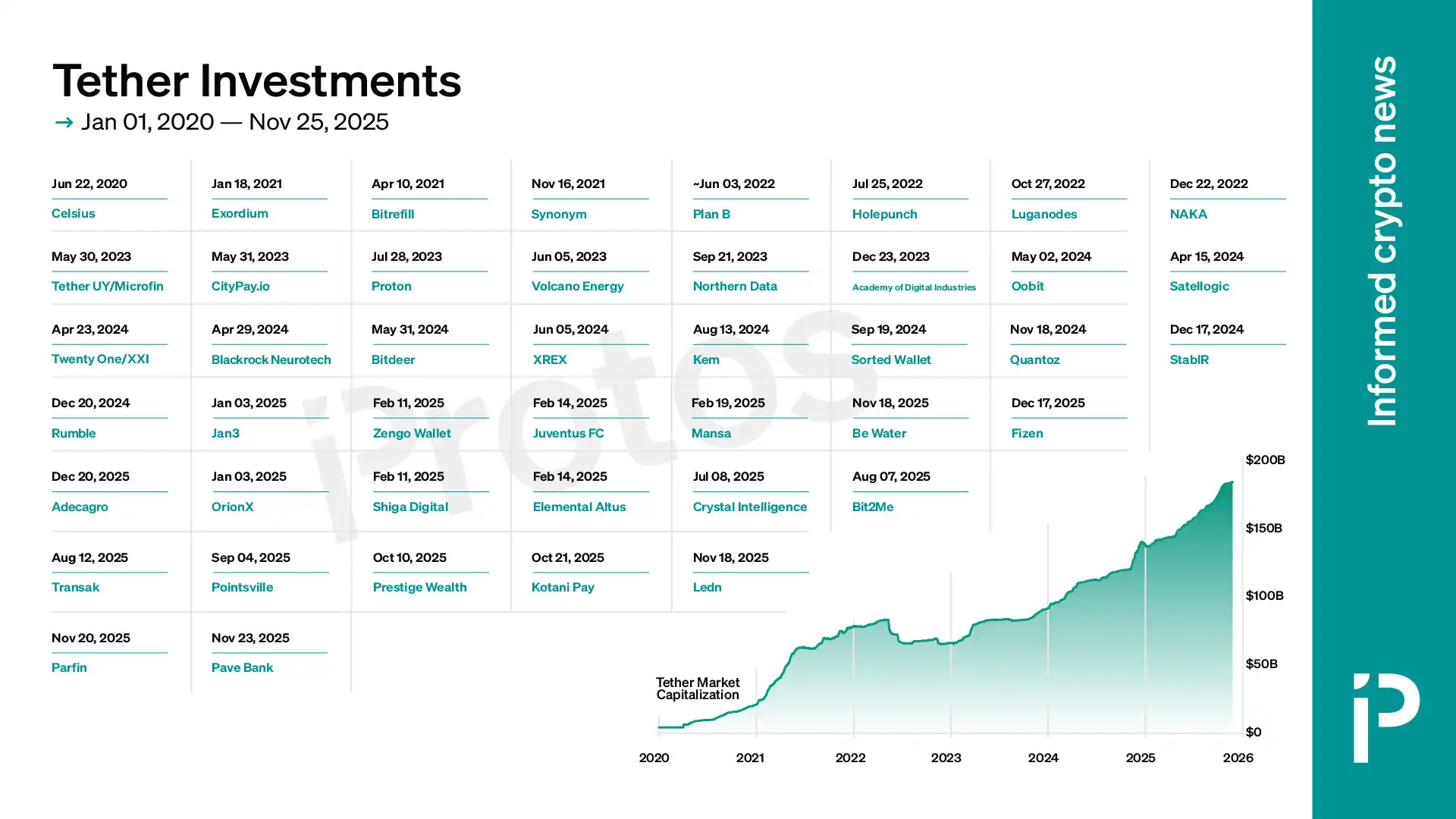
Tether is now one of the world's most influential financial groups. Not only does it operate the highest-valued stablecoin, but its investment portfolio spans across multiple fields, including cryptocurrency, payment processing, video streaming, artificial intelligence, brain-machine interfaces, farmland, satellites, football, and more.
These investments are aimed at expanding the company's reach and influence, and if successful, are expected to bring significant financial returns in the future.
Tether's CEO, Paolo Ardoino, has revealed that Tether has invested in over 120 companies, but only 24 are publicly listed on its official website's "Tether Ventures" page.
This public list has also changed over time. According to screenshots shared by Ardoino and internet archives, the initial list of Tether Ventures included OrionX. Tether had referred to OrionX as "one of Chile's leading digital asset exchanges" in a now-deleted blog post.
Protos reached out to Tether to inquire why the company was removed from the website but did not receive a response prior to publication.
In fact, there are many other investment projects that have been reported by the media—even sometimes appearing on Tether's own website—but for some reason, they have not been included on this investment portfolio page.
Samson Mow's Company
Samson Mow's company, the former Chief Strategy Officer of Blockstream, has received multiple investments from Tether.
One of the earliest investments was Tether's participation in Exordium's security token offering (STO). Exordium is the publisher behind the game "Infinite Fleet," founded by Mow. Exordium uses Holepunch technology, funded by Tether, to distribute its game client.
The Exordium website claims that its security token is still available on Bitfinex Securities (an affiliate of Tether). However, upon checking the Bitfinex Securities website, the token is not currently listed in the active trading pairs.
Exordium is not the only company invested in by Tether; Tether has also invested in Jan3, another company founded by Mow. Jan3 raised funds from Tether to "accelerate the development and expansion of the AQUA wallet."
Additionally, Blockstream has also received funding from iFinex, which is one of the companies operating the Bitfinex platform.
Celsius
Tether is also an equity investor in Celsius, a now-defunct cryptocurrency lending platform involved in a large-scale fraud.
Celsius's founder and former CEO, Alex Mashinsky, was recently sentenced to 12 years in prison.
The lack of mention of this investment on the Tether Ventures page is unsurprising, as the equity became worthless following the collapse of the fraudulent platform.
In addition to equity investment, Tether had also provided loans to Celsius, and the settlement of these loans was a significant point of contention in Celsius's bankruptcy proceedings. The lawsuit recently concluded with a settlement amount of $2.995 billion.
Volcano Energy
Volcano Energy is a Bitcoin mining project in El Salvador that initially aimed to power a series of Bitcoin mining machines using geothermal energy from a volcano.
Tether described its goal as "fulfilling its mission of investing in renewable energy to support and promote sustainable Bitcoin mining."
According to the project's website, since then, Volcano Energy has shifted its focus from volcano geothermal energy to wind and solar energy. Currently, the project has not started mining any Bitcoin.
Tether Uruguay / Microfin
Tether has also partnered with local firm Microfin to invest in a Bitcoin mining operation in Uruguay. Tether stated that this investment demonstrates its "commitment to energy innovation and the future of cryptocurrency."
In September of this year, reports emerged that Tether was planning to abandon the project due to unpaid electricity bills. At that time, Tether told Cointelegraph, "Tether continues to support these efforts and will seek a constructive path forward, reflecting our commitment to long-term sustainable opportunities in the region."
However, according to El Observador, it has since been reported that Tether has officially abandoned the project, citing high energy costs making it economically unviable.
Tether's Special Projects Division
Tether has several projects under its "Special Projects Division," led by Davide Rovelli.
These include Plan B, a cryptocurrency conference based in Switzerland operated by Rovelli's AltKey SA. Plan B's stated goal is to "establish a European hub for crypto in Lugano."
One of Plan B's self-proclaimed "masterpieces" is Luganodes, a provider of "staking-as-a-service." This service primarily focuses on the Tron network founded by Justin Sun, the second-largest network in terms of USDT token issuance.
2040 Energy / Proton
2040 Energy was originally a joint project between Tether and Swan.
The project eventually turned into a legal dispute, alleging that Tether induced key advisors to leave 2040 Energy and instead launch the Proton Management project, which had closer ties to Tether. Both 2040 Energy and Proton Management were funded by Tether.
Recently, Proton Management successfully applied for mandatory arbitration in the Central District Court of California. These projects represent only part of Tether's evolution into a major backer of the Bitcoin mining ecosystem.
Satellogic
Tether even extended its investment tentacles to space, investing in Satellogic, a company that operates satellites and sells observation data.
In a press release announcing the investment, Satellogic stated that the funds "will help advance our mission as we continue to focus on the strategic deployment of space assets, the national security market in the United States, and the opportunities of the global space system."
In October, Satellogic announced that it would publicly sell a portion of its equity.
Parfin
In a blog post, Tether described Parfin as "a digital asset custody, tokenization, trading, and management platform in Latin America."
This investment is part of Tether's belief, as Ardoino described it, that Latin America will become one of the global blockchain innovation hubs."
Among other features, the Parfin platform promotes its "compliance-as-a-service" management tools for other financial institutions. Parfin also launched a product called Rayls, described as a "blockchain for banks."
According to CoinMarketCap data, the associated token's market cap is around $44 million.
Ledn
Ledn is a Bitcoin lending platform, referred to by Ardoino as being able to "expand credit channels without the need for individuals to sell their digital assets."
Ledn is one of the smaller lenders to have lent to Alameda Research. Following the FTX and Alameda collapse, Ledn claimed to have "fully absorbed the impact of the outstanding loan with Alameda" and further noted that "Ledn also has a small amount of assets on FTX, which will not affect customer assets."
Ledn had previously relied on Genesis Global Capital as a partner but reportedly terminated the relationship before Genesis's collapse. These issues occurred before Tether invested in the company.

Kotani Pay
Tether describes Kotani Pay as "an infrastructure that connects Web3 users across Africa with local payment channels for deposits and withdrawals."
It promotes its ability to convert various local currencies into cryptocurrency. Additionally, it offers a so-called "Stablecoin Settlement Solution" aimed at facilitating cross-border payments and claims to be faster than banks.
Bit2Me
Bit2Me is described in Tether's blog as the "leading Spanish-language digital asset platform."
It provides exchange services, as well as "Asset Management (Earn)" products, "Loan" products that allow users to take out cryptocurrency-backed loans, and a "Blockchain Securities Exchange."
It has a platform coin called B2M. According to self-reported data on CoinMarketCap, its market cap has dropped from a peak of around $550 million to just $58 million.
Pave Bank
Tether's recent investment went to Pave Bank, a bank regulated in Georgia, which promises to provide "global, secure multi-asset banking" and "programmable banking."
The company claims to be a "tech company" in terms of product design and construction, and a "fully regulated bank" in terms of risk, capital, and regulatory management.
Prestige Wealth
Prestige Wealth (or Aurelion) is a peculiar company. Similar to other Digital Asset Treasury (DAT) companies, the difference is that the assets it invests in are Tether Gold, a tokenized version of a so-called Real World Asset (RWA).
Tether invested in this company when it was raising funds to purchase Tether Gold. A large part of its Private Investment in Public Equity (PIPE) financing was contributed in the form of Tether (USDT) tokens.
In the press release announcing this investment, Aurelion's CEO Björn Schmidtke stated: "This is not just about returns or finance; it's about redefining how real wealth is held, transferred, and preserved in the digital age."
The press release further claims that Aurelion offers "returns, transparency, regulatory compliance, and daily on-chain verification."
Pointsville
Pointsville is another company focused on tokenizing real-world assets (RWA) and providing a loyalty program.
The company is led by Gabor Gurbacs, whose LinkedIn profile indicates he is the Chief Strategic Advisor of Tether.
Ardoino, in describing the funding in a press release, stated, "Tokenization is rapidly becoming one of the most practical, impactful drivers of real-world asset applications. Tether's Hadron platform is proud to support this transformation, working with Pointsville's experienced team to provide the necessary scale and availability to integrate real-world assets and loyalty programs into the digital economy."
Transak
Transak describes itself as the "global leader in fiat-to-crypto infrastructure," with Ardoino mentioning that they are "accelerating adoption in emerging and developed markets, bridging the financial access gap, and creating new opportunities for businesses and consumers."
It offers over-the-counter (OTC) trading services as well as fiat on/off-ramp services.
Unlike the aforementioned investments, Tether does have some other significant investments indeed listed on the website.
Rumble and Northern Data
When Tether initially invested in Northern Data, it was a data center and Bitcoin mining company.
Tether quickly became a major shareholder. Since then, Northern Data has spun off its mining business into Peak Mining and shifted its focus heavily towards artificial intelligence (AI).
Tether also invested in Rumble, a video streaming platform popular among right-wing individuals, especially those banned from Twitch.
Subsequently, Rumble acquired Northern Data in a deal that gave Tether around 30% ownership of Rumble. In addition to bringing cryptocurrency onto its balance sheet, Rumble also introduced Tether as a primary advertising client, with Tether committing to invest $100 million in advertising.
Rumble's recent earnings call discussed the company's intent to transition into a self-described "freedom-first" AI infrastructure company.
Ardoino was prominently mentioned during the conference call, at one point stating that "Rumble's vision aligns perfectly with ours."
Rumble CEO Chris Pavlovski also claimed during the conference call that Rumble will be promoting its cryptocurrency-based Rumble Wallet to all of its users this month. Risk capital firm 1789 Capital, with Donald Trump Jr. as a partner, has also invested in Rumble.
Bitdeer
Jihan Wu has a long history in the Bitcoin mining industry, being the co-founder and former CEO of Bitmain.
He now leads Bitdeer, a company that split off from Bitmain and went public on NASDAQ. Tether has invested in Bitdeer, holding a stake that peaked at over 20% and subsequently reduced to around 18%.

CityPay.io
CityPay.io is a Georgia-based company focused on helping merchants accept cryptocurrency payments.
When Tether invested in the company, it was stated to be part of its "expansion of influence in Georgia." Ardoino noted that Tether is "excited to collaborate with CityPay.io to bring greater innovation and efficiency to Georgia's payment industry."
Fizen
Fizen is described in a Tether blog post as a company "focused on self-custody wallets and digital payments."
Fizen's website promotes the ability to "earn on the go" and emphasizes the capability to "enjoy returns anytime, anywhere."
Ardoino stated that this investment "underscores our commitment to expanding global access to efficient, reliable digital financial solutions, thereby promoting the wise, responsible use of digital assets in everyday life."
Kem
Kem is described in a Tether blog post as "a platform designed for remittances and financial management," primarily operating in the Middle East and North Africa. Ardoino referred to this investment as reinforcing "Tether's commitment to promoting financial inclusion and stability."
The Kem website describes it as the "first cryptocurrency bank." While this may seem like Kem is actually not a bank, and it certainly is not the first bank to attempt to serve the cryptocurrency industry.
However, its website does indicate that "Kem operates through Kemfinity s.r.o. (company number: 221 62 194), which is an entity holding a VASP (Virtual Asset Service Provider) license in the Czech Republic."
Sorted Wallet
Sorted Wallet is described by Tether as a platform that "provides a secure, convenient cryptocurrency exchange, bridging the gap for underserved populations in developing regions with no bank accounts or limited banking services."
In addition to providing a wallet, it also promotes the ability for users to "cash out USDT to bank, airtime, or mobile money accounts."
Ardoino claims, "By supporting Sorted Wallet, we are unlocking new opportunities for individuals with basic-feature phones to participate in the financial system. Our goal is to ensure that everyone, regardless of their location or type of phone, can securely manage and use cryptocurrency, empowering them to build a more secure financial future and actively participate in the evolving digital economy."
Synonym
Synonym is a Bitcoin wallet provider that includes Lightning Network functionality, with its website indicating it is "a Tether company."
In addition to the wallet, the company is also behind Pubky, which its website describes as an application driven by "a new decentralized protocol, incorporating social tags and social curation features."
Furthermore, it also offers Atomicity, described as a "P2P trust system" aimed at achieving "business and collaboration beyond traditional big bank credit cards."
Shiga
Shiga Digital is described in a Tether blog post as "a modern platform providing a path to pan-African blockchain financial solutions that are real-world usable and easily accessible. Shiga Digital offers virtual accounts, OTC services, fund management, and forex services to African businesses."
Its website presents "Empower your business with a decentralized banking solution." Shiga claims to be an EU-licensed Virtual Asset Service Provider but does not seem to be a bank in the literal sense.
XREX
XREX is described on the Tether Ventures page as a "cross-border B2B payment provider in emerging markets based on USDT," while on its official website, it is described as "shaping the future of banking."
Its website claims it is a FinCEN-regulated Money Service Business, a licensed major payment institution in Singapore, and a licensed VASP Anti-Money Laundering Registrar in Taiwan. The website does not appear to mention any banking licenses.
Tether's article about the investment states that this investment will enable XREX to "facilitate compliant, USDT-based cross-border B2B payments in emerging markets." Additionally, the article mentions that "XREX will collaborate with the Unitas Foundation to launch XAU1, a dollar-pegged unitized stablecoin backed by excess reserves of Tether Gold (XAUt)."
StablR and Quantoz
StablR is launching a stablecoin in Europe designed to comply with the Markets in Crypto-Assets Regulation (MiCA) framework and relies on the Hadron tokenization platform created by Tether.
Quantoz is another company planning to launch a stablecoin in Europe that complies with MiCA standards using Tether's Hadron platform. Tether had offered its own Euro-pegged stablecoin, EURT, but that project has been discontinued.
Blackrock Neurotech
Perhaps Tether's most peculiar investment is in Blackrock Neurotech, a company focused on developing brain-machine interfaces.
This investment falls under the "Tether Evo" umbrella. The Tether Evo website states: "Tether stands at the intersection of innovation and human potential, dedicated to propelling humanity into a future where technology and human capabilities are fused in ways previously unimagined."
Academy of Digital Industries
Tether has also invested in the Academy of Digital Industries, an online training and education platform based in Georgia. This investment is said to have allowed the platform to expand its courses on "Bitcoin, stablecoins, peer-to-peer technology, and artificial intelligence."
Be Water
In a blog post announcing Tether's investment, Be Water was described as "an innovative media company focused on creating and distributing audio, video, film, and live streaming content." Ardoino stated that this investment aligns with Tether's belief in the "importance of independent media in shaping an informed society."
Crystal Intelligence
Tether's investment in the blockchain analytics firm Crystal Intelligence seems to align with its desire to "combat illicit stablecoin usage by supporting law enforcement and building a more secure, resilient digital asset ecosystem." Tether has also partnered with Crystal Intelligence's competitor, Chainalysis, integrating it into the Tether Hadron platform.
Elemental Altus
Tether also invested in Elemental Altus, a precious metals royalty company. Ardoino described this investment as aligning with Tether's "long-held belief that tangible assets like Bitcoin and gold will underpin the most enduring form of digital value."
Holepunch
Tether and its sister company Bitfinex are also backers of Holepunch, a secure peer-to-peer communication platform that offers the Keet video chat app. Ardoino also serves as Holepunch's Chief Strategy Officer.
Juventus Football Club
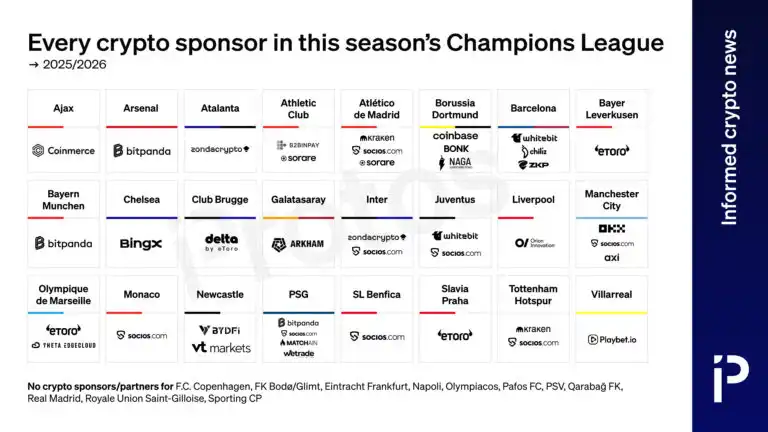
One of the most puzzling investments is in the Juventus Football Club, where Tether sought to position it as an opportunity to "integrate its futuristic investment portfolio into the sports industry." This also indicates Tether's desire to incorporate "stablecoins, digital assets, and human-centric technology into everyday life."
Zengo Wallet
Tether describes Zengo as a "leading self-custody crypto wallet known for its emphasis on security and usability" and further claims that Zengo has served 1.5 million users with "no instances of wallet hacks, phishing, or takeovers."
Zengo is a Multi-Party Computation (MPC) wallet that protects your cryptocurrency keys by storing them in shards on your own mobile device and Zengo's servers.
Mansa
Mansa claims to provide revolving credit lines to payment companies to help facilitate transaction settlements and fast fund turnover in customer accounts. Additionally, its website describes other services it offers, including over-the-counter forex trading and "virtual card processing."
Oobit
Tether describes Oobit as "a mobile payment app." Ardoino stated that Tether's investment is part of Tether and Oobit's "joint vision to drive widespread cryptocurrency adoption globally."
Adecoagro
Adecoagro is an agricultural group that also invests in energy production. Following Tether's acquisition of a majority stake in the company, it announced a memorandum of understanding "to explore a strategic partnership focused on bitcoin mining."
NAKA
NAKA is a company that claims to be dedicated to developing a "self-custody payment card." Crunchbase data indicates that Tether has invested in it.
Twenty One
Lastly, there is Twenty One, a Digital Asset Treasury (DAT) company led by Jack Mallers and owned by Tether, which has partnered with Tether's key custodian Cantor Fitzgerald.
Twenty One's website claims to currently hold 43,514 bitcoins.
Conclusion
Protos can only confirm around a quarter of Tether's reported investments (assuming Ardoino's "120+" statement remains accurate).
The confirmed investments reveal a financial company deeply rooted in and beyond the cryptocurrency industry, while the vast majority of its other investments remain unknown, making it nearly impossible for outsiders to assess Tether's full impact and reach.
Source: "Original Article Link"
You may also like

US AI Startup Goes All In on Chinese Mega-Model | Rewire News Morning Brief

Trump Lies Again: A "Five-Day Pause" Psyop, How Wall Street, Bitcoin, and Polymarket Insiders Synced Uposciogen

When a Token Becomes Labor, People Become the Interface

Ceasefire News Leaked Ahead of Time? Large Polymarket Bets on Outcome Before Trump's Tweet

BlackRock CEO's Annual Shareholder Letter: How is Wall Street Using AI to Keep Profiting from National Pension Funds?

Sun Valley Releases 2025 Financial Report: Bitcoin Mining Revenue Reaches $670 Million, Accelerating Transformation to AI Infrastructure Platform
On March 16, 2026, in Dallas, Texas, USA, CanGu Company (New York Stock Exchange code: CANG, hereinafter referred to as "CanGu" or the "Company") today announced its unaudited financial performance for the fourth quarter and full year ended December 31, 2025. As a bitcoin mining enterprise relying on a globally operated layout and dedicated to building an integrated energy and AI computing power platform, CanGu is actively advancing its business transformation and infrastructure development.
• Financial Performance:
Total revenue for the full year 2025 was $688.1 million, with $179.5 million in the fourth quarter.
Bitcoin mining business revenue for the full year was $675.5 million, with $172.4 million in the fourth quarter.
Full-year adjusted EBITDA was $24.5 million, while the fourth quarter was -$156.3 million.
• Mining Operations and Costs:
A total of 6,594.6 bitcoins were mined throughout the year, averaging 18.07 bitcoins per day; of which 1,718.3 bitcoins were mined in the fourth quarter, averaging 18.68 bitcoins per day.
The average mining cost for the full year (excluding miner depreciation) was $79,707 per bitcoin, and for the fourth quarter, it was $84,552;
The all-in sustaining costs were $97,272 and $106,251 per bitcoin, respectively.
As of the end of December 2025, the company has cumulatively produced 7,528.4 bitcoins since entering the bitcoin mining business.
• Strategic Progress:
The company has completed the termination of the American Depositary Receipt (ADR) program and transitioned to a direct listing on the NYSE to enhance information transparency and align with its strategic direction, with a long-term goal of expanding its investor base.
CEO Paul Yu stated: "2025 marked the company's first full year as a bitcoin mining enterprise, characterized by rapid execution and structural reshaping. We completed a comprehensive adjustment of our asset system and established a globally distributed mining network. Additionally, the company introduced a new management team, further strengthening our capabilities and competitive advantage in the digital asset and energy infrastructure space. The completion of the NYSE direct listing and USD pricing also signifies our transformation into a global AI infrastructure company."
"As we enter 2026, the company will continue to optimize its balance sheet structure and enhance operational efficiency and cost resilience through adjustments to the miner portfolio. At the same time, we are advancing our strategic transformation into an AI infrastructure provider. Leveraging EcoHash, we will utilize our capabilities in scalable computing power and energy networks to provide cost-effective AI inference solutions. The relevant site transformations and product development are progressing simultaneously, and the company is well-positioned to sustain its execution in the new phase."
The company's Chief Financial Officer, Michael Zhang, stated: "By 2025, the company is expected to achieve significant revenue growth through its scaled mining operations. Despite recording a net loss of $452.8 million from ongoing operations, mainly due to one-time transformation costs and market-driven fair value adjustments, the company, from a financial perspective, will reduce its leverage, optimize its Bitcoin reserve strategy and liquidity management, introduce new capital to strengthen its financial position, and seize investment opportunities in high-potential areas such as AI infrastructure while navigating market volatility."
The total revenue for the fourth quarter was $1.795 billion. Of this, the Bitcoin mining business contributed $1.724 billion in revenue, generating 1,718.3 Bitcoins during the quarter. Revenue from the international automobile trading business was $4.8 million.
The total operating costs and expenses for the fourth quarter amounted to $4.56 billion, primarily attributed to expenses related to the Bitcoin mining business, as well as impairment of mining machines and fair value losses on Bitcoin collateral receivables.
This includes:
· Cost of Revenue (excluding depreciation): $1.553 billion
· Cost of Revenue (depreciation): $38.1 million
· Operating Expenses: $9.9 million (including related-party expenses of $1.1 million)
· Mining Machine Impairment Loss: $81.4 million
· Fair Value Loss on Bitcoin Collateral Receivables: $171.4 million
The operating loss for the fourth quarter was $276.6 million, a significant increase from a loss of $0.7 million in the same period of 2024, primarily due to the downward trend in Bitcoin prices.
The net loss from ongoing operations was $285 million, compared to a net profit of $2.4 million in the same period last year.
The adjusted EBITDA was -$156.3 million, compared to $2.4 million in the same period last year.
The total revenue for the full year was $6.881 billion. Of this, the revenue from the Bitcoin mining business was $6.755 billion, with a total output of 6,594.6 Bitcoins for the year. Revenue from the international automobile trading business was $9.8 million.
The total annual operating costs and expenses amount to $1.1 billion.
Specifically, they include:
· Revenue Cost (excluding depreciation): $543.3 million
· Revenue Cost (depreciation): $116.6 million
· Operating Expenses: $28.9 million (including related-party expenses of $1.1 million)
· Miner Impairment Loss: $338.3 million
· Bitcoin Collateral Receivable Fair Value Change Loss: $96.5 million
The full-year operating loss is $437.1 million. The continuing operations net loss is $452.8 million, while in 2024, there was a net profit of $4.8 million.
The 2025 non-GAAP adjusted net profit is $24.5 million (compared to $5.7 million in 2024). This measure does not include share-based compensation expenses; refer to "Use of Non-GAAP Financial Measures" for details.
As of December 31, 2025, the company's key assets and liabilities are as follows:
· Cash and Cash Equivalents: $41.2 million
· Bitcoin Collateral Receivable (Non-current, related party): $663.0 million
· Miner Net Value: $248.7 million
· Long-Term Debt (related party): $557.6 million
In February 2026, the company sold 4,451 bitcoins and repaid a portion of related-party long-term debt to reduce financial leverage and optimize the asset-liability structure.
As per the stock repurchase plan disclosed on March 13, 2025, as of December 31, 2025, the company had repurchased a total of 890,155 shares of Class A common stock for approximately $1.2 million.

The US AI Startup Is Loving China's Open Source Model

Three Weeks of the US-Iran War: Who's Making Money, Who's Paying the Bill?

Interpreting Polymarket's Major Update Last Night: Fee Expansion, Self-Regulation, and New Incentives

From Human Application to Intelligent Collaboration: How GOAT Network Builds the Next Generation Digital Economy

CZ Washington Dialogue: Crypto Entrepreneurs are Accelerating Their Return to the United States

Morning Report | Strategy increased its holdings by 1,031 bitcoins last week; Katana Blockchain acquires IDEX; NYSE completes rule change to eliminate trading limits on crypto ETF options

Electric Capital: Tracking 501 types of yield-generating RWA assets, we discovered these patterns
Those who are cut off by AI will not disappear; they will become the creators of the next round of the economy

Stablecoins reshaping cross-border payments in Asia? Strategic panorama and investment opportunity analysis

Zuckerberg is building an AI agent to help him as CEO

Bloomberg: Swiss Private Bank Old Guard Rifts, Is Bitcoin the Spark?
Zuckerberg is building an AI assistant to help him be CEO
US AI Startup Goes All In on Chinese Mega-Model | Rewire News Morning Brief
Trump Lies Again: A "Five-Day Pause" Psyop, How Wall Street, Bitcoin, and Polymarket Insiders Synced Uposciogen
When a Token Becomes Labor, People Become the Interface
Ceasefire News Leaked Ahead of Time? Large Polymarket Bets on Outcome Before Trump's Tweet
BlackRock CEO's Annual Shareholder Letter: How is Wall Street Using AI to Keep Profiting from National Pension Funds?
Sun Valley Releases 2025 Financial Report: Bitcoin Mining Revenue Reaches $670 Million, Accelerating Transformation to AI Infrastructure Platform
On March 16, 2026, in Dallas, Texas, USA, CanGu Company (New York Stock Exchange code: CANG, hereinafter referred to as "CanGu" or the "Company") today announced its unaudited financial performance for the fourth quarter and full year ended December 31, 2025. As a bitcoin mining enterprise relying on a globally operated layout and dedicated to building an integrated energy and AI computing power platform, CanGu is actively advancing its business transformation and infrastructure development.
• Financial Performance:
Total revenue for the full year 2025 was $688.1 million, with $179.5 million in the fourth quarter.
Bitcoin mining business revenue for the full year was $675.5 million, with $172.4 million in the fourth quarter.
Full-year adjusted EBITDA was $24.5 million, while the fourth quarter was -$156.3 million.
• Mining Operations and Costs:
A total of 6,594.6 bitcoins were mined throughout the year, averaging 18.07 bitcoins per day; of which 1,718.3 bitcoins were mined in the fourth quarter, averaging 18.68 bitcoins per day.
The average mining cost for the full year (excluding miner depreciation) was $79,707 per bitcoin, and for the fourth quarter, it was $84,552;
The all-in sustaining costs were $97,272 and $106,251 per bitcoin, respectively.
As of the end of December 2025, the company has cumulatively produced 7,528.4 bitcoins since entering the bitcoin mining business.
• Strategic Progress:
The company has completed the termination of the American Depositary Receipt (ADR) program and transitioned to a direct listing on the NYSE to enhance information transparency and align with its strategic direction, with a long-term goal of expanding its investor base.
CEO Paul Yu stated: "2025 marked the company's first full year as a bitcoin mining enterprise, characterized by rapid execution and structural reshaping. We completed a comprehensive adjustment of our asset system and established a globally distributed mining network. Additionally, the company introduced a new management team, further strengthening our capabilities and competitive advantage in the digital asset and energy infrastructure space. The completion of the NYSE direct listing and USD pricing also signifies our transformation into a global AI infrastructure company."
"As we enter 2026, the company will continue to optimize its balance sheet structure and enhance operational efficiency and cost resilience through adjustments to the miner portfolio. At the same time, we are advancing our strategic transformation into an AI infrastructure provider. Leveraging EcoHash, we will utilize our capabilities in scalable computing power and energy networks to provide cost-effective AI inference solutions. The relevant site transformations and product development are progressing simultaneously, and the company is well-positioned to sustain its execution in the new phase."
The company's Chief Financial Officer, Michael Zhang, stated: "By 2025, the company is expected to achieve significant revenue growth through its scaled mining operations. Despite recording a net loss of $452.8 million from ongoing operations, mainly due to one-time transformation costs and market-driven fair value adjustments, the company, from a financial perspective, will reduce its leverage, optimize its Bitcoin reserve strategy and liquidity management, introduce new capital to strengthen its financial position, and seize investment opportunities in high-potential areas such as AI infrastructure while navigating market volatility."
The total revenue for the fourth quarter was $1.795 billion. Of this, the Bitcoin mining business contributed $1.724 billion in revenue, generating 1,718.3 Bitcoins during the quarter. Revenue from the international automobile trading business was $4.8 million.
The total operating costs and expenses for the fourth quarter amounted to $4.56 billion, primarily attributed to expenses related to the Bitcoin mining business, as well as impairment of mining machines and fair value losses on Bitcoin collateral receivables.
This includes:
· Cost of Revenue (excluding depreciation): $1.553 billion
· Cost of Revenue (depreciation): $38.1 million
· Operating Expenses: $9.9 million (including related-party expenses of $1.1 million)
· Mining Machine Impairment Loss: $81.4 million
· Fair Value Loss on Bitcoin Collateral Receivables: $171.4 million
The operating loss for the fourth quarter was $276.6 million, a significant increase from a loss of $0.7 million in the same period of 2024, primarily due to the downward trend in Bitcoin prices.
The net loss from ongoing operations was $285 million, compared to a net profit of $2.4 million in the same period last year.
The adjusted EBITDA was -$156.3 million, compared to $2.4 million in the same period last year.
The total revenue for the full year was $6.881 billion. Of this, the revenue from the Bitcoin mining business was $6.755 billion, with a total output of 6,594.6 Bitcoins for the year. Revenue from the international automobile trading business was $9.8 million.
The total annual operating costs and expenses amount to $1.1 billion.
Specifically, they include:
· Revenue Cost (excluding depreciation): $543.3 million
· Revenue Cost (depreciation): $116.6 million
· Operating Expenses: $28.9 million (including related-party expenses of $1.1 million)
· Miner Impairment Loss: $338.3 million
· Bitcoin Collateral Receivable Fair Value Change Loss: $96.5 million
The full-year operating loss is $437.1 million. The continuing operations net loss is $452.8 million, while in 2024, there was a net profit of $4.8 million.
The 2025 non-GAAP adjusted net profit is $24.5 million (compared to $5.7 million in 2024). This measure does not include share-based compensation expenses; refer to "Use of Non-GAAP Financial Measures" for details.
As of December 31, 2025, the company's key assets and liabilities are as follows:
· Cash and Cash Equivalents: $41.2 million
· Bitcoin Collateral Receivable (Non-current, related party): $663.0 million
· Miner Net Value: $248.7 million
· Long-Term Debt (related party): $557.6 million
In February 2026, the company sold 4,451 bitcoins and repaid a portion of related-party long-term debt to reduce financial leverage and optimize the asset-liability structure.
As per the stock repurchase plan disclosed on March 13, 2025, as of December 31, 2025, the company had repurchased a total of 890,155 shares of Class A common stock for approximately $1.2 million.


 App
App