
 Buy Crypto
- Markets
 Futures
- Spot
- Copy Trade
- Earn
- More
Robinhood Impressive Q3 Financial Report: Profit Triples, 'Event Contracts' Emerge as a New Growth Engine

Original Title: "Revenue Doubled, Profit Tripled: Robinhood's Earnings Report Exceeds Expectations, Explosive Growth in Options Trading | Earnings Insight"
Original Authors: He Hao, Long Yue, Wall Street News
The "American Retail Investor Hub" Robinhood has delivered an impressive third-quarter performance.
The online brokerage's third-quarter earnings report released on Wednesday showed that both its revenue and profit exceeded Wall Street's expectations. Thanks to the overall growth in cryptocurrency, options, and stock trading volumes, the company's transaction-based revenue more than doubled year-over-year, driving net profit from $150 million in the same period last year to $556 million. Meanwhile, cryptocurrency revenue surged by 300%, but fell short of expectations.
Despite strong performance, Robinhood's stock price still saw a slight decline in after-hours trading. The company also announced a significant senior leadership change, with its CFO of over seven years, Jason Warnick, planning to retire in 2026. The company has appointed Shiv Verma, Senior Vice President of Finance and Strategy, as his successor. This smooth transition is aimed at ensuring the continuity of the company's strategy.
So far this year, Robinhood's stock price has risen by nearly 270% and was included in the S&P 500 Index in the third quarter. What was once seen as a retail investor frenzy during the pandemic now seems to have evolved into a force shaping the market, and Robinhood has successfully capitalized on this trend.
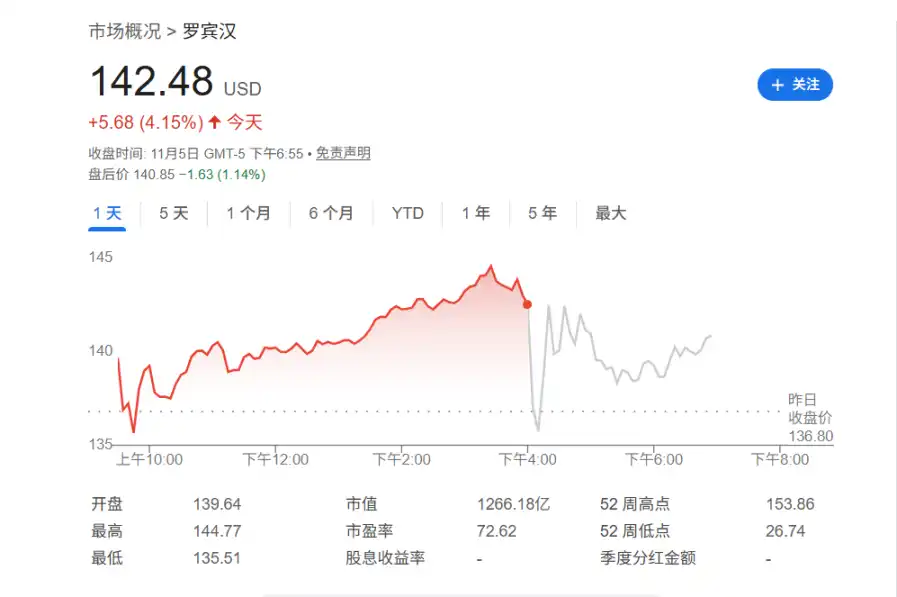
Robinhood Third-Quarter Earnings Report Highlights: Performance Significantly Exceeds Expectations, Trading Revenue Doubles
Key Financial Data:
· Revenue: Net revenue for the third quarter was $1.27 billion, analysts expected $1.21 billion.
· EBITDA: Adjusted EBITDA for the third quarter was $742 million, analysts expected $726.9 million.
· Earnings Per Share: $0.61, exceeding expectations of $0.53, compared to earnings per share of $0.17 in the same period last year.
· Net Profit: Net profit increased to $556 million, significantly higher than the net profit of $150 million in the same period last year.
· ARPU: Third-quarter ARPU (Average Revenue Per User) was $191, analysts expected $182.
· Monthly Active Users: Q3 monthly active users were 13.8 million, compared to analysts' expectations of 13.31 million.
Segment Data:
· Q3 Transaction-Based Revenue: $730 million, compared to analysts' expectation of $725.8 million.
· Q3 Cryptocurrency Revenue: $268 million, a 300% increase, but below analysts' expectation of $287.2 million.
· Q3 Options Revenue: $304 million, compared to analysts' expectation of $301.3 million.
The core driver of performance growth came from the strong recovery in the transaction business. In the third quarter, the company's transaction-based revenue reached $730 million, more than doubling year-over-year. Stock trading revenue grew by 132%, options trading revenue grew by 50%, and cryptocurrency trading revenue surged by 300% to $268 million, slightly below the analysts' expectation of $287.2 million.
“Event Contracts” Emerging as a Growth Engine
One of the most striking highlights in the financial report was the explosive growth of the “Event Contracts” (Prediction Markets) business. In the third quarter, the trading volume of event contracts on the platform surged to 2.3 billion shares, more than doubling from the previous quarter.
According to the soon-to-retire CFO Jason Warnick, the start of the fourth quarter has been even stronger, with the trading volume in just October surpassing 2.5 billion shares. This included approximately $25 million from the platform's prediction market business.
Recently, Robinhood expanded the scope of event contracts from the original sports and finance to further include politics, entertainment, and technology. Robinhood, in partnership with Kalshi, allows users to bet on the “yes/no” outcomes of future events related to sports, politics, entertainment, and technology.
Warnick stated in the announcement that the prediction market business has become one of the company's new business lines contributing approximately $100 million in annualized revenue. The incoming CFO Shiv Verma also emphasized in an interview: “This is a new asset class, and we want to be at the forefront. This is one of the areas we are focusing our investments on.”
Event contracts still represent only a small part of Robinhood's overall revenue. However, the prediction market business has seen rapid growth in recent weeks: Piper Sandler's analysts estimate that the trading volume on Kalshi and the competing platform Polymarket nearly doubled in October. Analysts also note that these two platforms saw their two most active trading days since the 2024 election this past weekend.
However, such prediction market contracts—especially those related to sports and entertainment—have also sparked controversy as they blur the line between investment and gambling.
Executive Insights: Banking, Venture Business to Roll Out Successively
Robinhood CEO Vlad Tenev stated:
"Our team continues to rapidly roll out new products, driving record-breaking business performance in the third quarter, and we won't slow down—prediction market business is growing rapidly, Robinhood banking business is starting to roll out gradually, and Robinhood venture business is also about to launch."
CFO Jason Warnick commented in the announcement:
"The third quarter once again saw strong and profitable growth, as we continue to drive business diversification, adding two new business lines with annualized revenues of approximately $1 billion or more—Prediction Markets and Bitstamp."
CFO Announces Retirement Plan, Internal Promotion of Successor
Robinhood announced in its earnings report that Chief Financial Officer Jason Warnick will retire in 2026. This executive, who previously worked at Amazon, has been with Robinhood for over seven years and has been a key figure in the company's development.
As per the plan, Warnick will complete the transition in the first quarter of 2026 and will continue to serve as a strategic advisor until September 1, 2026. The company has appointed Senior Vice President of Finance and Strategy Shiv Verma as the next CFO. This move is seen as an internal promotion to ensure a smooth transition of financial strategy within the company.
Analysis and Commentary: Diversification Strategy Pays Off, Moving Towards a FinTech Company
Robinhood has been striving to diversify its revenue streams to reduce reliance on its trading business. Earlier this week, the company announced a partnership with Sage Home Loans to allow its customers to access home loans. Additionally, the company also plans to launch a closed-end fund to give U.S. retail investors exposure to pre-IPO companies.
Analysts note that Robinhood's third-quarter performance, announced on Wednesday, exceeded Wall Street expectations, continuing its strong performance this year and making it one of the standout companies among large U.S. tech stocks this year. Robinhood is betting that the new generation of investors will want to not only trade stocks on the same platform but also bet on sports, culture, and political events. So far, it seems this bet is paying off.
As Robinhood expands its business to comprehensive wealth management, the company is gradually narrowing the gap with Coinbase. The company has been attracting Fidelity and Schwab customers by actively offering deposit match incentives and has been driving its AUM growth through the acquisition of TradePMR.
Robinhood primarily targets retail investors. Robinhood was originally known for its user-friendly platform that made it easy for beginners to buy and sell stocks. However, today, its trading business has expanded significantly: in the third quarter, nearly 90% of Robinhood's trading-related revenue came from categories other than stocks, including options, futures, and cryptocurrencies.
David Bartosiak, a stock strategist at Zacks Investment Research, wrote in a morning report, "This is no longer the Robinhood of the pandemic era. It is now leaner, more diverse, and quietly growing into a true fintech contender."
You may also like

Tiger Research: What AI services do cryptocurrency companies offer?

The war not only drives up oil prices but also causes Circle's stock price to soar

When agents become consumers, who will rewrite the underlying logic of internet commerce?

AI Agents in Action Summit: March 31, Hong Kong Cyberport, focusing on the deep waters of AI implementation

29 Days In, What Are America’s Options on Iran?

Flash Crash Down 97%+ with Ongoing Unlocking, WLD Completes $65 Million Off-chain Funding: Who Is Still Buying?

Bitcoin for Real Estate? Fannie Mae Teams Up with Coinbase to Launch Crypto Mortgage
Tether Hires Big Four Auditor, USDT Enters First Attestation Phase

Google AI Paper Destroys $900B Storage Stock, Accused of Faking Experiment
Evaporate $2 Trillion, U.S. Stocks See Worst Start in 4 Years, Why is the Market Bearish?

The speed at which AI discovers vulnerabilities has surpassed the speed at which it patches vulnerabilities.

AI Crypto Trading Bot Explained: Aurora's Multi-Factor Strategy in WEEX Hackathon
Aurora demonstrates how structured, multi-agent AI Trading systems can deliver more adaptive and resilient performance in the WEEX AI Trading Hackathon.

Cyber Taoist Fortune Teller: Fake Taoist, AI Fortune Telling, and Northeastern Metaphysics History

Bloomberg: Stablecoin Payments Emerge as Crypto VC's Newest Favorite Thing
BeatSwap is evolving towards a full-stack Web3 infrastructure, covering the entire lifecycle of IP rights.
BeatSwap, a global Web3 Intellectual Property (IP) infrastructure project, is attempting to overcome the current fragmentation limitations of the Web3 ecosystem, building a full-stack system that covers the entire lifecycle of IP rights.
Currently, most Web3 projects are still in the stage of functional fragmentation, often focusing only on a single aspect, such as IP asset tokenization, transaction functionality, or a simple incentive model. This structural dispersion has become a key bottleneck hindering the industry's scale application.
BeatSwap's approach is more integrated, integrating multiple core modules into the same system, including:
· IP authentication and on-chain registration
· Authorization-based revenue sharing mechanism
· User-engagement-driven incentive system
· Transaction and liquidity infrastructure
Through the above integration, the platform builds an end-to-end closed-loop path, allowing IP rights to complete a full cycle of "creation, use, and monetization" within the same ecosystem.
BeatSwap is not limited to existing crypto users but is attempting to take the global music industry as a starting point, actively creating new market demand. Its core strategies include:
Exploring and incubating music creators (Artist discovery)
Building a fan community
Igniting IP-centric content consumption demand
The current global music industry is valued at around $260 billion, with over 2 billion digital music users. This means that the potential market corresponding to the tokenization and financialization of IP far exceeds the traditional crypto user base.
In this context, BeatSwap positions itself at the intersection of "real-world content demand" and "on-chain infrastructure," attempting to bridge the structural gap between content production and financial flow.
BeatSwap's upcoming core product "Space" is scheduled to launch in the second quarter of 2026. This product is defined as the SocialFi layer in the ecosystem, aiming to directly connect creators with users and achieve deep integration with other platform modules.
Key designs include:
A fan-centric interactive mechanism
Exposure and distribution logic based on $BTX staking
User paths connected to DeFi and liquidity structures
Thus, a complete user behavior loop is formed within the platform: Discovery → Participation → Consumption → Rewards → Trading
$BTX is designed to be a core utility asset within the ecosystem, rather than just a simple incentive token, with its value directly tied to platform activity and IP use cases.
Main features include:
· Yield distribution based on on-chain authorized actions
· Value reflection based on IP usage and user engagement dynamics
· Support for staking and DeFi participation mechanisms
· Value growth driven by ecosystem expansion
With the increased frequency of IP use, the utility and value support of $BTX will enhance simultaneously, helping alleviate the "disconnect between value and utility" issue present in traditional Web3 token models to some extent.
Currently, $BTX has been listed on several mainstream exchanges, including:
Binance Alpha
Gate
MEXC
OKX Boost
As the launch of "Space" approaches, BeatSwap is actively pursuing more exchange listings to further enhance liquidity and global accessibility, laying a foundation for future market expansion.
BeatSwap's goal is no longer limited to the traditional Web3 narrative but aims to target over 2 billion digital music users and a trillion KRW-scale content market.
By integrating content creators, users, capital, and liquidity into a blockchain framework centered around IP rights, BeatSwap is striving to build a next-generation infrastructure focused on "IP tokenization."
BeatSwap integrates IP authentication, authorization distribution, incentive mechanism, transaction system, and market construction to establish a unified structure that bridges the full lifecycle path of IP rights.
With the launch of the Q2 2026 "Space," the project is expected to become a key infrastructure connecting content and finance in the IP-RWA (Real World Assets) track.

Mag 7 Evaporates $2 Trillion | Rewire News Morning Edition

Losing $19K per Coin Mined, Bitcoin Mining Firms Collective AI Defection



 App
App