
 Buy Crypto
- Markets
 Futures
- Spot
- Copy Trade
- Earn
- More
RIP Alipay in Cambodia: The Rise and Fall

Original Article Title: "The Rise and Fall of Wisepay: The 'Cambodian Alipay', Perished Last Night"
Original Article Author: sleepy.txt, Dongcha Beating
December 1, 2025, Phnom Penh.
The breeze by the Mekong River was still hot and humid, but for the hundreds of thousands of Chinese people in the area, this winter was much colder than usual.
This day was destined to be engraved into the collective memory of Cambodian Chinese merchants.
In the morning, Sihanouk Boulevard. The once-revered financial icon, Wisepay's headquarters building, which was thought to be "never sleeping," lost its heartbeat overnight. The roaring sound of cash transport vehicles coming and going was gone, replaced by a cold "Withdrawal Suspension Notice" posted on the glass door and the hundreds of gradually stiffening Oriental faces in front of the main entrance out of fear.
History always rhymes. This scene seemed to transport people back to the eve of the Gold Yuan's collapse in Shanghai in 1948, or the Beijing Financial Street swept by the P2P crisis in 2018.
The collapse was not without warning signs. Over the past 48 days and nights, rumors of the impending collapse of this financial giant known as the "Cambodian Alipay" had spread like a plague in Phnom Penh's underground banks and Telegram groups. From the joint US-UK sanctions against the Prince Group, to the seizure of $15 billion in crypto assets, to the sharp discount of the stablecoin USDH issued by Wisepay in the black market, all signals pointed to the same outcome—liquidity drought.
Wisepay's shutdown was not just the sudden death of a company but also the end of a distorted era of commerce.
Over the turbulent past six years, it had been the most critical capillary of Cambodia's underground economy. It connected the casinos in Phnom Penh, the industrial parks in Sihanoukville, and even the fraud terminals on the other side of the ocean, building an offshore financial island seemingly impervious to the SWIFT system.
Its fall not only froze the assets and lives of tens of thousands of Chinese merchants but also heralded the complete bankruptcy of the "grassroots logic."
The fantasy that one could ignore rules by relying on technological advantages, or that one could evade bullets by hiding in the jungle, finally collided heavily with the geopolitical and regulatory iron plates.
This was a belated settlement, as well as a black coming-of-age ceremony tinged with blood that the generation of Chinese internet grassroots who ventured overseas had to go through.
The Lost Paradise of Tech Elites
If we replay the rise of Huiwang, we will find that its starting point was not evil, but the worship of efficiency to the extreme.
Let's turn back the clock to 2019. That year, China's Internet traffic dividend peaked, and the stock game began. "Going global" became the grand narrative of the tech elites from major companies seeking a new continent. A group of tech middle managers and product managers from major tech companies, carrying the most advanced code architecture and the vision of inclusive finance, landed at Phnom Penh Airport.
At that time, Cambodia's financial ecosystem was still in the Jurassic era.
Bank branches were scarce, operational efficiency was low, and foreign exchange controls were strict. For hundreds of thousands of Chinese merchants engaged in trade, catering, and construction in Phnom Penh, fund circulation was a nightmare. They either carried heavy US dollar cash on the street or endured the high exchange rates of underground money changers.
This kind of backwardness, in the eyes of Chinese Internet people accustomed to mobile payments, was not just a pain point but also a ubiquitous flow and significant arbitrage opportunity.
Using China's mature mobile payment technology to launch a "decimation" on Cambodia's traditional finance became the unspoken action plan of that generation of tech elites venturing abroad.
They did achieve it, and they did it beautifully. At the beginning of Huiwang Pay's launch, it used a kind of "brutal aesthetics" to conquer the market with convenience: a fully Chinese interface, 24/7 online customer service, instant settlement, replicating Alipay's silky-smooth user experience down to the pixel.

However, the real killer move was its extremely low entry threshold. In a country that originally required layers of approval, Huiwang did not require cumbersome identity authentication or tax verification. With just a mobile phone number, funds could flow freely in Phnom Penh's underground network.
This set of tactics was hugely successful in business. In just two years, Huiwang penetrated all aspects of life for Chinese people in Phnom Penh. From buying a cup of milk tea to paying project fees, it became the de facto "Chinese Central Bank" in Cambodia.
However, the neutrality of technology is often the biggest lie in the modern business world.
As these product managers who believed in "user experience first" ran wild in Phnom Penh, they quickly ran into a temptation that was unimaginable domestically—a vast wave of black-hat and gray-hat industries.
In the compliant business world, the core barrier for payment institutions is risk control; however, in Phnom Penh, the most profitable customers were gambling groups and fraud parks, and the service they needed most was precisely "risk-free."
For these behemoths, the fee rate is not important; what is important is concealment and security. They do not need a compliant e-wallet; what they need is an underground river that can instantly launder billions of dollars of black money.
This is a classic business ethics dilemma: when the growth KPI clashes with the compliance bottom line, who should technology bow to?
Huiwang chose to bow to growth.
They began to "optimize" the money laundering process with an internet-centric mindset. To retain these elite clients, they proactively removed facial recognition and relaxed transfer limits. In their logic, this was still "serving users" and "addressing pain points." They used "technology is innocent" to self-hypnotize, believing they were just building roads, with no concern for whether the trucks on the road were transporting goods or dirty money.
It was this "technological tool rationality" alienation that transformed Huiwang from a convenient payment tool into Southeast Asia's largest money laundering hub.
They thought they were the Jack Ma of Phnom Penh, using technology to transform business; little did they know that in the jungle without rules, they ultimately lived as Du Yuesheng by the Mekong River.
But this was only the beginning of their fall. Once the payment channels were opened, these clever individuals found another even more lucrative and darker track—introducing the "e-commerce escrow transaction" model into the human trafficking chain.
The Sinister SKU
In all internet business textbooks, the "platform model" is seen as the ultimate evolution of business. After Huiwang opened up the underlying infrastructure of payments, its ambition naturally extended to the transaction link.
In the jungle of Phnom Penh filled with fraud and violence, the scarcest resource is not the dollar, nor the headcount, but "trust."
This is a typical dark forest where the snakehead takes money but does not deliver people, the park takes people but does not pay, and the money laundering intermediary absconds with the funds. The high risks of eating each other alive greatly hinder the transaction efficiency of the dark industry.
For those product managers, this is not evil at all; it is clearly a perfect "trust mechanism optimization scenario."
In 2021, "Huiwang Guarantee" emerged out of nowhere.
Its product logic was simply a perfect replica of Taobao's; the buyer (fraudulent park) entrusted funds to the platform, the seller (human trafficker) shipped the goods, the buyer confirmed receipt after inspection, and the platform disbursed the loan and deducted a commission.
This set-up, used in Hangzhou to allow consumers to buy dresses with confidence, was used in Sihanoukville to buy and sell "frontend developers."
In the thousands of active Telegram groups of Huiwang Guarantee day and night, people were completely objectified into cold, hard SKUs.
Each supply and demand message in the group has been meticulously standardized and packaged, much like a Singles' Day product detail page:
「Proficient in Java, two years of experience at a top-tier company, obedient and compliant, passport in hand, all yours for a fixed price of 20,000 U.」
「Seeking to buy: European and American market promotion team, self-owned resources, price negotiable, escrow available.」
For the tech personnel maintaining systems in air-conditioned rooms, this is merely lines of code and data. They don't need to see how those individuals known as 'merchandise' are stuffed into vans, they don't need to hear the cries of agony under the stun baton; they only need to focus on the backend, each order and transaction volume, and the constantly rising GMV.
According to data from blockchain analysis company Elliptic, since 2021, the platform has facilitated transactions worth at least $24 billion through cryptocurrency. This is not just a number; it is the sum total of countless individual fates converted into chips.
Even more chilling is the frenzied iteration of product features.
To meet the park's demand for pursuing escapees, Huibang Guarantee has even spawned a 'bounty' business.
In those secretive groups, violence is no longer rampant barbarism but a priced and value-added service that can be ordered with a click: 「Capture a fleeing programmer, bounty of 50,000 USDT; provide effective localization, bounty of 10,000 USDT.」
This unrestrained expansion ultimately drew the gaze of the hunters. In February 2025, under pressure from the U.S. FBI, Telegram shut down Huibang Guarantee's main channel. This should have been a devastating blow, but the black market's resilience exceeded everyone's imagination.

Just a week later, hundreds of thousands of users seamlessly migrated to another chat app called Potato Chat through alternate links, like a tidal wave.
Telegram is known as the 'paper airplane' in the circle, while Potato Chat is referred to as the 'potato.' Compared to an airplane flying in the sky, the potato is deeply buried underground, more clandestine, and harder to be targeted by regulatory radar.
In this mass migration, the Huibang Group not only played a guiding role but also operated behind the scenes. They not only invested in 'Potato,' achieving a business reincarnation, but also developed an independent communication app called ChatMe, attempting to build a completely closed-loop, self-sufficient digital underworld kingdom.

This guerrilla warfare tactic of cunning rabbits is not just a mockery of regulation, but also a profound arrogance.
They firmly believe that as long as the code is written fast enough, they can outsmart the law; as long as the servers are hidden deep enough, they can build a lawless land outside of real-world rules. But they forget that even the servers of the dark web ultimately need electricity.
While they are busy changing identities in the virtual world, in the real world, an iron net targeting the money chain is quietly tightening.
Symbiosis Mode
In the chess game of finance, the highest power has never been about how many chips you have, but about having the power to define the chips.
The operators at Huwang keenly realize that no matter how many identities they change, as long as they still use USDT, their lifeline is always held by the Americans across the ocean, because Tether can cooperate with the FBI at any time to freeze on-chain assets with a single click.
So, they decide to establish their own Federal Reserve on the Mekong River.
In September 2024, Huwang officially issued the stablecoin USDH.
In the provocative official promotional material, the core selling point of USDH is blatantly defined as "assets cannot be frozen" and "not subject to traditional regulation." This is essentially a rallying cry to the global dark industry—a place where there is no FBI, no anti-money laundering laws, a place that is an absolutely free financial utopia.
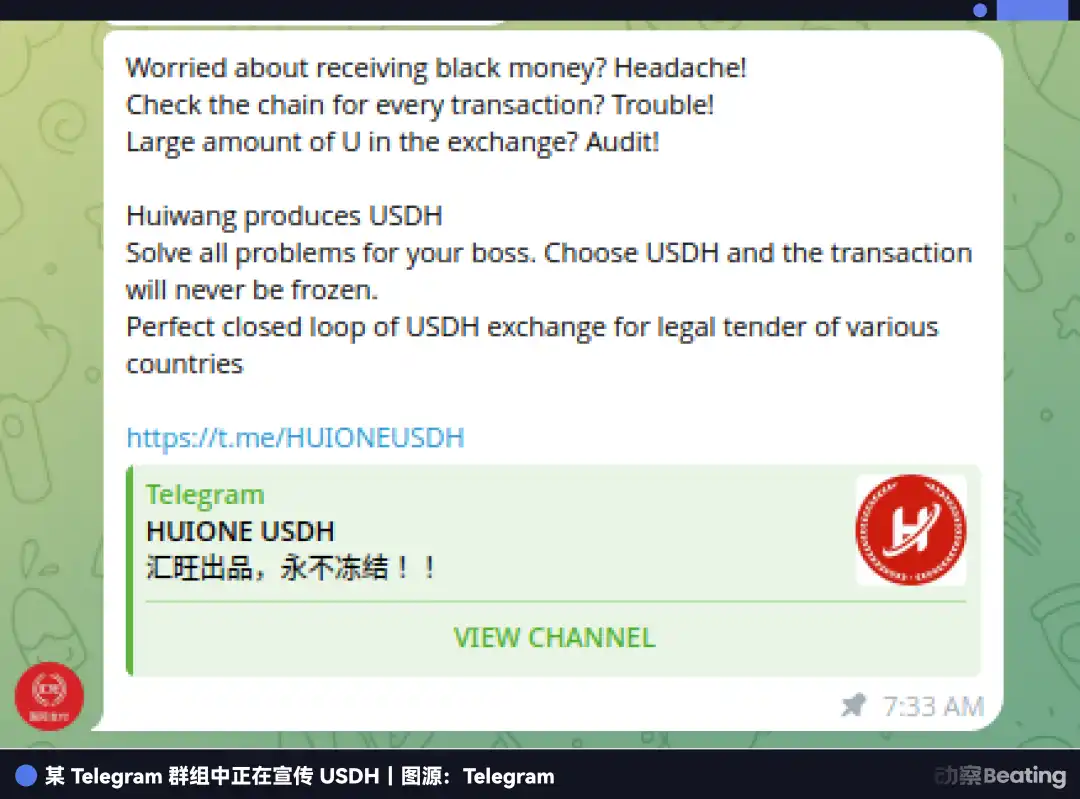
To promote this digital IOU issued by a private company, Huwang launched a financial product within various large industrial parks that made Wall Street blush—a deposit in USDH with an annualized return of 18% and a total return of 27% at maturity.
Then, a highly ironic scene unfolded. Those scam artists who were crazily rug pulling around the world, lured by this 18% high-interest rate, eventually willingly deposited the hard-earned illicit funds back into Huwang's liquidity pool.
In the underground world of Phnom Penh, those self-proclaimed clever rug pull operators failed to realize that in the face of the larger rug pull at Huwang, they themselves had also become "piglets" waiting to be slaughtered.
Where does this kind of "independent nation-building" arrogance come from?
If we look at the board of directors of Huwang Pay, a prominent name stands out: Hun To.
What does this name mean in Cambodia? He is the nephew of former Prime Minister Hun Sen and the cousin of current Prime Minister Hun Many. According to a report by the U.S. Department of the Treasury, this figure who moves in the core of power in Phnom Penh is not only a director of Huwang but also the umbilical cord connecting this company to the highest power in Cambodia.
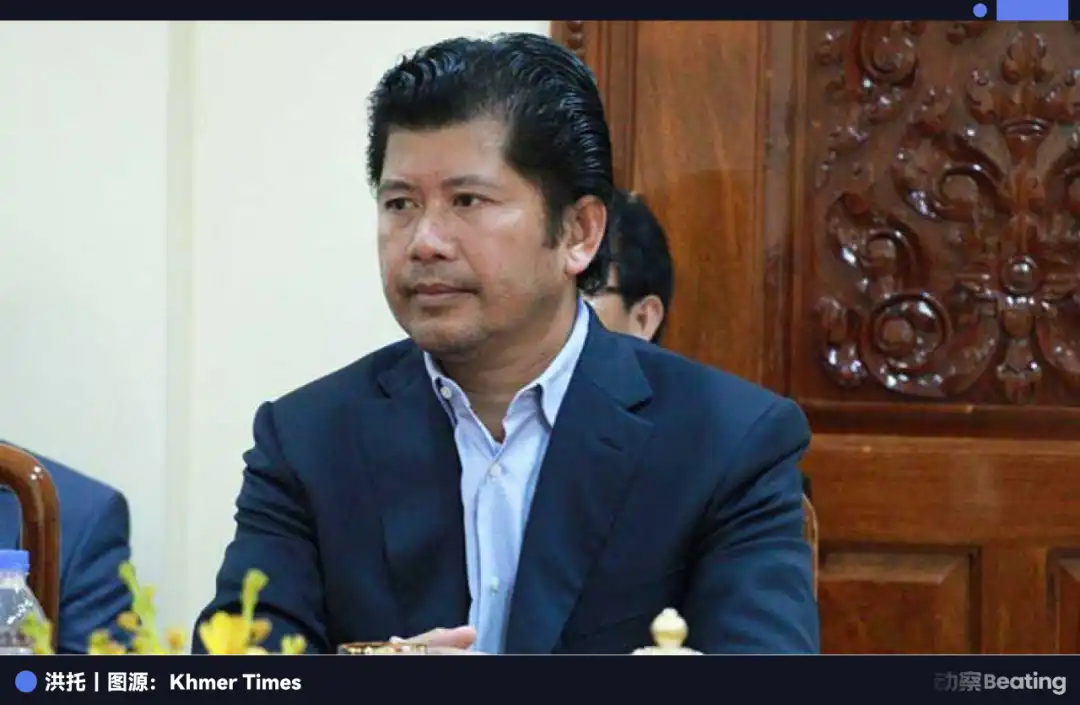
This is the most secretive "symbiotic model" in the Southeast Asian cybercriminal underworld.
The Chinese team is responsible for providing the technology. They use code from tech giants to build a payment system, utilize e-commerce logic to manage human trafficking, and employ blockchain technology to evade regulation. The local elites are responsible for providing the licensing rights. They offer legitimate bank licenses, turn a blind eye to the guarded compounds, and even ensure that the police ignore cries for help from within the high walls.
Technology provides efficiency, while power provides security. It is precisely because of this top-level "umbrella of protection" that they dare to publicly offer bounties for capturing individuals and even dare to issue a private currency challenging the dominance of the US dollar. For them, the law is not an untouchable red line but rather a commodity that can be purchased in bulk through interest-driven transactions.
This naked exchange of interests often masquerades under a cloak of heartwarming charity.
In Chinese-language newspapers in Cambodia, you can often see this scene: a senior executive from Huawang adorned with a ribbon, receiving an honor certificate from the elite, donating a large sum of money to a impoverished school, all the while beaming with a compassionate smile.
Simultaneously, in the Huawang guarantee group chat, money laundering transactions dripping with blood are frantically filling the screen.
The morning hosts an evil trading platform, while the afternoon hosts a charitable charity banquet.
This extreme sense of duality is not hypocrisy but a necessary means of survival. Just as back in the day Du Yuesheng in Shanghai established the position of "social virtuoso" through running schools and maintaining public order, along the Mekong River, "charity" is a special tax paid to the core of power, a whitening agent to cleanse one's identity, and most importantly, the lubricant that sustains the operation of this vast symbiotic entity.
This carefully woven web of political-business relationships once brought Huawang a sense of security for several years. They once believed that as long as they had secured their relationships in Phnom Penh, they could operate on the edge of the rule of law.
Until October 2025, when a butterfly from across the ocean began to flap its wings.
The sanction storm that started in Washington not only overturned the seemingly indestructible umbrella of protection but also directly shattered the fragile cornerstone of this "shadow central bank."
When Grassroots Wisdom Meets the Financial Iron Curtain
In the traditional logic of China's county-level economy, there are usually two ways to deal with trouble: either pull strings or change identities.
As the crisis began to emerge, Huawang's operators attempted to use the same old tricks. Even after their banking license was revoked in March 2025, they naively tried to distract by rebranding as "H-Pay" and claiming to "expand into Japan and Canada."
In their cognitive inertia, as long as the gold-edged panda statue is still standing, as long as the Hun Sen family's stake remains, this is once again a minor issue that can be easily resolved with money.
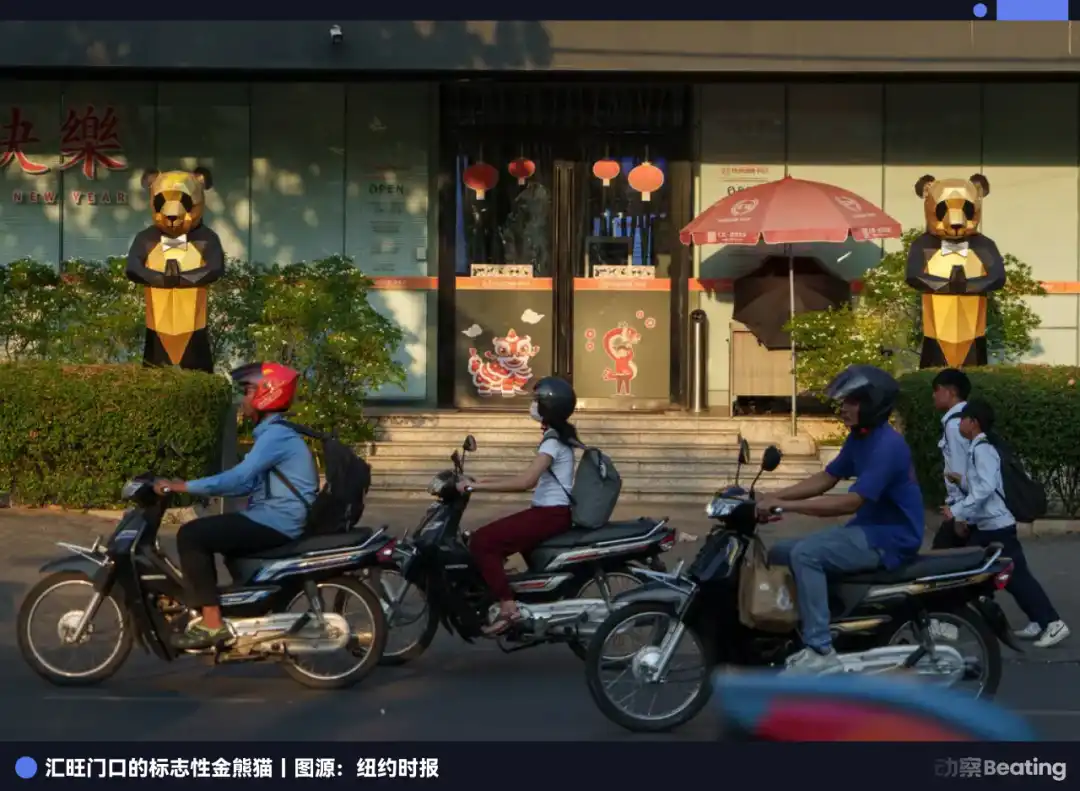
But this time, their opponent is no longer a local police officer accepting bribes, but the heavily armed U.S. national machinery.
On October 14, 2025, a massive black swan event occurred. The U.S. Department of Justice announced the seizure of $15 billion in cryptocurrency owned by Chen Zhi, under the Prince Group.
This sent shockwaves throughout Southeast Asia. Keep in mind that Cambodia's GDP in 2024 was only around $46 billion. This was not just an asset seizure; it was akin to directly draining one-third of the underground economy of this country.
For Huixiang, the Prince Group was not only its largest client but also the source of its liquidity. With the source dried up, downstream activities were bound to perish.
What added to their despair was the nature of the strike.
For a long time, the dark web had a near-superstitious misunderstanding of USDT, considering it to be "decentralized" and beyond legal control. However, USDT is, in reality, highly centralized. While the FBI cannot directly command Tether, as a business entity eager to access the mainstream financial system, Tether must strictly adhere to the U.S. Department of the Treasury's Office of Foreign Assets Control (OFAC) sanctions list.
When U.S. regulatory bodies issue a long-arm jurisdiction injunction, no SWAT teams are needed, nor lengthy transnational litigations. Tether's backend will freeze the related addresses. The hundreds of millions of dollars on-chain instantly become untransferable "dead money."
This was a form of warfare they had never comprehended. This group of clever individuals who rose to prominence by exploiting legal loopholes, the smartest thing they had ever done was to find a way around obstacles. But this time, their opponent tore down the load-bearing walls directly.
In the dust of the collapsing building, the ones who suffocated first were always the bottom-rung ants.
At the end of Huixiang's ecosystem, there is a large group of participants — the liquidity providers. In Phnom Penh, they are the human cash delivery motorcycles; in mainland China, they are the rent-a-house teams conducting transfers from obscure locations. They earn a meager one-tenth of a percent through exchange rate differentials but bear the highest risk in the entire system.
In the past, they were the most sensitive nerve endings of Huixiang's machine; now, they have become the most direct cannon fodder in the card-blocking operation.
In the Telegram "Frozen Friends Chat Group," there are thousands of desperate pleas every day. Their entire bank accounts are frozen, they are listed on a fraud punishment list, unable to even take a high-speed rail or plane, and they may even face the criminal risk of being arrested upon returning to their home country.
Once part of a fleet that made a fortune in a day, they have now become inmates in a high-risk cage. They hold USDH that they cannot sell, their domestic accounts are frozen, and they are trapped in a foreign land.
A Generation's Funeral
When the glass door of the PlusToken headquarters was posted with a notice, it wasn't just a company that fell but an era.
It was a requiem for the era of Chinese Internet companies venturing abroad, a historical footnote filled with fantasies and ambitions.
Within that specific time window, some entrepreneurs venturing abroad carried a "big baby mentality" into the Southeast Asian jungle. They desired both the windfall and freedom of lawless lands and the rules and security of the civilized world; they believed only in relationships and technology, yet had no reverence for the law.
They believed technology to be a neutral tool, unaware that a tool in the hands of those without boundaries would become a weapon of evil; they thought of globalization as escaping from one cage to the wilderness, not realizing that globalization meant moving from one set of rules to another more stringent set of rules.
The rise and fall of PlusToken are a modern fable about the "banality of evil."
Initially, they just wanted to create a user-friendly payment tool to solve the pain points of currency exchange; later, for growth, they turned into accomplices of the gray industry; then, in pursuit of windfall profits, they became architects and participants of sin.
The moment a person decides to establish order for evil, they are doomed not to turn back.
Years later, as the new generation of entrepreneurs venturing abroad sit in a gleaming new office in Phnom Penh, discussing ESG and compliant listings over Starbucks, perhaps no one will remember how much evil flowed through the city's underground cables.
Nor will anyone remember how many self-righteous "Du Yueshengs" were buried in the night on the Mekong River.
You may also like

From x402 to MPP: Cloudflare's crucial vote, will it go to Coinbase or Stripe?

BlackRock CEO issues annual open letter: The wave of tokenization has arrived, and we will lead this trend

When Backpack backstabs the community

When gold is no longer a safe haven, and Bitcoin continues to panic

Trump, the World's Largest Oil Trader

If the US and Iran have not reached an agreement in 5 days, what other cards does Trump have?

Tether Whale Dumps £12 Million, Backing Crypto’s ‘British Trump’
Ethereum Foundation Post: Rethinking the Division of Work Between L1 and L2 to Build the Ultimate Ethereum Ecosystem

Two Major Prediction Market Platforms Unite Rarely, What Is the Story Behind This New Fund?

WEEX Official Product Launch: Win LALIGA Tickets & Unlock the 3-in-1 Crypto Trading Suite
Trade crypto without downloading an app. Join the WEEX H5, API, SKILLs livestream to explore the new trading experience, win LALIGA VIP tickets, and share 420 USDT rewards.
Dragonfly Partners: Most agents will not engage in autonomous trading, how can crypto payments prevail?

US AI Startup Goes All In on Chinese Mega-Model | Rewire News Morning Brief

Trump Lies Again: A "Five-Day Pause" Psyop, How Wall Street, Bitcoin, and Polymarket Insiders Synced Uposciogen

When a Token Becomes Labor, People Become the Interface

Ceasefire News Leaked Ahead of Time? Large Polymarket Bets on Outcome Before Trump's Tweet
BlackRock CEO's Annual Shareholder Letter: How is Wall Street Using AI to Keep Profiting from National Pension Funds?

Sun Valley Releases 2025 Financial Report: Bitcoin Mining Revenue Reaches $670 Million, Accelerating Transformation to AI Infrastructure Platform
On March 16, 2026, in Dallas, Texas, USA, CanGu Company (New York Stock Exchange code: CANG, hereinafter referred to as "CanGu" or the "Company") today announced its unaudited financial performance for the fourth quarter and full year ended December 31, 2025. As a btc-42">bitcoin mining enterprise relying on a globally operated layout and dedicated to building an integrated energy and AI computing power platform, CanGu is actively advancing its business transformation and infrastructure development.
• Financial Performance:
Total revenue for the full year 2025 was $688.1 million, with $179.5 million in the fourth quarter.
Bitcoin mining business revenue for the full year was $675.5 million, with $172.4 million in the fourth quarter.
Full-year adjusted EBITDA was $24.5 million, while the fourth quarter was -$156.3 million.
• Mining Operations and Costs:
A total of 6,594.6 bitcoins were mined throughout the year, averaging 18.07 bitcoins per day; of which 1,718.3 bitcoins were mined in the fourth quarter, averaging 18.68 bitcoins per day.
The average mining cost for the full year (excluding miner depreciation) was $79,707 per bitcoin, and for the fourth quarter, it was $84,552;
The all-in sustaining costs were $97,272 and $106,251 per bitcoin, respectively.
As of the end of December 2025, the company has cumulatively produced 7,528.4 bitcoins since entering the bitcoin mining business.
• Strategic Progress:
The company has completed the termination of the American Depositary Receipt (ADR) program and transitioned to a direct listing on the NYSE to enhance information transparency and align with its strategic direction, with a long-term goal of expanding its investor base.
CEO Paul Yu stated: "2025 marked the company's first full year as a bitcoin mining enterprise, characterized by rapid execution and structural reshaping. We completed a comprehensive adjustment of our asset system and established a globally distributed mining network. Additionally, the company introduced a new management team, further strengthening our capabilities and competitive advantage in the digital asset and energy infrastructure space. The completion of the NYSE direct listing and USD pricing also signifies our transformation into a global AI infrastructure company."
"As we enter 2026, the company will continue to optimize its balance sheet structure and enhance operational efficiency and cost resilience through adjustments to the miner portfolio. At the same time, we are advancing our strategic transformation into an AI infrastructure provider. Leveraging EcoHash, we will utilize our capabilities in scalable computing power and energy networks to provide cost-effective AI inference solutions. The relevant site transformations and product development are progressing simultaneously, and the company is well-positioned to sustain its execution in the new phase."
The company's Chief Financial Officer, Michael Zhang, stated: "By 2025, the company is expected to achieve significant revenue growth through its scaled mining operations. Despite recording a net loss of $452.8 million from ongoing operations, mainly due to one-time transformation costs and market-driven fair value adjustments, the company, from a financial perspective, will reduce its leverage, optimize its Bitcoin reserve strategy and liquidity management, introduce new capital to strengthen its financial position, and seize investment opportunities in high-potential areas such as AI infrastructure while navigating market volatility."
The total revenue for the fourth quarter was $1.795 billion. Of this, the Bitcoin mining business contributed $1.724 billion in revenue, generating 1,718.3 Bitcoins during the quarter. Revenue from the international automobile trading business was $4.8 million.
The total operating costs and expenses for the fourth quarter amounted to $4.56 billion, primarily attributed to expenses related to the Bitcoin mining business, as well as impairment of mining machines and fair value losses on Bitcoin collateral receivables.
This includes:
· Cost of Revenue (excluding depreciation): $1.553 billion
· Cost of Revenue (depreciation): $38.1 million
· Operating Expenses: $9.9 million (including related-party expenses of $1.1 million)
· Mining Machine Impairment Loss: $81.4 million
· Fair Value Loss on Bitcoin Collateral Receivables: $171.4 million
The operating loss for the fourth quarter was $276.6 million, a significant increase from a loss of $0.7 million in the same period of 2024, primarily due to the downward trend in Bitcoin prices.
The net loss from ongoing operations was $285 million, compared to a net profit of $2.4 million in the same period last year.
The adjusted EBITDA was -$156.3 million, compared to $2.4 million in the same period last year.
The total revenue for the full year was $6.881 billion. Of this, the revenue from the Bitcoin mining business was $6.755 billion, with a total output of 6,594.6 Bitcoins for the year. Revenue from the international automobile trading business was $9.8 million.
The total annual operating costs and expenses amount to $1.1 billion.
Specifically, they include:
· Revenue Cost (excluding depreciation): $543.3 million
· Revenue Cost (depreciation): $116.6 million
· Operating Expenses: $28.9 million (including related-party expenses of $1.1 million)
· Miner Impairment Loss: $338.3 million
· Bitcoin Collateral Receivable Fair Value Change Loss: $96.5 million
The full-year operating loss is $437.1 million. The continuing operations net loss is $452.8 million, while in 2024, there was a net profit of $4.8 million.
The 2025 non-GAAP adjusted net profit is $24.5 million (compared to $5.7 million in 2024). This measure does not include share-based compensation expenses; refer to "Use of Non-GAAP Financial Measures" for details.
As of December 31, 2025, the company's key assets and liabilities are as follows:
· Cash and Cash Equivalents: $41.2 million
· Bitcoin Collateral Receivable (Non-current, related party): $663.0 million
· Miner Net Value: $248.7 million
· Long-Term Debt (related party): $557.6 million
In February 2026, the company sold 4,451 bitcoins and repaid a portion of related-party long-term debt to reduce financial leverage and optimize the asset-liability structure.
As per the stock repurchase plan disclosed on March 13, 2025, as of December 31, 2025, the company had repurchased a total of 890,155 shares of Class A common stock for approximately $1.2 million.



 App
App