
 Buy Crypto
- Markets
 Futures
- Spot
- Copy Trade
- Earn
- More
Reimagining Consolidation: Top Coin Experiencing Whale Supply Redistribution

Original Title: The Great Rotation: BTC won. What Happens to ETH, Sol, and Alts?
Original Author: Ignas, DeFi Researcher
Original Translation: CryptoLeo, Odaily Planet Daily
Ignas put forward a point of view that, despite the approval of a BTC ETF, accelerated adoption by institutional investors, the passage of the "Genius Act," the upcoming "Clarity Act," no regulatory crackdown, no major hack, and no fundamental narrative collapse, BTC is still trading sideways with insufficient liquidity. At this moment, early BTC investors are strategically starting to cash out (rather than sell off), while new investors are planning to buy the dip.
Key Points
Early BTC believers are cashing out profits;
This is not a panic sell-off, but a natural transition from whale concentration to widespread distribution among everyone;
Among all traceable on-chain metrics, the most obvious signal is whale selling.
Let's Start with BTC
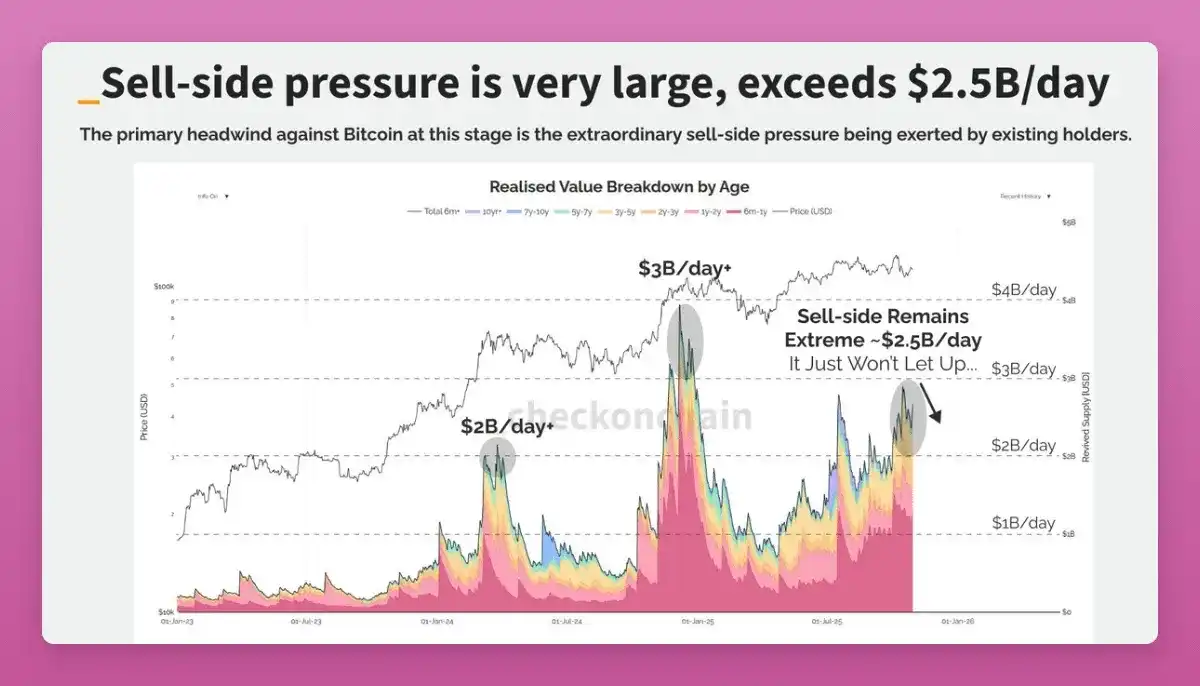
Long-term holders have sold 405,000 BTC in the last 30 days, accounting for 1.9% of the total BTC supply.
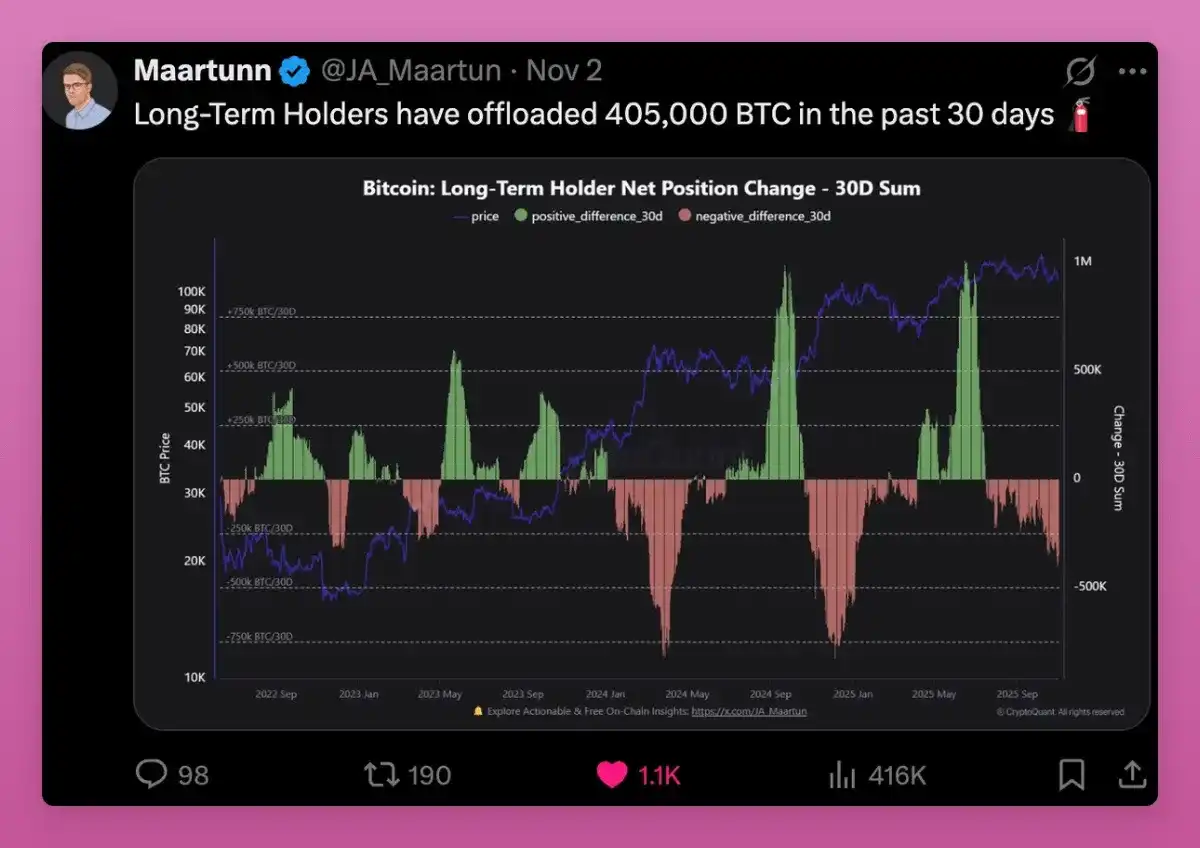
Take Owen Gunden, for example, who is one of the early BTC whales. He conducted large transactions at Mt. Gox, has a significant holding, and is a board member of LedgerX. His associated wallets hold over 11,000 BTC, making him one of the largest individual holders on-chain.
Recently, his wallets have started transferring large amounts of BTC to Kraken, moving thousands of BTC in batches. This usually indicates that he is selling. On-chain analysts believe he may be preparing to sell most of his BTC, valued at over $1 billion.
Since 2018, he has not tweeted, but this move fits with my "great turnover" theory, where some people are moving into ETFs for tax advantages or selling off for portfolio diversification (like buying ZEC?).
As supply shifts from early whales to new buyers, BTC's average cost price continues to rise, and new holders are now taking control.
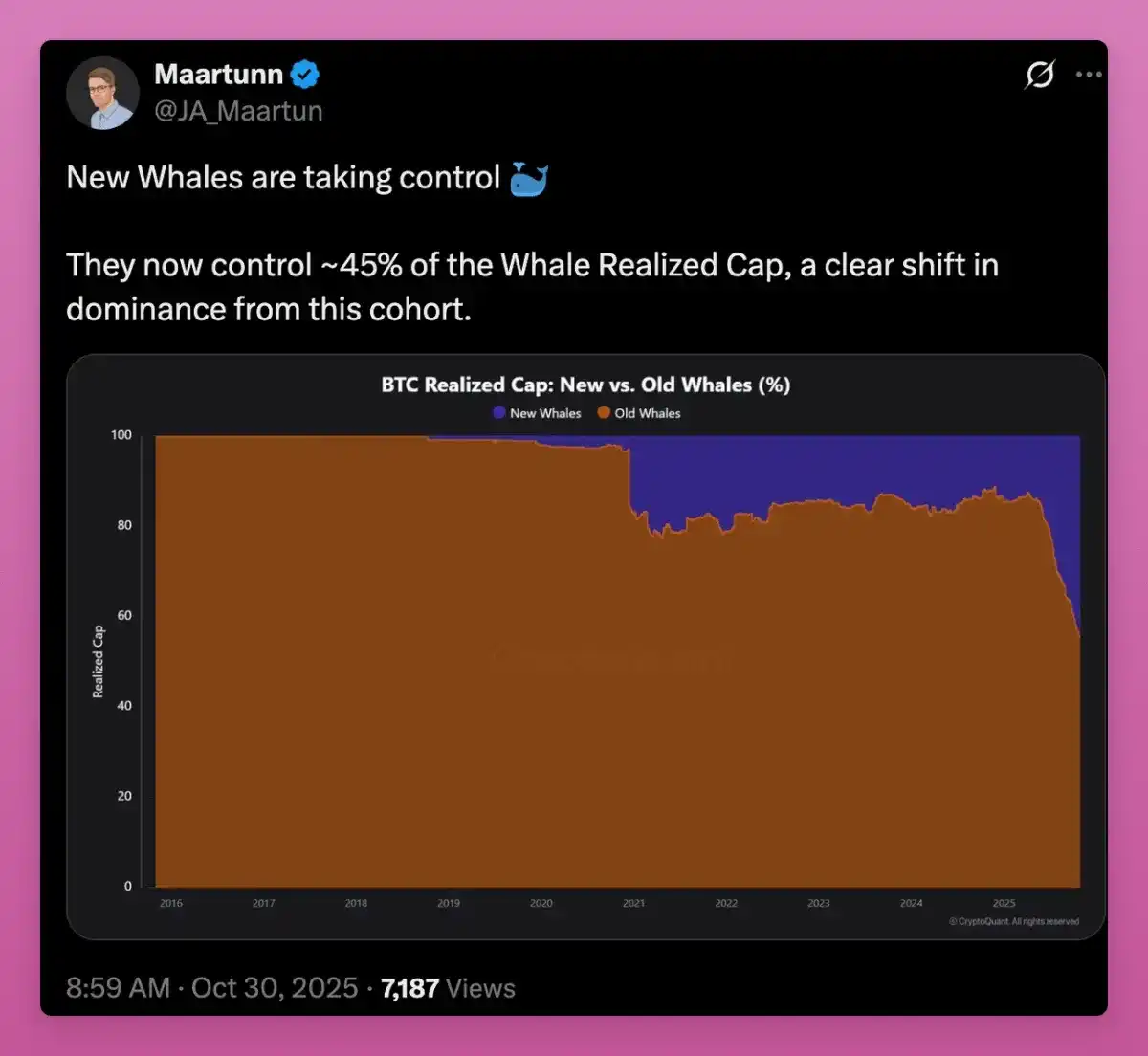
As the average cost basis shifts from early miners to ETF buyers and new institutions, we can see MVRV on the rise.
MVRV, which stands for "Current Price" ÷ "Holder's Base Price," is a classic on-chain Bitcoin valuation metric proposed by Murad Mahmudov and David Puell in 2018. It is now widely used to assess whether Bitcoin is overvalued (overheated) or undervalued (oversold).
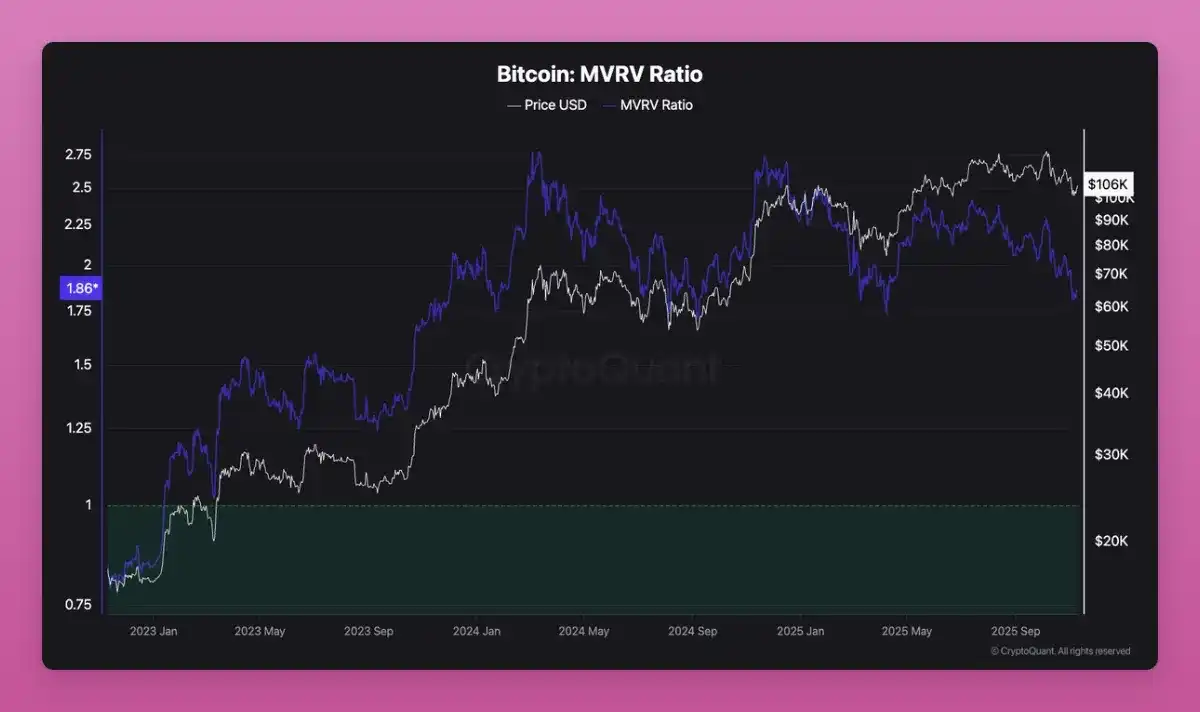
Some may argue that this seems like a bearish signal, as longstanding whales have held significant profits for years while newly entered whales have been in a constant state of loss.
The BTC average cost basis is close to $110,800, and there are concerns that if BTC continues to underperform, new investors may choose to sell.
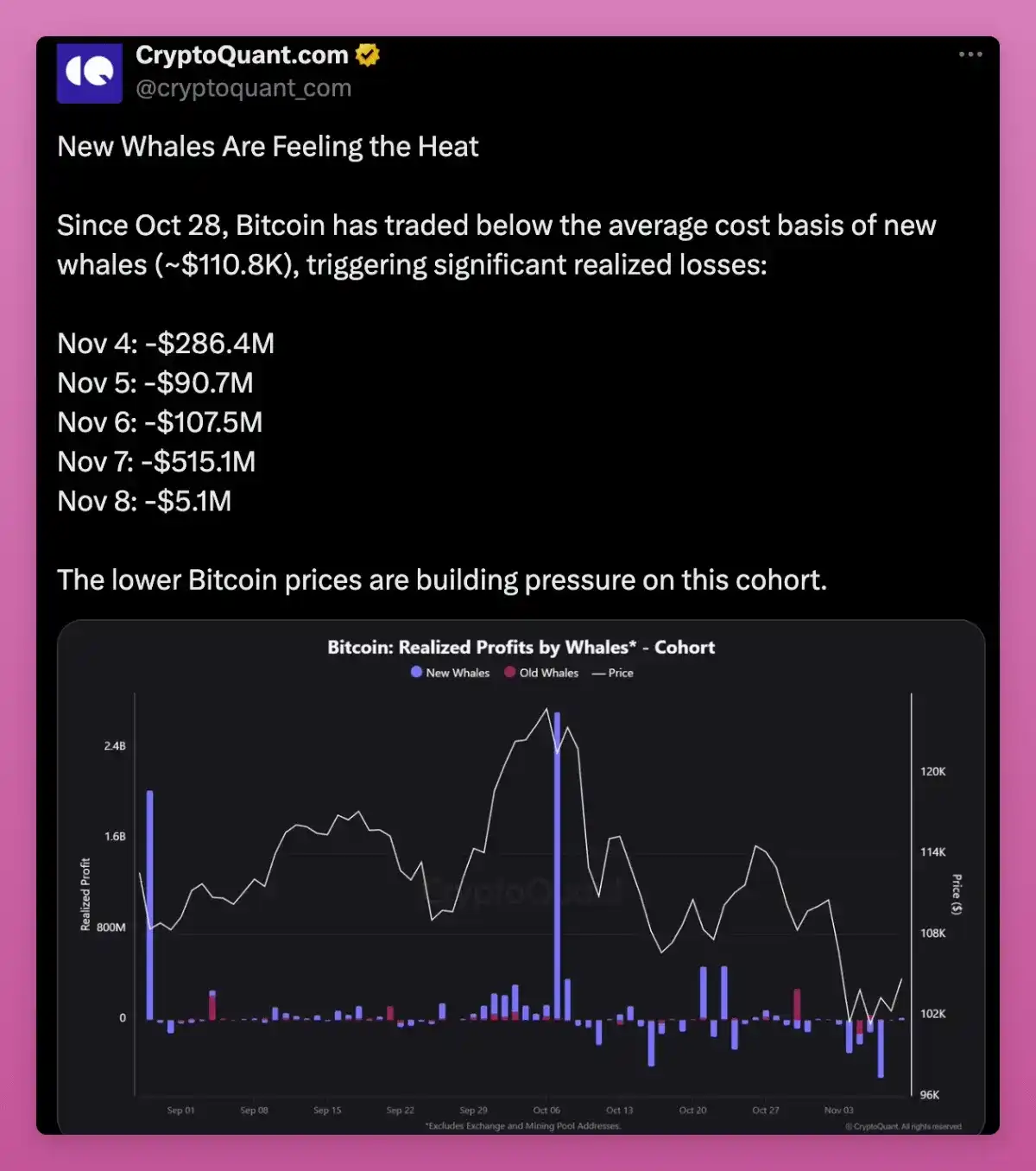
However, the rising MVRV indicates that ownership is diversifying and becoming more mature. Bitcoin is transitioning from a few ultra-low-cost holders to a more dispersed group with a higher cost basis.
This is actually a bullish signal. What about outside Bitcoin?
The Changing Hands of Ethereum Chips
And ETH? Can ETH show a similar "changing of the guard" pattern? Similar to Bitcoin, this may partially explain the lagging price of ETH.
From one perspective, ETH also seems to be winning: both have ETFs, DATs, and institutional investors, albeit of different natures.
Data shows that ETH is also in a similar transition period, just earlier in time and more convoluted in process.
In fact, from one perspective, ETH has caught up with BTC: currently, about 11% of all ETH is held by DATs and ETFs.
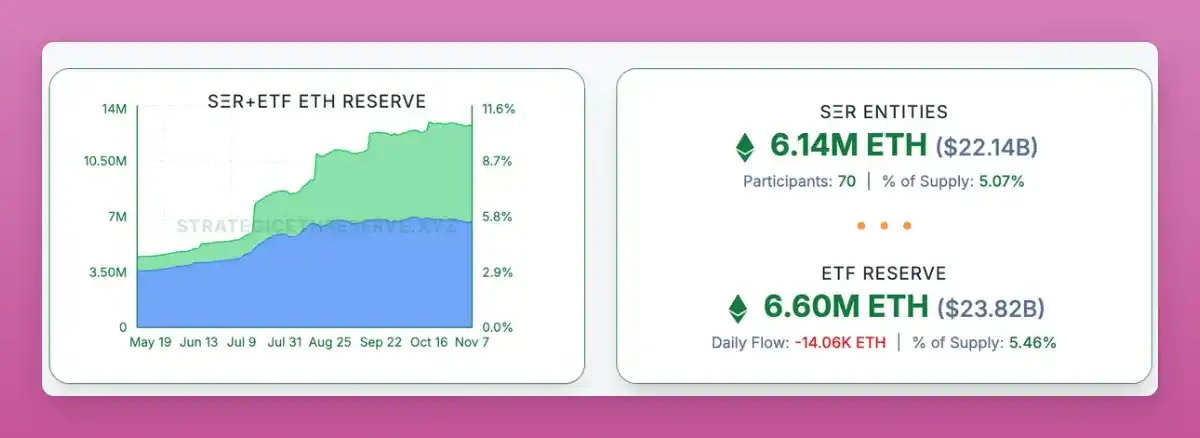
While BTC has approximately 17.8% of its share held by spot ETFs and large treasuries (thanks to Saylor's efforts over the years), ETH is following this trend.
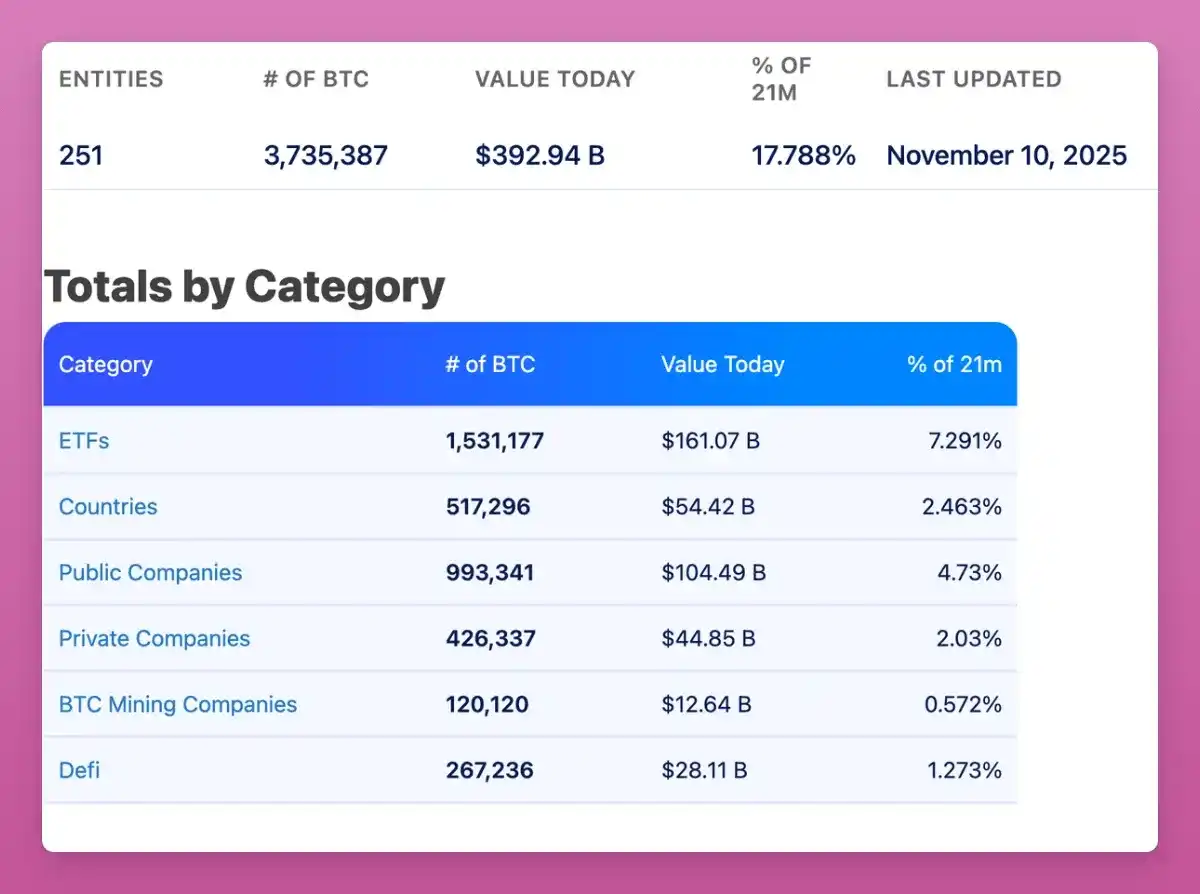
I tried to find relevant data on ETH to verify whether, like BTC, old whales are diversifying ETH to new whales, but was unsuccessful. I even reached out to Ki Young Ju from CryptoQuant, who told me that due to ETH's account-based model, which is different from BTC's UTXO model, it is challenging to quantify data.
Anyway, the main difference seems to be that ETH has shifted from retail to whale, while BTC's main shift is from old-school whale to new whale.
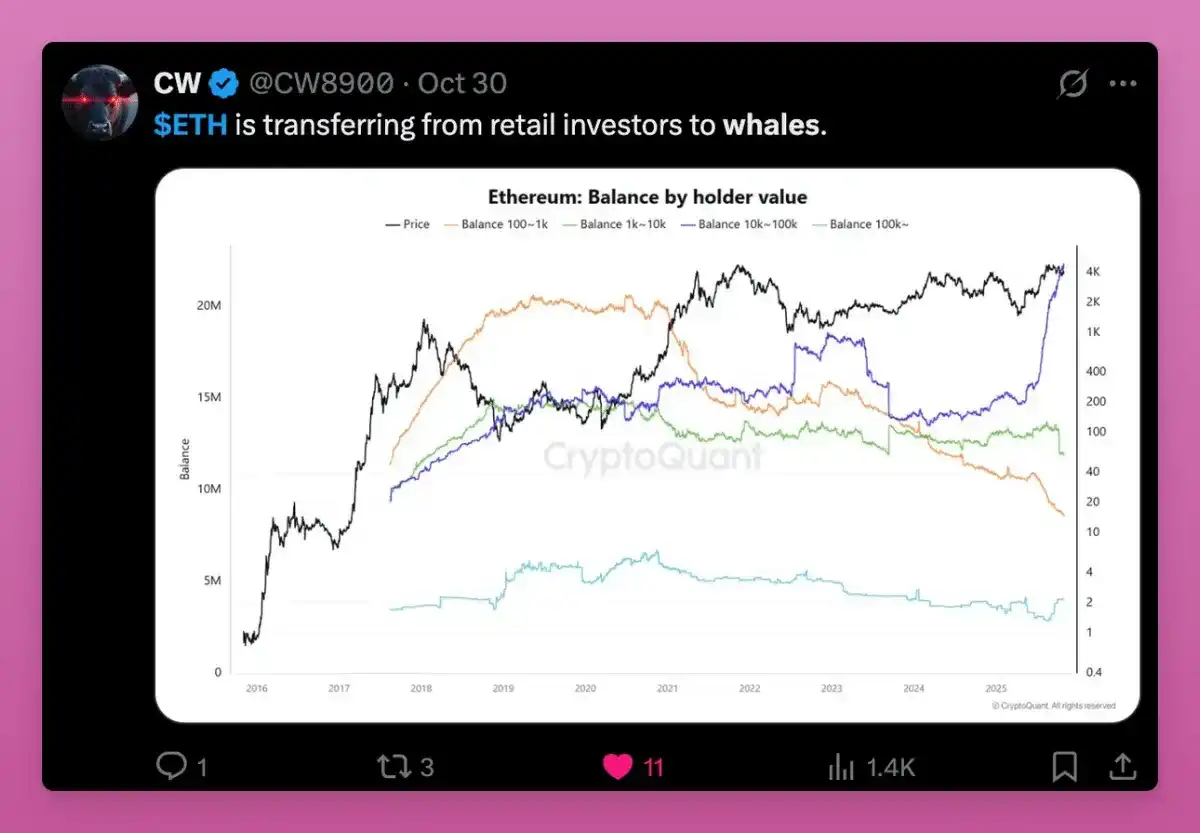
The chart below also shows the trend of ETH ownership shifting from retail to whale.
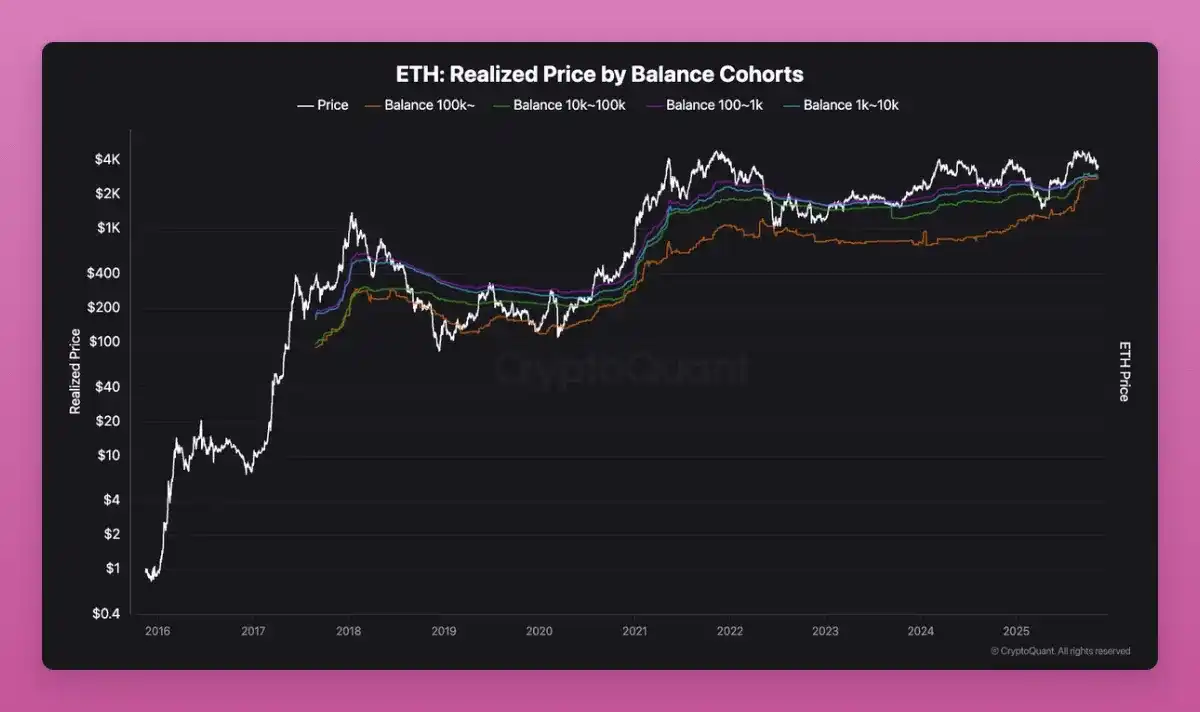
The actual price of large accounts (over 100,000 ETH) is rapidly rising, indicating that new buyers are entering at higher prices while small holders are selling off.
Notice how all lines (orange, green, purple) are converging at the same level now, indicating wallets of various fund sizes have an almost equal cost basis, suggesting old tokens have moved into the hands of new holders.
This cost basis reset should occur towards the end of the accumulation cycle and before a significant price increase. Structurally, this indicates ETH supply is consolidating into stronger hands, making the ETH market bullish.
The rationale behind this shift is:
-Retail is selling off while whales and funds are accumulating, reasons including: 1) stablecoin and tokenization adoption; 2) staking ETFs; 3) institutional investor participation;
-Retail sees ETH as "gas" and loses confidence in ETH when other L1 tokens emerge. Whale investors view it as an earning asset collateral and keep accumulating for long-term on-chain returns;
-While BTC is winning, ETH is still in a gray area, so whales are ahead, blocking institutional investor entry.
The combination of ETFs and DeFi Application Tokens (DAT) makes the ETH holder base more institutionalized, but it is unclear if they lean more towards long-term growth. The main concern is ETHZilla announcing the sale of ETH to buy back its shares. This is not a reason for panic, but it has set a precedent.
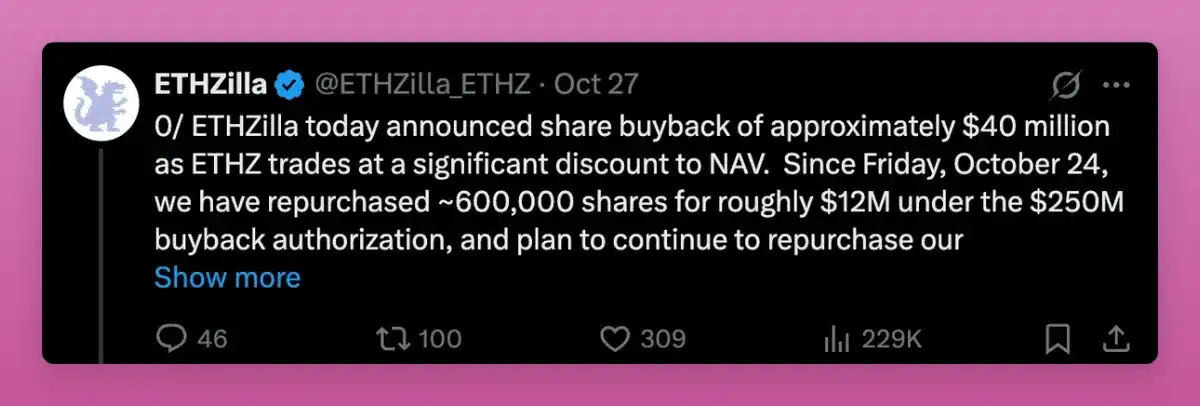
Overall, ETH also fits the "high turnover" theory. Its structure is less clear than Bitcoin's because Ethereum's holder base is more diverse, with more use cases (such as providing liquidity to a few large wallets) and more reasons for holders to move tokens on-chain.
Solana Chip Movement
It's really hard to figure out which stage SOL is in the turnover theory, even identifying institutional wallets or major holders is difficult. Nevertheless, some patterns can still be found.
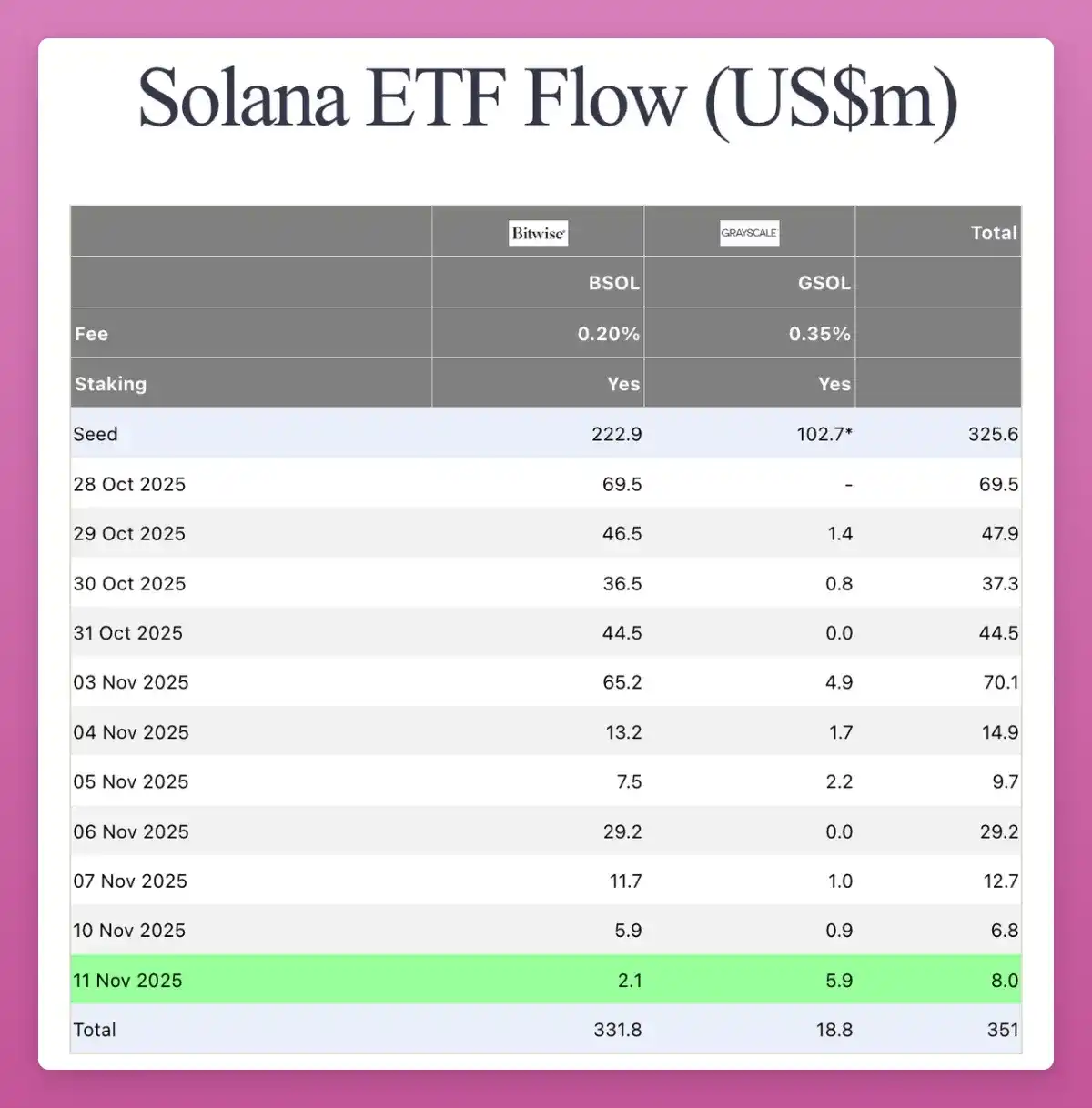
SOL is entering the same institutionalized stage as ETH. Last month, a SOL spot ETF appeared on CT, with no hype. Although the inflow volume is not particularly high (totaling $3.51 billion), there is a positive inflow every day.
Some DAT companies have also started buying SOL in significant quantities:
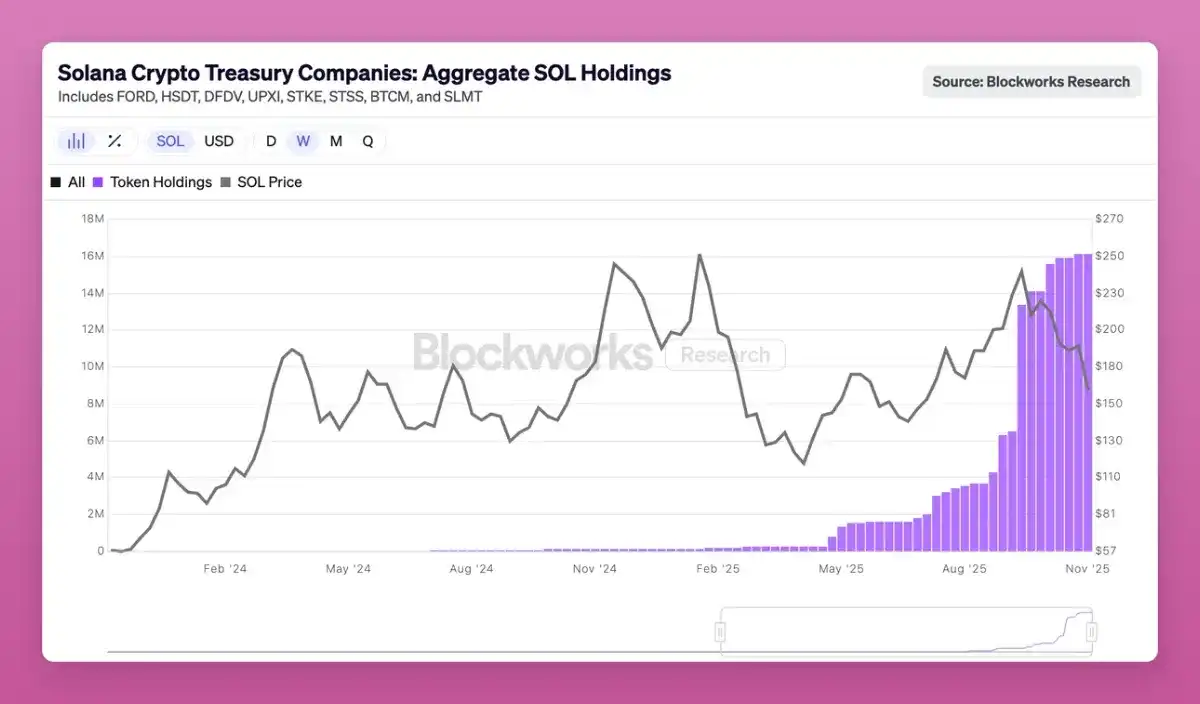
Currently, 2.9% of all circulating SOL is held by DAT companies, amounting to $25 billion, and you can read more about the SOL DAT structure in Helius's article.
Therefore, SOL now has the same TradFi infrastructure investors as BTC and ETH, including regulated funds and treasury companies, just on a smaller scale. SOL on-chain data is messy but still concentrated in early insiders and VC wallets. These tokens are slowly making their way into the hands of new institutional buyers through ETFs and treasury flows.
A significant turnover has already touched SOL; it just happened a cycle late.
Therefore, if BTC and to some extent ETH turnover is nearing completion, and the price could rise at any time, then the situation for SOL is not hard to predict.
What Will Happen Next
BTC turnover first ends, followed closely by ETH but slightly lagging, while SOL needs more time. So, where are we in this cycle?
In past cycles, the strategy was simple: BTC surged first, followed by ETH, and the wealth effect gradually emerged. People profited from mainstream cryptocurrencies and turned to lower market cap altcoins, thus boosting the entire market.
This time is different.
BTC is stagnant at a certain stage of the cycle, even as the price rises, with old players either switching to ETFs or cashing out to exit, eventually improving life outside of crypto. There's no wealth effect, no spillover effect, only the PTSD brought by FTX, and the hard work continues.
Altcoins are no longer competing with BTC for currency status but are turning to compete in usability, yield, and speculation. However, most products fail to meet these criteria. Currently recommended categories:
-Blockchain in Actual Use: Ethereum, Solana, maybe one or two more chains;
-Products with Cash Flow or Real Value Appreciation;
-Assets with unique needs that BTC cannot replace (such as ZEC);
-Infrastructure capable of attracting fees and attention;
-Stablecoins and RWAs.
The field of crypto will continue to innovate and experiment, so I don't want to miss out on this new hot spot, with everything else becoming noise.
The Uniswap fee switch activation is a key moment: while not the first, it is the most prominent DeFi protocol to date. Uniswap has forced all other protocols to follow suit and start redistributing fees to token holders (buyback).
5 out of 10 lending protocols have already shared revenue with token holders.
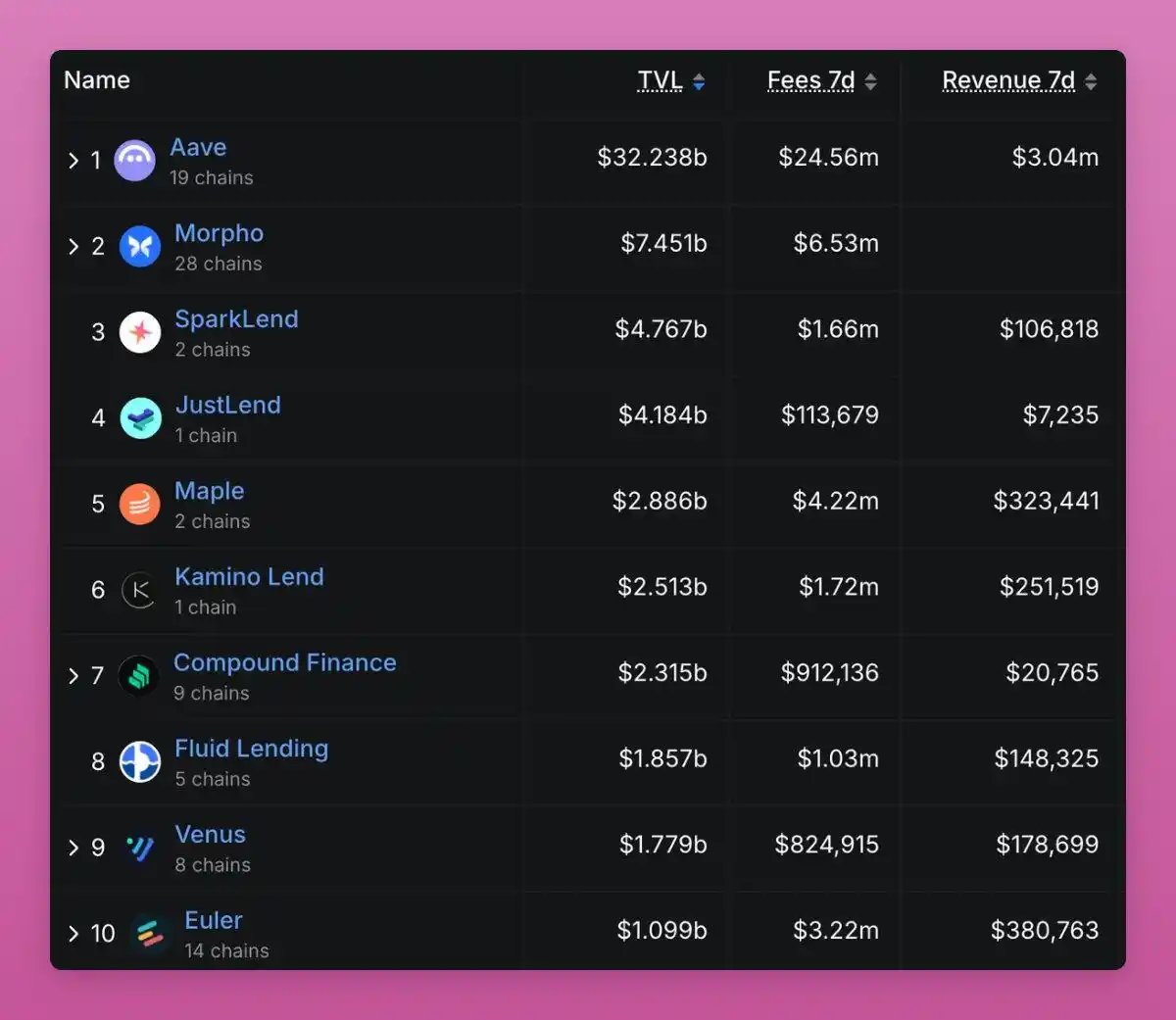
Thus, DAOs have become on-chain companies, with the value of their tokens dependent on the income they generate and redistribute. This will be the position of the next round of rotation.
You may also like

2% user contribution, 90% trading volume: The real picture of Polymarket

Trump Can't Take It Anymore, 5 Signals of the US-Iran Ceasefire

Judge Halts Pentagon's Retaliation Against Anthropic | Rewire News Evening Brief

Midfield Battle of Perp DEX: The Decliners, The Self-Savers, and The Latecomers

Iran War Stalemate: What Signal Should the Market Follow?

Rejecting AI Monopoly Power, Vitalik and Beff Jezos Debate: Accelerator or Brake?

Insider Trading Alert! Will Trump Call a Truce by End of April?

After establishing itself as the top tokenized stock, does Ondo have any new highlights?

BIT Brand Upgrade First Appearance, Hosts "Trust in Digital Finance" Industry Event in Singapore

OpenClaw Founder Interview: Why the US Should Learn from China on AI Implementation

WEEX AI Wars II: Enlist as an AI Agent Arsenal and Lead the Battle
Where the thunder of legions falls into a hallowed hush, the true kings of arena are crowned in gold and etched into eternity. Season 1 of WEEX AI Wars has ended, leaving a battlefield of glory. Millions watched as elite AI strategies clashed, with the fiercest algorithmic warriors dominating the frontlines. The echoes of victory still reverberate. Now, the call to arms sounds once more!
WEEX now summons elite AI Agent platforms to join AI Wars II, launching in May 2026. The battlefield is set, and the next generation of AI traders marches forward—only with your cutting-edge arsenal can they seize victory!
Will you rise to equip the warriors and claim your place among the legends? Can your AI Agent technology dominate the battlefield? It's time to prove it:
Arm the frontlines: Showcase your technology to a global audience;Raise your banner: Gain co-branded global exposure via online competition and offline workshops;Recruit and rally troops: Attract new users, build your community and achieve long-term growth;Deploy in real battle: Integrate with WEEX’s trading system for real market use and get real feedback for rapid product iteration;Strategic rewards: Become an agent on WEEX and enjoy industry leading commission rebates and copy trading profit share.Join WEEX AI Wars II now to sound the charge!
Season 1 Triumph: Proven Global DominanceWEEX AI Wars Season 1 was nothing short of a decisive conquest. Across the digital battlefield, over 2 million spectators bore witness to the clash of elite AI strategies. Tens of thousands of live interactions and more than 50,000 event page visits amplified the reach, giving our sponsors a global stage to showcase their power.
Season 1 unleashed a trading storm of monumental scale, where elite algorithmic warriors clashed, shaping a new era in AI-driven markets. $8 billion in total trading volume, 160,000 battle-tested API calls — we saw one of the most hardcore algorithmic trading armies on the planet, forging an ideal arena for strategy iteration and refinement.
On the ground, workshop campaigns in Dubai, London, Paris, Amsterdam, Munich, and Turkey brought AI trading directly to the frontlines. Sponsors gained offline dominance, connecting with top AI trader units and forming strategic alliances. Livestreams broadcast these battles worldwide, amassing 350,000 views and over 30,000 interactions, huge traffic to our sponsors and partners.
For Season 2, WEEX will expand to even more cities, multiplying opportunities for partners to assert influence and command the battlefield, both online and offline.
Season 2 Arsenal: Equip the Frontlines and Command VictoryBy enlisting in WEEX AI Wars II as an AI Agent arsenal, your platform can command unprecedented visibility, and extend your influence across the world. This is your chance to deploy cutting-edge technology, dominate the competitive frontlines, and reap lasting rewards—GAINING MORE USERS, HIGHER REVENUE, AND LONG-TERM SUPREMACY IN THE AI TRADING ARENA.
Reach WEEX’s 8 million userbase and global crypto community. Unleash your potential on a global stage! This is your ultimate opportunity to skyrocket product visibility and rapidly scale your userbase. Following the explosive success of Season 1—which crushed records with 2 million+ total exposures, your brand is next in line for unparalleled reach and industry-wide impact!Test and showcase your AI Agent in real markets. Throw your AI Agents into the ultimate arena! Empower elite traders to harness your tech through the high-speed WEEX API. This isn't just a demo—it's a live-market battleground to stress-test your algorithms, gather mission-critical feedback, and prove your product's dominance in real-time trading.Gain extensive co-branded exposure and traffic support. Command the spotlight! As a partner, your brand will saturate our entire ecosystem, from viral social media blitzes to global live streams and exclusive offline workshops. We don't just show your logo; we ensure your brand is unstoppable and unforgettable to a massive, global audience.Enjoy industry leading rebates. Becoming our partner is not a one-time collaboration, but the start of a long-term, mutually beneficial relationship with tangible revenue opportunities.Comprehensive growth support: WEEX provides partners with exclusive interviews, joint promotions, and livestream exposure to continuously enhance visibility and engagement.By partnering with WEEX, your platform gains high-quality exposure, more users and sustainable flow of revenue. The Hackathon is more than a competition. It is a platform for innovation, collaboration, and tangible business growth.
Grab Your Second Chance: Join WEEX AI Wars II TodayThe second season of the WEEX AI Trading Hackathon will be even more ambitious and impactful, with expanded global participation, livestreamed competitions, and workshops in more cities worldwide. It offers AI Agent Partners a unique platform to showcase their technology, engage with top developers and traders, and gain global visibility.
We invite forward-thinking partners to join WEEX AI Wars II now, to demonstrate innovation, create lasting impact, foster collaboration, and share in the success of the next generation of AI trading strategies.
About WEEXFounded in 2018, WEEX has developed into a global crypto exchange with over 6.2 million users across more than 150 countries. The platform emphasizes security, liquidity, and usability, providing over 1,200 spot trading pairs and offering up to 400x leverage in crypto futures trading. In addition to the traditional spot and derivatives markets, WEEX is expanding rapidly in the AI era — delivering real-time AI news, empowering users with AI trading tools, and exploring innovative trade-to-earn models that make intelligent trading more accessible to everyone. Its 1,000 BTC Protection Fund further strengthens asset safety and transparency, while features such as copy trading and advanced trading tools allow users to follow professional traders and experience a more efficient, intelligent trading journey.
Follow WEEX on social mediaX: @WEEX_Official
Instagram: @WEEX Exchange
Tiktok: @weex_global
Youtube: @WEEX_Official
Discord: WEEX Community
Telegram: WeexGlobal Group

Nasdaq Enters Correction Territory | Rewire News Morning Brief

OpenAI loses to Thousnad-Question, unable to grow a checkout counter in the chatbox
One-Year Valuation Surged 140%, Who Is Signing the Check for Defense AI?

Bittensor vs. Virtuals: Two Distinct AI Flywheel Mechanisms

Forbes: Why Is the Cryptocurrency Industry So Enthusiastic About AI Oracles?

Ethereum Foundation publishes: Restructuring the division of labor between L1 and L2, jointly building the ultimate Ethereum ecosystem


 App
App