
 Buy Crypto
- Markets
 Futures
- Spot
- Copy Trade
- Earn
- More
Macro Insight: Powell's "Fog of War" and the Financial "Hunger Games"

Original Article Title: "Driving in Fog" and the Financial Hunger Games
Original Article Author: arndxt, Crypto Analyst
Original Article Translation: Doraemon, Odaily Planet Daily
A significant pullback coincides with the Quantitative Easing (QE) cycle—when the Federal Reserve intentionally extends the maturity date of its held assets to lower long-term yields (this operation is known as the "Operation Twist" and QE2/QE3).
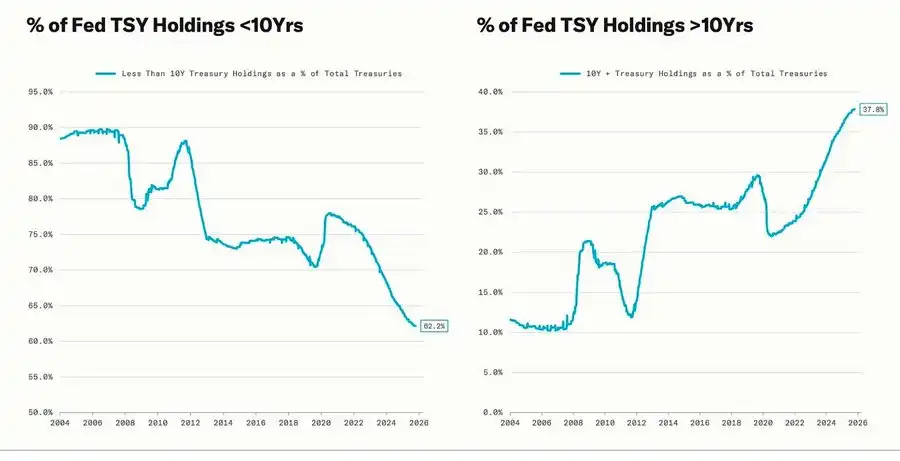
Powell's metaphor of "Driving in Fog" is no longer limited to the Federal Reserve itself but has become a reflection of today's global economy. Whether policymakers, companies, or investors, all are groping forward in an environment with a lack of clear visibility, relying only on liquidity reflex and short-term incentive mechanisms.
The new policy regime exhibits three characteristics: limited visibility, fragile confidence, and liquidity-driven distortion.
The Fed's "Hawkish Rate Cut"
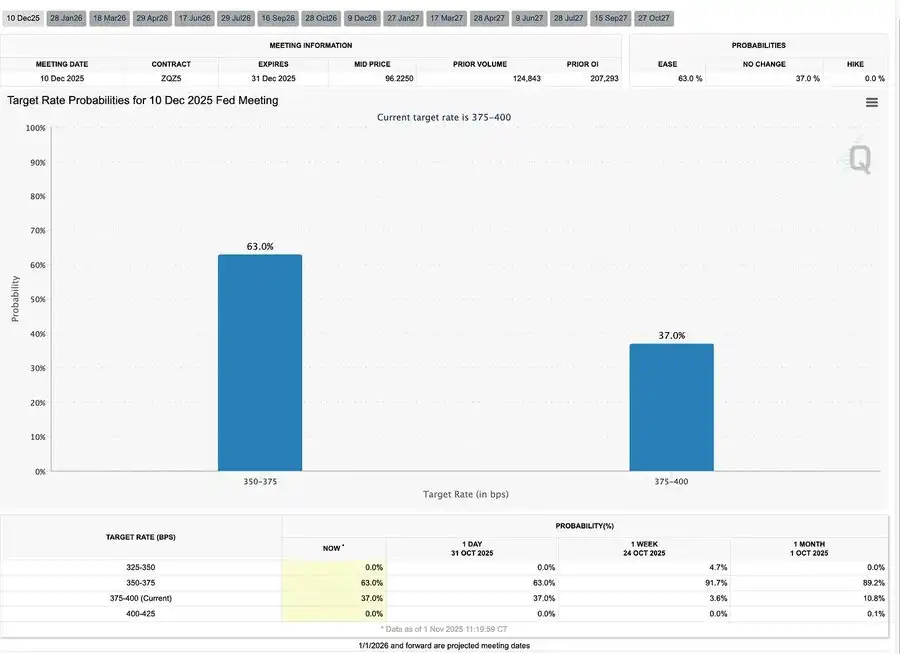
This 25-basis-point "risk-management-style" rate cut has brought the rate range down to 3.75%–4.00%, more of a "reserve of options" than an easing.
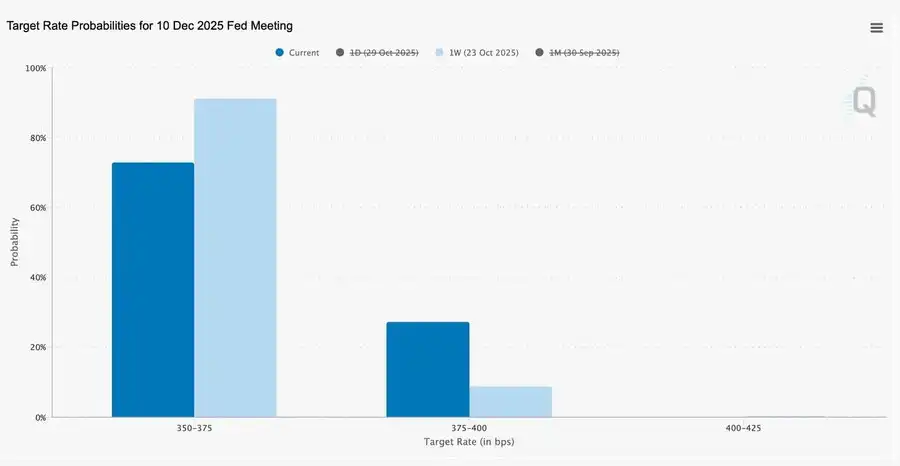
Given the existence of two completely opposite views, Powell sent a clear signal to the market: "Slow Down—Visibility Is Gone."
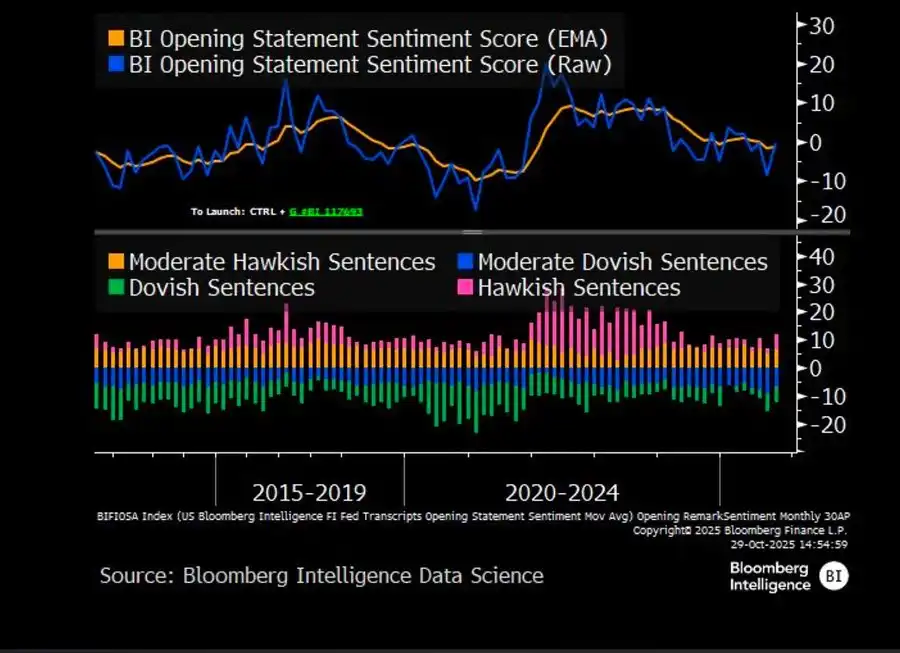
Due to the data blackout caused by the government shutdown, the Fed was almost "flying blind." Powell's hint to traders was very clear: Whether the rate can be announced in December is still uncertain. Rate cut expectations rapidly recede, the short-end rate curve is flattening, and the market is digesting the shift from "data-driven" to "data-missing" caution.
2025: Liquidity "Hunger Games"
The central bank's repeated intervention measures have institutionalized speculative behavior. Now, what determines asset performance is not productivity but liquidity itself—this structure has led to continuous valuation expansion while credit in the real economy weakens.
The discussion further extends to a sober look at the current financial system: passive concentration, algorithmic reflexivity, retail options frenzy—
· Passive capital and quantitative strategies dominate liquidity, with volatility determined by positions rather than fundamentals.
· Retail call option buying frenzy and Gamma squeeze in the "Meme sector" create synthetic price momentum, while institutional funds flock to the increasingly narrow market leaders.
· The host refers to this phenomenon as the "Financial Hunger Games"—a system shaped by structural inequality and policy reflexivity, forcing small investors towards speculative survivalism.
2026 Outlook: The Boom and Risks of Capital Expenditure
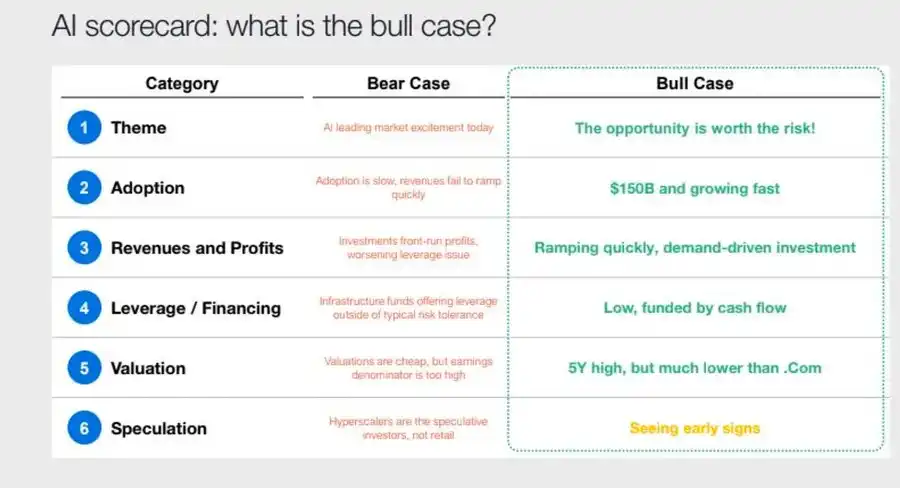
The AI investment wave is driving "Big Tech" into a post-cycle industrialization phase—currently driven by liquidity, but facing leverage-sensitive risks in the future.
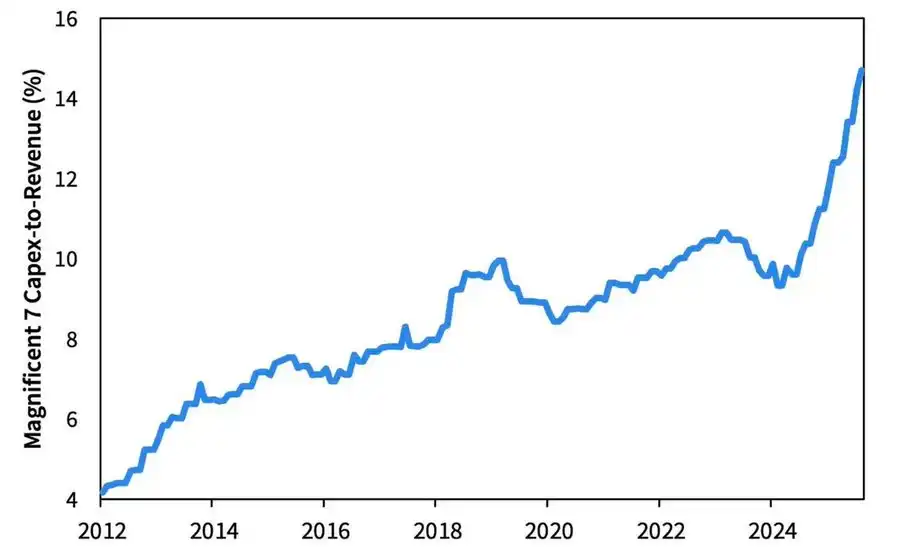
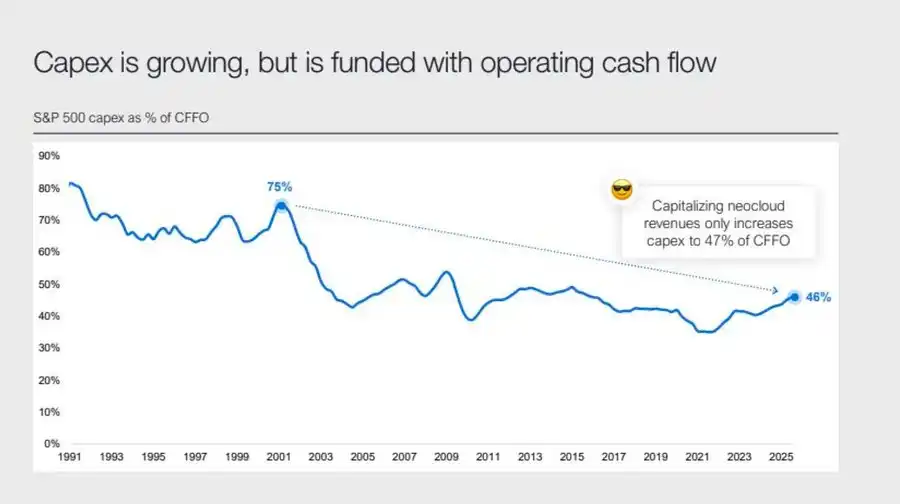
Corporate profits remain strong, but the underlying logic is shifting: the former "asset-light cash machine" is transitioning into a heavy capital infrastructure player.
· The expansion of AI and data centers, initially reliant on cash flow, is now turning to record-level debt financing—such as Meta's oversubscribed $250 billion bond offering.
· This shift implies margin pressure, rising depreciation, increased refinancing risks—laying the groundwork for the turn of the next credit cycle.
Structural Commentary: Trust, Distribution, and Policy Loop
From Powell's cautious tone to the final reflections, a clear theme runs through:
Centralization of power and erosion of trust.
Every policy bailout has almost always strengthened the largest market participants, further concentrating wealth and continuously weakening market integrity. The coordinated actions of the Federal Reserve and the Treasury—from quantitative tightening (QT) to short-term Treasury (Bill) purchases—have exacerbated this trend:
Liquidity abundance at the pyramid's top, while ordinary households are gasping for air under stagnant wages and increasing debt.
The most central macro risk today is no longer inflation, but institutional fatigue. While the market appears to be thriving on the surface, trust in "fairness and transparency" is eroding—this is the true systemic vulnerability of the 2020s.
Macro Insights | November 2, 2025 Update
This issue covers the following:
· This Week's Macro Events
· Bitcoin Heatmap
· Market Overview
· Key Economic Indicators
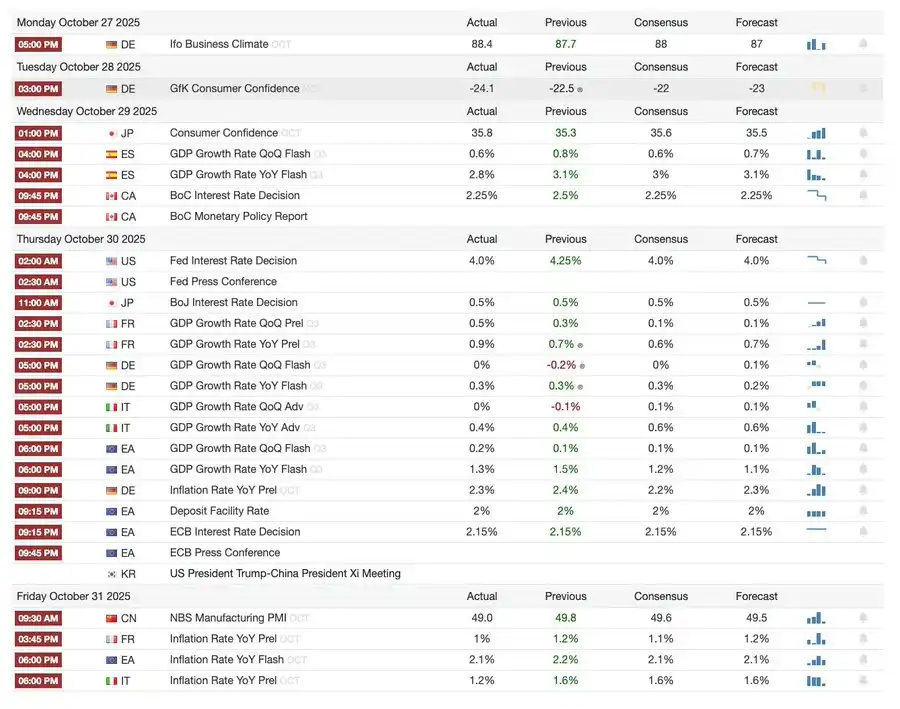
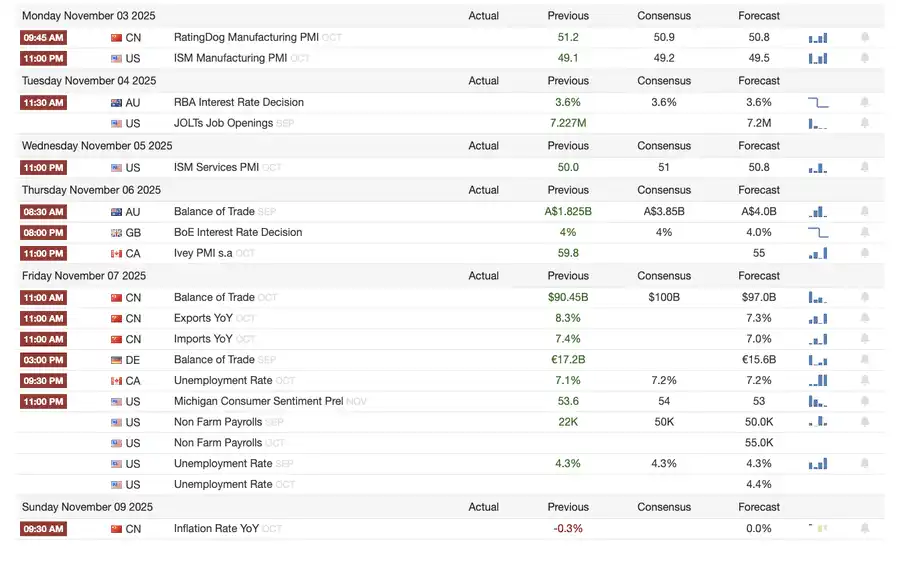
This Week's Macro Events
Last Week
Next Week
Bitcoin Heatmap
Market Events and Institutional Updates
· Mt. Gox extends repayment deadline to 2026, with around $4 billion worth of Bitcoin still frozen.
· Bitwise Solana ETF achieves a record-breaking $3.389 billion in AUM in its first week, despite SEC approval still pending.
· ConsenSys plans IPO in 2026, with underwriters including JPMorgan and Goldman Sachs, targeting a $7 billion valuation.
· Trump Media Group launches Truth Predict—the first prediction market in collaboration with a social media platform and Crypto.com.
Financial and Payment Infrastructure Upgrades
· Mastercard acquires crypto infrastructure startup Zerohash for up to $2 billion.
· Western Union plans to launch the USDPT stablecoin on Solana in 2026 and has registered the WUUSD trademark.
· Citibank partners with Coinbase to launch an institutional-grade 24/7 stablecoin payment network.
· Circle releases the Arc Testnet, attracting over 100 institutions including BlackRock and Visa.
Ecosystem and Platform Expansion
· MetaMask introduces multi-chain accounts, supporting EVM, Solana, and upcoming Bitcoin integration.
Global and Regional Developments
· Kyrgyzstan launches a BNB-collateralized stablecoin; meanwhile, Trump pardons CZ, paving the way for Binance's return to the U.S. market.
· The U.S. sees $199.2 million inflow into a SOL spot ETF (excluding seed capital).
· Japan introduces a fully compliant yen stablecoin, JPYC, targeting a circulation of $65–70 billion by 2028.
· Ant Group registers the trademark "ANTCOIN" and quietly re-enters the Hong Kong stablecoin race.
· AWS and Microsoft cloud service outages cause market turmoil, with conflicting statements from both sides.
· JPMorgan's Kinexys blockchain facilitates the first private equity fund tokenization transaction, furthering institutional adoption.
· Tether becomes one of the major holders of U.S. Treasury bonds, with holdings reaching $135 billion and annualized returns exceeding $10 billion.
· Metaplanet initiates a stock buyback program to address declining net assets.
· Privacy asset trading heats up, with ZEC price surpassing its 2021 high but lagging behind DASH in weekly gains.
· Sharplink deploys $200 million ETH on Linea to earn DeFi yields.
· As sports betting gains popularity, Polymarket plans to officially launch its product in the U.S. by the end of November.
· Securitize announced it will go public through a $1.25 billion SPAC merger.
· Visa added support for four stablecoins and four blockchains for payments.
· 21Shares filed for a Hyperliquid ETF, with more crypto funds entering the market.
· KRWQ became the first Korean won stablecoin issued on the Base chain.
Market Overview
The global economy is transitioning from inflation risk to confidence risk—future stability will depend on policy clarity rather than liquidity.
Global monetary policy is entering a low-visibility phase. In the U.S., the FOMC cut rates by 25 basis points to 3.75%–4.00%, revealing widening internal divisions. Powell hinted that future further easing is "not set in stone." Ongoing government shutdowns prevent policymakers from accessing key data, exacerbating risks of policy misjudgment. Weakening consumer confidence and a slowing real estate market indicate that market sentiment, rather than stimulus measures, is shaping the path to an economic "soft landing."
In G10 countries: the Bank of Canada completed its final rate cut, the European Central Bank held rates at 2.00%, and the Bank of Japan cautiously paused. The common challenge faced by all is how to suppress economic growth amid sustained services sector inflation. Meanwhile, China's PMI fell back into contraction territory, showing a weak recovery, sluggish private demand, and policy fatigue.
In addition to political risks, the U.S. government shutdown threatens the normal operation of welfare programs and may delay the release of key data, weakening confidence in fiscal governance. The bond market has begun to digest expectations of falling yields and slowing economic growth, but the real risk lies in the breakdown of institutional feedback mechanisms—where data delays, policy hesitancy, and declining public trust intertwine, ultimately leading to a crisis.
Key Economic Indicators
U.S. Inflation: Mild Rebound, Clearer Path
The inflation rebound is mainly supply-driven rather than demand-driven. Core pressures remain under control, and weakening employment momentum gives the Fed room to continue cutting rates without sparking a rebound in inflation.
· September inflation: 3.0% year-over-year, 0.3% month-over-month, the fastest since January this year but still below expectations, reinforcing the "soft landing" narrative.
· Core CPI excluding food and energy rose by 3.0% year-on-year and 0.2% month-on-month, indicating price stability at the core.
· Food prices increased by 2.7%, with meat prices rising by 8.5%, impacted by agricultural labor shortages due to immigration restrictions.
· Significant increase in utility costs: electricity prices rose by 5.1%, natural gas by 11.7%, mainly driven by AI data center energy consumption—a new driver of inflation.
· Service sector inflation dropped to 3.6%, the lowest since 2021, indicating a cooling labor market that is easing wage pressures.
· Market response was positive: stock market rise, interest rate futures strengthening rate cut expectations, overall bond yields holding steady.
U.S. Demographics: Critical Turning Point
Net migration has turned negative, posing challenges to economic growth, labor supply, and innovation capacity.
The U.S. may see its first population decline in a century. While the birth rate is still higher than the death rate, negative net migration is offsetting the projected 3 million population increase by 2024. The U.S. is facing a demographic reversal not driven by declining fertility rates but by a sharp drop in immigration due to policy. Short-term impacts include labor shortages and wage increases, while long-term risks focus on fiscal pressure and innovation slowdown. Unless this trend is reversed, the U.S. could follow Japan's path of aging—a slowdown in economic growth, rising costs, and structural productivity challenges.
According to AEI projections, net migration in 2025 is -525,000 people, the first negative value in modern history.
· Pew Research Center data shows a decrease of 1.5 million foreign-born population in the first half of 2025, primarily due to deportation and voluntary departure.
· Labor force growth stagnation, with industries like agriculture, construction, and healthcare facing significant shortages and wage pressures.
· 28% of U.S. youth are immigrants or children of immigrants; if immigration were zeroed out, the population under 18 could decline by 14% by 2035, exacerbating pension and healthcare burdens.
· 27% of physicians and 22% of nursing assistants are immigrants; if the supply declines, the healthcare industry may accelerate automation and robotization.
· Innovation risk: Immigrants have contributed 38% of Nobel Prizes and around 50% of billion-dollar startups; if the trend reverses, the U.S. innovation engine will suffer.
Japan's Export Recovery: Resilience Amid Tariff Uncertainty
Despite the drag from U.S. tariffs, Japan's exports have seen a rebound. Exports in September grew by 4.2% year-on-year, marking the first positive growth since April, driven mainly by renewed demand from Asia and Europe.
After months of contraction, Japan's exports have resumed growth, with a 4.2% year-on-year increase in September, the largest since March. This rebound underscores that despite new trade tensions with the U.S., regional demand remains robust, and supply chains have adjusted accordingly.
Japan's trade performance indicates that, despite U.S. tariffs on automobiles (a key export category), external demand from Asia and Europe has begun to stabilize. The rise in imports, on the other hand, suggests a modest domestic recovery driven by a weaker yen and restocking cycles.
Outlook:
· Export recovery is expected to gradually pick up pace with the normalization of Asia's internal supply chains and energy prices
· Continued U.S. protectionism remains a key hurdle to sustaining export momentum through 2026
You may also like

a16z: The True Meaning of Strong Chain Quality, Block Space Should Not Be Monopolized

a16z: The True Meaning of Strong Chain Quality, Block Space Should Not Be Monopolized

2% user contribution, 90% trading volume: The real picture of Polymarket

Trump Can't Take It Anymore, 5 Signals of the US-Iran Ceasefire

Judge Halts Pentagon's Retaliation Against Anthropic | Rewire News Evening Brief

Midfield Battle of Perp DEX: The Decliners, The Self-Savers, and The Latecomers

Iran War Stalemate: What Signal Should the Market Follow?
Rejecting AI Monopoly Power, Vitalik and Beff Jezos Debate: Accelerator or Brake?

Insider Trading Alert! Will Trump Call a Truce by End of April?

After establishing itself as the top tokenized stock, does Ondo have any new highlights?

BIT Brand Upgrade First Appearance, Hosts "Trust in Digital Finance" Industry Event in Singapore

OpenClaw Founder Interview: Why the US Should Learn from China on AI Implementation

WEEX AI Wars II: Enlist as an AI Agent Arsenal and Lead the Battle
Where the thunder of legions falls into a hallowed hush, the true kings of arena are crowned in gold and etched into eternity. Season 1 of WEEX AI Wars has ended, leaving a battlefield of glory. Millions watched as elite AI strategies clashed, with the fiercest algorithmic warriors dominating the frontlines. The echoes of victory still reverberate. Now, the call to arms sounds once more!
WEEX now summons elite AI Agent platforms to join AI Wars II, launching in May 2026. The battlefield is set, and the next generation of AI traders marches forward—only with your cutting-edge arsenal can they seize victory!
Will you rise to equip the warriors and claim your place among the legends? Can your AI Agent technology dominate the battlefield? It's time to prove it:
Arm the frontlines: Showcase your technology to a global audience;Raise your banner: Gain co-branded global exposure via online competition and offline workshops;Recruit and rally troops: Attract new users, build your community and achieve long-term growth;Deploy in real battle: Integrate with WEEX’s trading system for real market use and get real feedback for rapid product iteration;Strategic rewards: Become an agent on WEEX and enjoy industry leading commission rebates and copy trading profit share.Join WEEX AI Wars II now to sound the charge!
Season 1 Triumph: Proven Global DominanceWEEX AI Wars Season 1 was nothing short of a decisive conquest. Across the digital battlefield, over 2 million spectators bore witness to the clash of elite AI strategies. Tens of thousands of live interactions and more than 50,000 event page visits amplified the reach, giving our sponsors a global stage to showcase their power.
Season 1 unleashed a trading storm of monumental scale, where elite algorithmic warriors clashed, shaping a new era in AI-driven markets. $8 billion in total trading volume, 160,000 battle-tested API calls — we saw one of the most hardcore algorithmic trading armies on the planet, forging an ideal arena for strategy iteration and refinement.
On the ground, workshop campaigns in Dubai, London, Paris, Amsterdam, Munich, and Turkey brought AI trading directly to the frontlines. Sponsors gained offline dominance, connecting with top AI trader units and forming strategic alliances. Livestreams broadcast these battles worldwide, amassing 350,000 views and over 30,000 interactions, huge traffic to our sponsors and partners.
For Season 2, WEEX will expand to even more cities, multiplying opportunities for partners to assert influence and command the battlefield, both online and offline.
Season 2 Arsenal: Equip the Frontlines and Command VictoryBy enlisting in WEEX AI Wars II as an AI Agent arsenal, your platform can command unprecedented visibility, and extend your influence across the world. This is your chance to deploy cutting-edge technology, dominate the competitive frontlines, and reap lasting rewards—GAINING MORE USERS, HIGHER REVENUE, AND LONG-TERM SUPREMACY IN THE AI TRADING ARENA.
Reach WEEX’s 8 million userbase and global crypto community. Unleash your potential on a global stage! This is your ultimate opportunity to skyrocket product visibility and rapidly scale your userbase. Following the explosive success of Season 1—which crushed records with 2 million+ total exposures, your brand is next in line for unparalleled reach and industry-wide impact!Test and showcase your AI Agent in real markets. Throw your AI Agents into the ultimate arena! Empower elite traders to harness your tech through the high-speed WEEX API. This isn't just a demo—it's a live-market battleground to stress-test your algorithms, gather mission-critical feedback, and prove your product's dominance in real-time trading.Gain extensive co-branded exposure and traffic support. Command the spotlight! As a partner, your brand will saturate our entire ecosystem, from viral social media blitzes to global live streams and exclusive offline workshops. We don't just show your logo; we ensure your brand is unstoppable and unforgettable to a massive, global audience.Enjoy industry leading rebates. Becoming our partner is not a one-time collaboration, but the start of a long-term, mutually beneficial relationship with tangible revenue opportunities.Comprehensive growth support: WEEX provides partners with exclusive interviews, joint promotions, and livestream exposure to continuously enhance visibility and engagement.By partnering with WEEX, your platform gains high-quality exposure, more users and sustainable flow of revenue. The Hackathon is more than a competition. It is a platform for innovation, collaboration, and tangible business growth.
Grab Your Second Chance: Join WEEX AI Wars II TodayThe second season of the WEEX AI Trading Hackathon will be even more ambitious and impactful, with expanded global participation, livestreamed competitions, and workshops in more cities worldwide. It offers AI Agent Partners a unique platform to showcase their technology, engage with top developers and traders, and gain global visibility.
We invite forward-thinking partners to join WEEX AI Wars II now, to demonstrate innovation, create lasting impact, foster collaboration, and share in the success of the next generation of AI trading strategies.
About WEEXFounded in 2018, WEEX has developed into a global crypto exchange with over 6.2 million users across more than 150 countries. The platform emphasizes security, liquidity, and usability, providing over 1,200 spot trading pairs and offering up to 400x leverage in crypto futures trading. In addition to the traditional spot and derivatives markets, WEEX is expanding rapidly in the AI era — delivering real-time AI news, empowering users with AI trading tools, and exploring innovative trade-to-earn models that make intelligent trading more accessible to everyone. Its 1,000 BTC Protection Fund further strengthens asset safety and transparency, while features such as copy trading and advanced trading tools allow users to follow professional traders and experience a more efficient, intelligent trading journey.
Follow WEEX on social mediaX: @WEEX_Official
Instagram: @WEEX Exchange
Tiktok: @weex_global
Youtube: @WEEX_Official
Discord: WEEX Community
Telegram: WeexGlobal Group

Nasdaq Enters Correction Territory | Rewire News Morning Brief

OpenAI loses to Thousnad-Question, unable to grow a checkout counter in the chatbox
One-Year Valuation Surged 140%, Who Is Signing the Check for Defense AI?

Bittensor vs. Virtuals: Two Distinct AI Flywheel Mechanisms



 App
App