
 Buy Crypto
- Markets
 Futures
- Spot
- Copy Trade
- Earn
- More
Key Market Insights for November 5th, how much did you miss out on?

Featured News
1. GIGGLE Continues Surge with a Short-Term Breakthrough to $143, 24-hour Gain Expands to 178%
2. MMT Surges Briefly Touching $1.5
3. Bitcoin Rebounds Breakthrough $102,000, 24-hour Loss Narrows to 4.7%
4. U.S. Government Enters 36th Day of "Shutdown," Setting a New Record for the Longest Ever
Trending Topics
Source: Overheard on CT (tg: @overheardonct), Kaito
Here is the translation of the original content:
[PEPE]
Today, discussions around PEPE mainly focused on significant market activities and notable purchases. A new Chinese whale has been actively acquiring Plush Pepe NFTs, spending millions of dollars to support the floor, while another noteworthy purchase was Plush Pepe #1442, transacted at a price of 9718 TON. Additionally, a clever whale who previously profited from PEPE made a substantial investment in ASTER. Despite the overall bearish sentiment in the crypto market, PEPE remains a hot topic due to these high-profile transactions.
[STREAM]
STREAM Finance took center stage today due to a major loss caused by an external fund manager, resulting in $93 million losses, leading to deposit and withdrawal freezes and a drop in the value of its stablecoin xUSD. This event has raised concerns about the wider DeFi ecosystem's exposure to STREAM's financial troubles, with other protocols (such as Morpho, Euler, and Silo) potentially at risk of contagion. This situation sparked debates on the importance of risk management practices and operational transparency in DeFi.
[MORPHO]
Today, the discussion around MORPHO mainly focused on the aftermath of the Stream Finance crash, leading to a strict scrutiny of the Curator model used by Morpho. This event highlighted the risks associated with high-yield vaults and the importance of risk management in DeFi. Despite the negative sentiment, some tweets defended Morpho's isolated market model, emphasizing that it prevented a wider spread. The discussion also involved the need for Curators to have better transparency and accountability, as well as the potential for DeFi to responsibly scale.
[LINK]
Today, Chainlink (LINK) garnered attention due to several significant announcements and developments. The launch of Chainlink's Chainlink Runtime Environment (CRE) and Chainlink Confidential Computing was highlighted as a key innovation enabling private smart contracts and enhancing on-chain finance. UBS successfully executed the first on-chain tokenized fund redemption using Chainlink's Digital Transfer Agent, marking a milestone in blockchain infrastructure. Additionally, Tradeweb partnered with Chainlink to on-chain publish U.S. Treasury data through DataLink, further advancing institutional tokenization efforts. Despite these positive developments, there are concerns about a Chainlink oracle failure leading to a $1 million vulnerability in the Moonwell protocol.
[MOMENTUM]
Momentum (MMT) received significant attention today as it was listed on several major exchanges, including Binance, Bybit, and OKX. The token's launch was marked by various trading opportunities, airdrop distributions, and investor protection features. The community is excited about the project's potential, with discussions highlighting its innovative DeFi mechanisms such as the ve(3,3) model and strategic partnerships. The token's performance, trading incentives, and future growth prospects are key topics driving the discussion around MMT.
Featured Articles
1. "Wall Street Continues to Sell Off, How Much Further Will Bitcoin Drop?"
In the first week of November, the sentiment in the crypto market was very bearish. Bitcoin has plummeted to a new low below the "10.11" crash, failing to hold the $100,000 mark and even dropping below $99,000, hitting a six-month low, while Ethereum fell to a low of $3,000. The total 24-hour liquidation amount exceeded $2 billion, with long positions losing $1.63 billion and short positions being liquidated for $400 million.
2.《Why Does the Bitcoin Price Surge When the US Government Shuts Down?》
The US government shutdown has officially entered its record-breaking 36th day. In the past two days, the global financial markets have tumbled. The Nasdaq, Bitcoin, tech stocks, Nikkei Index, and even safe-haven assets such as US Treasuries and gold have not been spared. As market panic spreads, Washington politicians continue to bicker over the budget. Is there a connection between the US government shutdown and the global financial market downturn? The answer is emerging.
On-chain Data
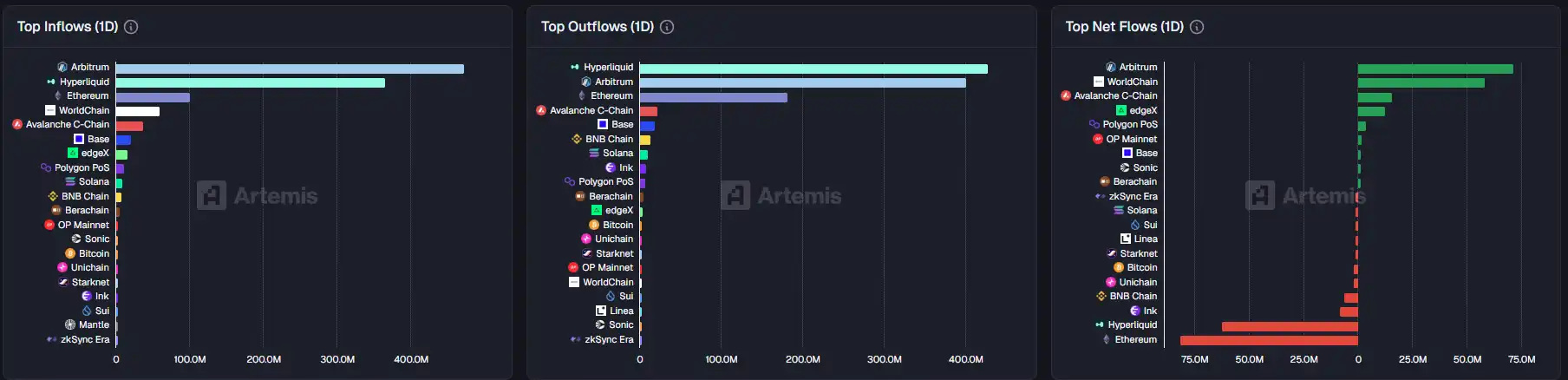
On-chain Fund Flow Data for the Week of November 5
You may also like

PUMP Valuation Breakdown: On-chain Data Disproves the "Fake Volume" Theory, Where Does the Real Discount Come From?

Tiger Research: What AI services do cryptocurrency companies offer?

The war not only drives up oil prices but also causes Circle's stock price to soar

When agents become consumers, who will rewrite the underlying logic of internet commerce?

AI Agents in Action Summit: March 31, Hong Kong Cyberport, focusing on the deep waters of AI implementation

29 Days In, What Are America’s Options on Iran?

Flash Crash Down 97%+ with Ongoing Unlocking, WLD Completes $65 Million Off-chain Funding: Who Is Still Buying?

Bitcoin for Real Estate? Fannie Mae Teams Up with Coinbase to Launch Crypto Mortgage
Tether Hires Big Four Auditor, USDT Enters First Attestation Phase

Google AI Paper Destroys $900B Storage Stock, Accused of Faking Experiment
Evaporate $2 Trillion, U.S. Stocks See Worst Start in 4 Years, Why is the Market Bearish?

The speed at which AI discovers vulnerabilities has surpassed the speed at which it patches vulnerabilities.
AI Crypto Trading Bot Explained: Aurora's Multi-Factor Strategy in WEEX Hackathon
Aurora demonstrates how structured, multi-agent AI Trading systems can deliver more adaptive and resilient performance in the WEEX AI Trading Hackathon.

Cyber Taoist Fortune Teller: Fake Taoist, AI Fortune Telling, and Northeastern Metaphysics History

Bloomberg: Stablecoin Payments Emerge as Crypto VC's Newest Favorite Thing
BeatSwap is evolving towards a full-stack Web3 infrastructure, covering the entire lifecycle of IP rights.
BeatSwap, a global Web3 Intellectual Property (IP) infrastructure project, is attempting to overcome the current fragmentation limitations of the Web3 ecosystem, building a full-stack system that covers the entire lifecycle of IP rights.
Currently, most Web3 projects are still in the stage of functional fragmentation, often focusing only on a single aspect, such as IP asset tokenization, transaction functionality, or a simple incentive model. This structural dispersion has become a key bottleneck hindering the industry's scale application.
BeatSwap's approach is more integrated, integrating multiple core modules into the same system, including:
· IP authentication and on-chain registration
· Authorization-based revenue sharing mechanism
· User-engagement-driven incentive system
· Transaction and liquidity infrastructure
Through the above integration, the platform builds an end-to-end closed-loop path, allowing IP rights to complete a full cycle of "creation, use, and monetization" within the same ecosystem.
BeatSwap is not limited to existing crypto users but is attempting to take the global music industry as a starting point, actively creating new market demand. Its core strategies include:
Exploring and incubating music creators (Artist discovery)
Building a fan community
Igniting IP-centric content consumption demand
The current global music industry is valued at around $260 billion, with over 2 billion digital music users. This means that the potential market corresponding to the tokenization and financialization of IP far exceeds the traditional crypto user base.
In this context, BeatSwap positions itself at the intersection of "real-world content demand" and "on-chain infrastructure," attempting to bridge the structural gap between content production and financial flow.
BeatSwap's upcoming core product "Space" is scheduled to launch in the second quarter of 2026. This product is defined as the SocialFi layer in the ecosystem, aiming to directly connect creators with users and achieve deep integration with other platform modules.
Key designs include:
A fan-centric interactive mechanism
Exposure and distribution logic based on $BTX staking
User paths connected to DeFi and liquidity structures
Thus, a complete user behavior loop is formed within the platform: Discovery → Participation → Consumption → Rewards → Trading
$BTX is designed to be a core utility asset within the ecosystem, rather than just a simple incentive token, with its value directly tied to platform activity and IP use cases.
Main features include:
· Yield distribution based on on-chain authorized actions
· Value reflection based on IP usage and user engagement dynamics
· Support for staking and DeFi participation mechanisms
· Value growth driven by ecosystem expansion
With the increased frequency of IP use, the utility and value support of $BTX will enhance simultaneously, helping alleviate the "disconnect between value and utility" issue present in traditional Web3 token models to some extent.
Currently, $BTX has been listed on several mainstream exchanges, including:
Binance Alpha
Gate
MEXC
OKX Boost
As the launch of "Space" approaches, BeatSwap is actively pursuing more exchange listings to further enhance liquidity and global accessibility, laying a foundation for future market expansion.
BeatSwap's goal is no longer limited to the traditional Web3 narrative but aims to target over 2 billion digital music users and a trillion KRW-scale content market.
By integrating content creators, users, capital, and liquidity into a blockchain framework centered around IP rights, BeatSwap is striving to build a next-generation infrastructure focused on "IP tokenization."
BeatSwap integrates IP authentication, authorization distribution, incentive mechanism, transaction system, and market construction to establish a unified structure that bridges the full lifecycle path of IP rights.
With the launch of the Q2 2026 "Space," the project is expected to become a key infrastructure connecting content and finance in the IP-RWA (Real World Assets) track.

Mag 7 Evaporates $2 Trillion | Rewire News Morning Edition



 App
App