
 Buy Crypto
- Markets
 Futures
- Spot
- Copy Trade
- Earn
- More
In the DeFi Buyback Wave: Uniswap, Lido Caught in "Centralization" Controversy

Original Article Title: Uniswap, Lido, Aave?! How DeFi Is Quietly Becoming More Centralized
Original Article Author: Oluwapelumi Adejumo
Original Article Translation: Saoirse, Foresight News
On November 10, when Uniswap's management submitted the "UNIfication" proposal, the document read more like a corporate restructuring than a protocol update.
The proposal plans to activate previously unused protocol fees, route funds through a new on-chain treasury engine, and utilize the proceeds to buy and burn UNI tokens. This model is reminiscent of a stock buyback plan in the traditional finance realm.
A day later, Lido also introduced a similar mechanism. Its decentralized autonomous organization (DAO) proposed to establish an automatic buyback system: when the Ethereum price exceeds $3,000 and the annualized revenue surpasses $40 million, the excess staking rewards will be used to repurchase its governance token LDO.
This mechanism deliberately adopts a "countercyclical" strategy—stronger in bull markets and more conservative in tightening market conditions.
These initiatives collectively signal a major transformation in the DeFi space.
Over the past few years, the DeFi space has been dominated by "Meme tokens" and incentive-driven liquidity activities; now, leading DeFi protocols are repositioning around core market fundamentals such as "revenue, fee capture, capital efficiency."
However, this shift has also forced the industry to face a series of thorny issues: ownership control, ensuring sustainability, and whether "decentralization" is gradually giving way to corporate logic.
The New Financial Logic of DeFi
For much of 2024, DeFi's growth relied mainly on cultural fervor, incentive programs, and liquidity mining. Recent actions such as "reinstating fees" and "implementing a buyback framework" indicate that the industry is attempting to more directly tie token value to business performance.
Take Uniswap, for example, its initiative to "burn up to 100 million UNI tokens" redefines UNI from a pure "governance asset" to an asset that is closer to a "protocol economic interest certificate"—even though it lacks the legal protection or cash flow distribution rights of equity.
The scale of such buyback plans is not to be underestimated. MegaETH Lab researcher BREAD estimates that, at the current fee level, Uniswap could generate approximately $38 million in buyback power per month.
This amount would exceed the buyback rate of Pump.fun but fall below the $95 million monthly buyback scale of Hyperliquid.
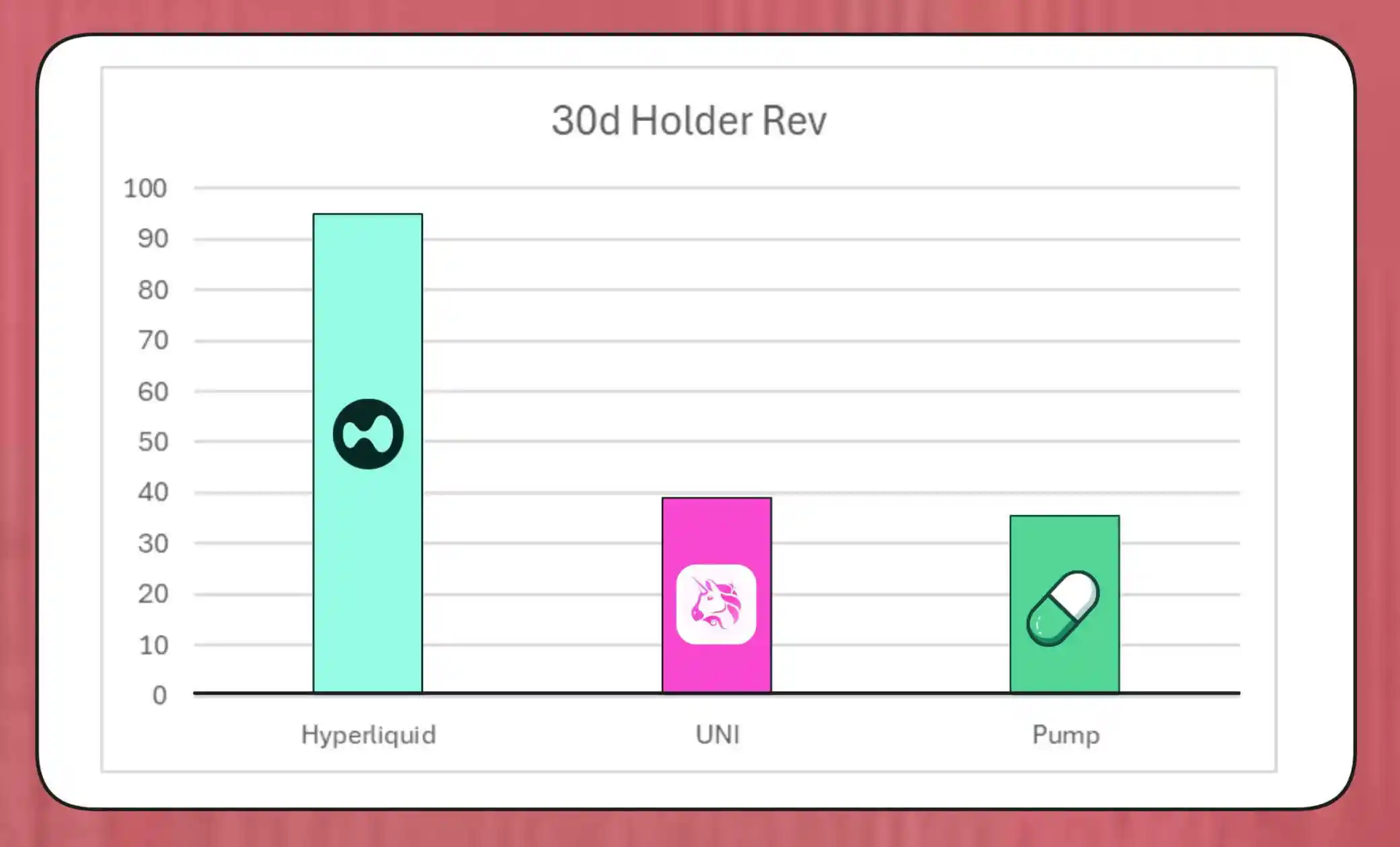
Comparison of Hyperliquid, Uniswap, and Pump.fun Token Buybacks (Source: Bread)
Lido's simulated mechanism structure indicates that it could support a buyback scale of about $10 million per year; the bought-back LDO tokens will be paired with wstETH to be injected into a liquidity pool to enhance trading depth.
Other protocols are also accelerating similar initiatives: Jupiter will allocate 50% of its operational revenue to JUP token buybacks; dYdX will allocate a quarter of the network fees to buybacks and validator incentives; Aave is also devising a specific plan to invest up to $50 million annually, driving buybacks through treasury funds.
According to Keyrock data, token holder dividends linked to revenue have grown over fivefold since 2024. In just the month of July 2025, the total expenditure or allocation on buybacks and incentives by various protocols amounts to approximately $800 million.
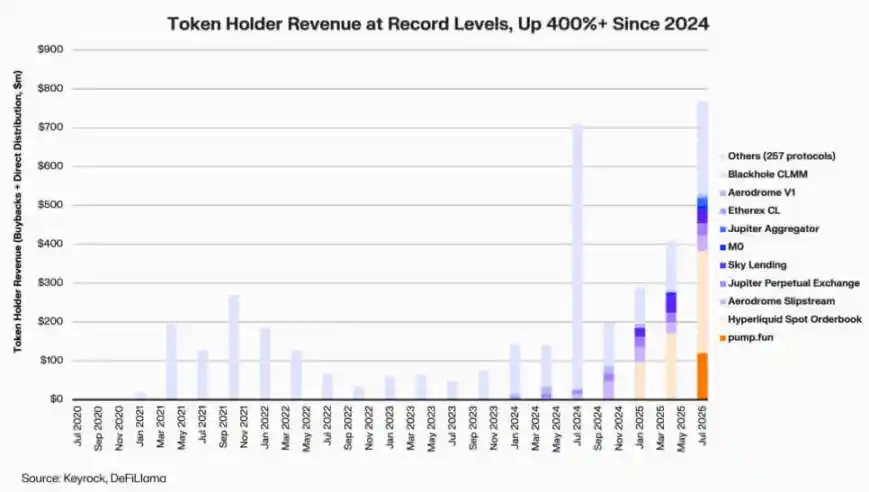
DeFi Protocol Holder Revenue (Source: Keyrock)
Thus, about 64% of the revenue from top protocols now flows back to token holders—a stark contrast to the previous cycle of "reinvestment first, distribution later."
Behind this trend is a new consensus forming in the industry: "scarcity" and "recurring income" are becoming the core of the DeFi value narrative.
Institutionalization of Tokenomics
The buyback wave reflects that the integration of DeFi with institutional finance is deepening.
DeFi protocols are beginning to adopt traditional financial metrics such as "P/E ratio," "yield threshold," and "net distribution rate" to convey value to investors—investors who are also evaluating DeFi projects in the same way they would evaluate a growth-stage enterprise.
This integration has provided fund managers with a common analytical language, but it has also brought new challenges: DeFi's original design did not include institutional requirements such as "discipline" and "transparency," which are now expected by the industry.
It is worth noting that Keyrock's analysis has indicated that many buyback plans heavily rely on existing treasury reserves rather than sustainable recurring cash flows.
This model may be able to temporarily support token prices, but its long-term sustainability is questionable—especially in a market environment where "fee income is cyclical and often linked to token price increases."
Additionally, Blockworks analyst Marc Ajoon believes that "self-initiated buybacks" usually have limited market impact and may result in unrealized losses for the protocol during token price declines.
In light of this, Ajoon advocates for establishing a "data-driven automatic adjustment system": allocate funds when valuations are low, shift towards reinvestment when growth metrics are weak, ensure that buybacks reflect actual operational performance, and not speculative pressure.
He stated: "As it stands now, buybacks are not a panacea... Due to the 'buyback narrative,' the industry blindly places it above other paths that may bring higher returns."
Arca's Chief Investment Officer Jeff Dorman holds a more comprehensive view.
He believes that corporate buybacks reduce the number of outstanding shares, but tokens exist within a unique network—their supply cannot be offset through traditional restructuring or M&A activities.
Therefore, burning tokens can drive protocols towards a "fully distributed system"; however, holding tokens can also reserve flexibility for the future—if demand or growth strategies require, issuance can be increased at any time. This duality makes DeFi's capital allocation decisions more impactful than those in the stock market.
New Risks Emerge
While the financial logic of buybacks is straightforward, its governance implications are complex and far-reaching.
Take Uniswap, for example, where the "UNIfication" proposal plans to transfer operational control from the community foundation to a private entity, Uniswap Labs. This centralization tendency has raised alarms among analysts who believe that this could replicate a "hierarchical structure that decentralized governance was supposed to avoid."
In response to this, DeFi researcher Ignas points out: "The original vision of cryptocurrency 'decentralization' is becoming increasingly challenging."
Ignas emphasizes that over the past few years, this "centralization tendency" has gradually emerged—the most typical example being that DeFi protocols often rely on "emergency shutdowns" or "core team accelerated decisions" when addressing security issues.
In his view, the core issue is this: even if "centralization" makes economic sense, it can still harm transparency and user engagement.
However, proponents argue that this concentration of power may be a "functional necessity" rather than an "ideological choice."
Eddy Lazzarin, Chief Technology Officer at the venture capital firm a16z, described Uniswap's "UNIfication" model as a "closed-loop model" — under this model, the revenue generated by decentralized infrastructure flows directly to token holders.
He further added that the DAO will still retain the power to "mint tokens for future development," thus striking a balance between flexibility and financial discipline.
The tension between "distributed governance" and "execution layer decisions" is not a new issue, but today its financial impact has greatly expanded.
Currently, the treasuries of top protocol managers hold hundreds of millions of dollars, and their strategic decisions can significantly impact the entire liquidity ecosystem. Therefore, as the DeFi economy matures, the focus of governance discussions is shifting from the "decentralization ideal" to the "actual impact on the balance sheet."
DeFi's Maturity Test
The token buyback trend indicates that decentralized finance is transitioning from a "free exploration phase" to a "structured, metrics-driven industry." What once defined this space as "free exploration" is gradually being replaced by "cash flow transparency," "performance accountability," and "investor interest alignment."
However, maturity also brings new risks:
· Governance may lean towards "centralized control";
· Regulators may view buybacks as "actual dividends," sparking compliance disputes;
· Teams may shift focus from "technical innovation" to "financial engineering," neglecting core business development.
The sustainability of this transformation depends on decisions at the execution level:
· The "programmatic buyback model" can embed transparency through on-chain automation, preserving decentralization;
· The "self-initiated buyback framework," although faster to implement, may undermine credibility and legal clarity;
· A "hybrid system" (linking buybacks to measurable, verifiable network metrics) could be a compromise, but there are currently few real-world cases proving its "resilience."
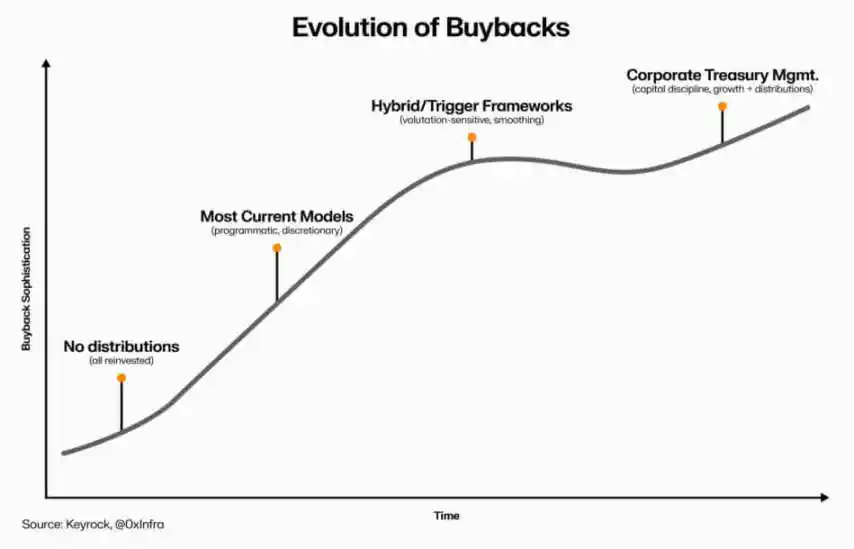
The Evolution of DeFi Token Buybacks (Source: Keyrock)
One thing is clear: the interaction between DeFi and traditional finance has surpassed mere "simple imitation." Today, the sector, while preserving its "open-source foundation," is integrating corporate management principles such as "treasury management," "capital allocation," and "balance sheet prudence."
Token buybacks are a concentrated manifestation of this integration—it combines market dynamics with economic logic, driving DeFi protocols to transform into "self-funded, income-driven organizations": accountable to the community, with "execution effectiveness" rather than "ideology" as the measuring standard.
You may also like

Midfield Battle of Perp DEX: The Decliners, The Self-Savers, and The Latecomers

Iran War Stalemate: What Signal Should the Market Follow?

Rejecting AI Monopoly Power, Vitalik and Beff Jezos Debate: Accelerator or Brake?

Insider Trading Alert! Will Trump Call a Truce by End of April?

After establishing itself as the top tokenized stock, does Ondo have any new highlights?

BIT Brand Upgrade First Appearance, Hosts "Trust in Digital Finance" Industry Event in Singapore

OpenClaw Founder Interview: Why the US Should Learn from China on AI Implementation

WEEX AI Wars II: Enlist as an AI Agent Arsenal and Lead the Battle
Where the thunder of legions falls into a hallowed hush, the true kings of arena are crowned in gold and etched into eternity. Season 1 of WEEX AI Wars has ended, leaving a battlefield of glory. Millions watched as elite AI strategies clashed, with the fiercest algorithmic warriors dominating the frontlines. The echoes of victory still reverberate. Now, the call to arms sounds once more!
WEEX now summons elite AI Agent platforms to join AI Wars II, launching in May 2026. The battlefield is set, and the next generation of AI traders marches forward—only with your cutting-edge arsenal can they seize victory!
Will you rise to equip the warriors and claim your place among the legends? Can your AI Agent technology dominate the battlefield? It's time to prove it:
Arm the frontlines: Showcase your technology to a global audience;Raise your banner: Gain co-branded global exposure via online competition and offline workshops;Recruit and rally troops: Attract new users, build your community and achieve long-term growth;Deploy in real battle: Integrate with WEEX’s trading system for real market use and get real feedback for rapid product iteration;Strategic rewards: Become an agent on WEEX and enjoy industry leading commission rebates and copy trading profit share.Join WEEX AI Wars II now to sound the charge!
Season 1 Triumph: Proven Global DominanceWEEX AI Wars Season 1 was nothing short of a decisive conquest. Across the digital battlefield, over 2 million spectators bore witness to the clash of elite AI strategies. Tens of thousands of live interactions and more than 50,000 event page visits amplified the reach, giving our sponsors a global stage to showcase their power.
Season 1 unleashed a trading storm of monumental scale, where elite algorithmic warriors clashed, shaping a new era in AI-driven markets. $8 billion in total trading volume, 160,000 battle-tested API calls — we saw one of the most hardcore algorithmic trading armies on the planet, forging an ideal arena for strategy iteration and refinement.
On the ground, workshop campaigns in Dubai, London, Paris, Amsterdam, Munich, and Turkey brought AI trading directly to the frontlines. Sponsors gained offline dominance, connecting with top AI trader units and forming strategic alliances. Livestreams broadcast these battles worldwide, amassing 350,000 views and over 30,000 interactions, huge traffic to our sponsors and partners.
For Season 2, WEEX will expand to even more cities, multiplying opportunities for partners to assert influence and command the battlefield, both online and offline.
Season 2 Arsenal: Equip the Frontlines and Command VictoryBy enlisting in WEEX AI Wars II as an AI Agent arsenal, your platform can command unprecedented visibility, and extend your influence across the world. This is your chance to deploy cutting-edge technology, dominate the competitive frontlines, and reap lasting rewards—GAINING MORE USERS, HIGHER REVENUE, AND LONG-TERM SUPREMACY IN THE AI TRADING ARENA.
Reach WEEX’s 8 million userbase and global crypto community. Unleash your potential on a global stage! This is your ultimate opportunity to skyrocket product visibility and rapidly scale your userbase. Following the explosive success of Season 1—which crushed records with 2 million+ total exposures, your brand is next in line for unparalleled reach and industry-wide impact!Test and showcase your AI Agent in real markets. Throw your AI Agents into the ultimate arena! Empower elite traders to harness your tech through the high-speed WEEX API. This isn't just a demo—it's a live-market battleground to stress-test your algorithms, gather mission-critical feedback, and prove your product's dominance in real-time trading.Gain extensive co-branded exposure and traffic support. Command the spotlight! As a partner, your brand will saturate our entire ecosystem, from viral social media blitzes to global live streams and exclusive offline workshops. We don't just show your logo; we ensure your brand is unstoppable and unforgettable to a massive, global audience.Enjoy industry leading rebates. Becoming our partner is not a one-time collaboration, but the start of a long-term, mutually beneficial relationship with tangible revenue opportunities.Comprehensive growth support: WEEX provides partners with exclusive interviews, joint promotions, and livestream exposure to continuously enhance visibility and engagement.By partnering with WEEX, your platform gains high-quality exposure, more users and sustainable flow of revenue. The Hackathon is more than a competition. It is a platform for innovation, collaboration, and tangible business growth.
Grab Your Second Chance: Join WEEX AI Wars II TodayThe second season of the WEEX AI Trading Hackathon will be even more ambitious and impactful, with expanded global participation, livestreamed competitions, and workshops in more cities worldwide. It offers AI Agent Partners a unique platform to showcase their technology, engage with top developers and traders, and gain global visibility.
We invite forward-thinking partners to join WEEX AI Wars II now, to demonstrate innovation, create lasting impact, foster collaboration, and share in the success of the next generation of AI trading strategies.
About WEEXFounded in 2018, WEEX has developed into a global crypto exchange with over 6.2 million users across more than 150 countries. The platform emphasizes security, liquidity, and usability, providing over 1,200 spot trading pairs and offering up to 400x leverage in crypto futures trading. In addition to the traditional spot and derivatives markets, WEEX is expanding rapidly in the AI era — delivering real-time AI news, empowering users with AI trading tools, and exploring innovative trade-to-earn models that make intelligent trading more accessible to everyone. Its 1,000 BTC Protection Fund further strengthens asset safety and transparency, while features such as copy trading and advanced trading tools allow users to follow professional traders and experience a more efficient, intelligent trading journey.
Follow WEEX on social mediaX: @WEEX_Official
Instagram: @WEEX Exchange
Tiktok: @weex_global
Youtube: @WEEX_Official
Discord: WEEX Community
Telegram: WeexGlobal Group

Nasdaq Enters Correction Territory | Rewire News Morning Brief

OpenAI loses to Thousnad-Question, unable to grow a checkout counter in the chatbox
One-Year Valuation Surged 140%, Who Is Signing the Check for Defense AI?

Bittensor vs. Virtuals: Two Distinct AI Flywheel Mechanisms

Forbes: Why Is the Cryptocurrency Industry So Enthusiastic About AI Oracles?

Ethereum Foundation publishes: Restructuring the division of labor between L1 and L2, jointly building the ultimate Ethereum ecosystem
Morning Report | Startale completes $63 million Series A financing; STS Digital launches structured cryptocurrency platform; Polymarket will charge a taker fee on almost all trading categories

The most important thing in Web3 primary market investment

The strategic focus of cryptocurrency in reconstructing the international monetary system and the Chinese solution



 App
App