
 Buy Crypto
- Markets
 Futures
- Spot
- Copy Trade
- Earn
- More
How is MegaETH's public sale allocation distributed?

Source: MegaETH
Handling a 28x oversubscribed sale with over 53,000 participants is not as easy as it sounds. In my previous article, I mentioned that our sale focused primarily on two groups:
· Those who were early active members of the MegaETH community
· Those whom we believe will be long-term supporters of MegaETH
A few days before the sale ended, @artemis_onchain (our data lead) and I met in Istanbul to start extensive simulations. We tried many different methods to "perfectly" measure each person's contribution, but quickly realized that in such a short period, this was not feasible as "contribution" is a multidimensional concept.
So we decided to break down the issue into two parts:
· Fairly distributing to existing community members
· Establishing a data-driven scoring and allocation system for long-term investors
The following part of this article will detail how we achieved these two goals and the outcomes we eventually reached.
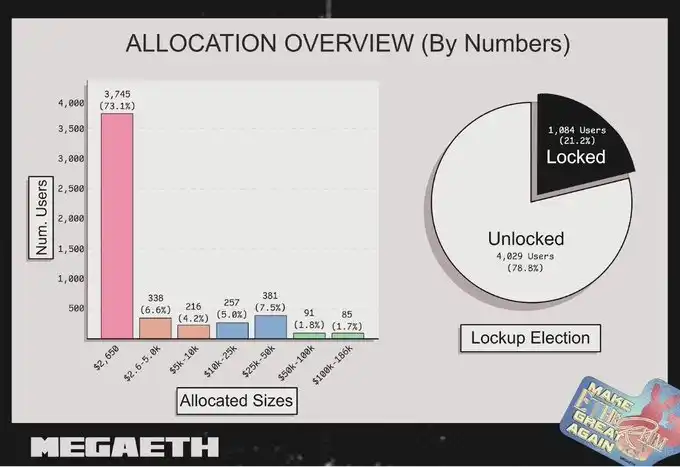
Allocation to Existing Community Members
For the first allocation pool — our existing community, we took the most traditional approach: manual allocation.
Relying on our existing community infrastructure, including @Heisenbruh and our mod network, we compiled a list covering members who have continuously been deeply involved since MegaETH emerged from stealth mode.
This list includes those:
· Who early joined and remained active
· Who helped shape the project's culture and values
· Who supported us during bear markets and quiet periods
· Who provided feedback, signals, and energy before there was a token for speculation
It should be noted that most of these individuals did not opt for vesting. We believe this is perfectly fine. Their contribution has already been rewarded through time, attention, and trust. In our view, they have already "put in the work".
In the spirit of transparency, we hereby disclose the list of sales participants that we believe represent the core community from the past few years.
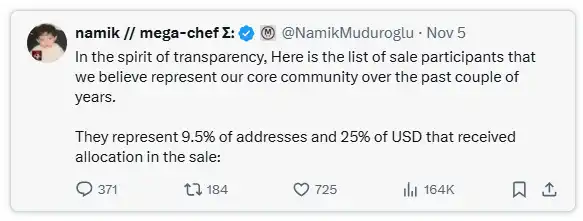
We acknowledge that this list is not perfect, and some people are definitely missing. If you are one of them, I am truly sorry.
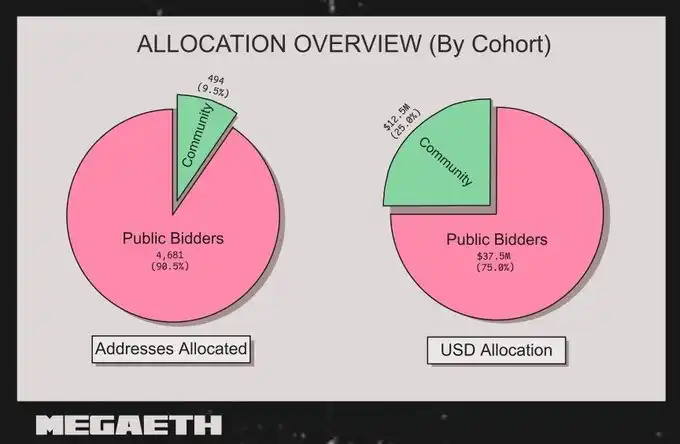
Apart from these community members and selected application developers with a one-year lockup, the rest were not personally selected by the team.
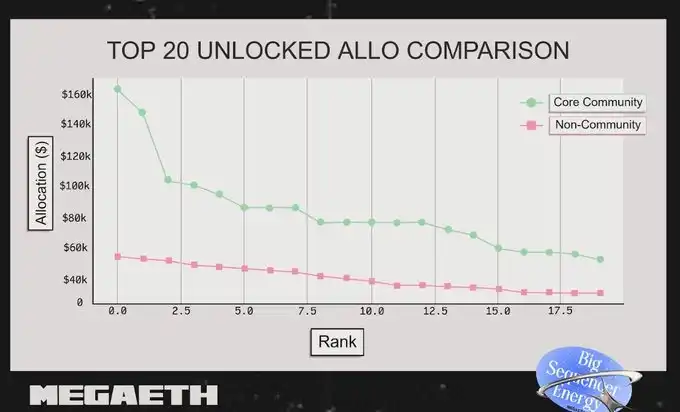
Even among this group selected by the team, not everyone received a full allocation, and the disparity is quite significant.
Due to the scale of the sale and market demand constraints, we had to make some trade-offs. However, we believe that this approach, while respecting those who have supported us all along, also avoids turning the entire sale into a mere popularity contest.
Compared to the results of algorithmic automatic allocation, these users generally have higher allocations. Except for the aforementioned application developers, most participants' shares are non-lockup.
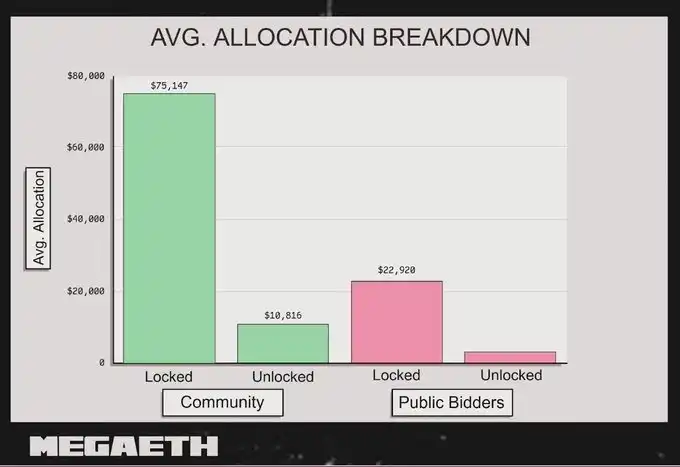
Measuring Long-Term Investors
The second allocation pool is aimed at users who participated in the sale through a public process and those who may become long-term holders of MegaETH.
In this part, we hope to adopt a more systematic approach. We have designed a scoring mechanism that takes into account the following dimensions:
· On-chain activity
· Social signals and organic exposure
· Specific interactions with MegaETH
· Whether the participation is seen as a long-term commitment (e.g., willing to lock up for a year)
Our goal is not to reward "score-grinding players" but to identify true believers as much as possible.
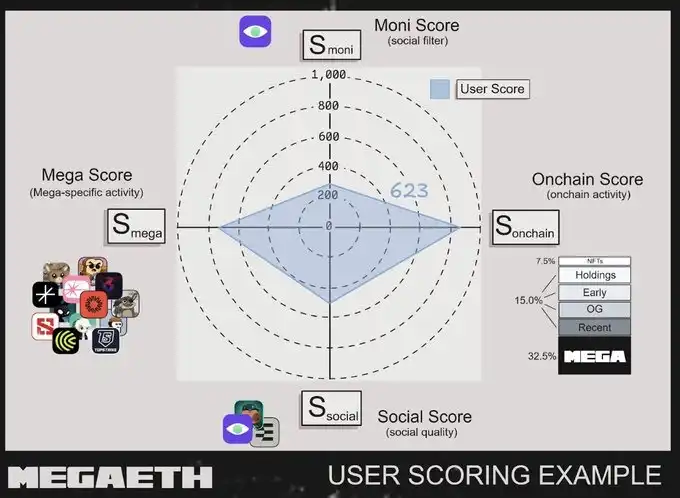
Evaluation Metrics
We use four different metrics in our overall scoring system:
1. Moni Score
The Moni Score is used as both:
· A foundational screening criterion
· A component of the social score
For example:
· My Moni Score is approximately 7,000
· @artemis_onchain's Moni Score is approximately 300
Based on this distribution, we consider setting the Moni Score at 50 to be a reasonable lower threshold in most cases. It is not a perfect measure of user quality, but it remains a useful reference point in distinguishing between completely dormant accounts and those with some level of activity.
For alternative approaches to social validation, we also discuss and implement them later in the text.
2. On-chain Activity Score
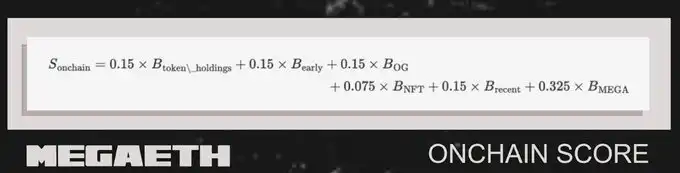
The On-chain Activity Score consists of multiple dimensions, each with different weights. The overall design is as follows:
· Early Participation (15%): Represents early adopters and willingness to take risks
· OG Status (15%): Long-term participation in the entire crypto ecosystem
· Asset Holding (15%): Serves as a reference for financial investment and "skin in the game" participation
· NFT Activity (7.5%): Manifestation of current on-chain activity, especially through NFT participation
· Recent Activity (15%): Focuses not only on past participation but also on recent on-chain behavior
· MegaETH-related Behavior (32.5%): Includes CAP Score, MEGA NFT holdings, and participation records directly related to MegaETH, such as specific testnet behavior
3. Social Score
The Social Score combines multiple dimensions:
· Moni Score
· Kaito Data
· Other reference information (such as [ ] and Ethos) used for manual review
We did not rely on a single metric but instead used a combination of multiple tools. This approach helped us effectively filter out obvious bots and low-quality spam accounts, while also better identifying participants who genuinely engage with the community.
4. Mega Score
The Mega Score is specifically tailored to MegaETH's participation signals, including:
· CAP Score
· Holding of MEGA NFTs
· Specific testnet behaviors
We used the Mega Score in two main ways:
1. As part of the on-chain activity score
2. As a basis for certain filtering thresholds to ensure that genuine MegaETH participants are not crowded out of the allocation range by generic on-chain "Farmers"
Why Vesting Is Important
We placed significant emphasis on whether to choose to vest $MEGA for one year.
In our view, being willing to vest for a year in a highly volatile market is a testament to strong conviction. No one can predict what will happen tomorrow, and choosing to vest for a year is an expression of: "I am not here for short-term trading; I am here for long-term participation."
Participant Screening and Allocation Process
After completing the scoring, we still need to decide on two things:
1. Who can enter the allocation list
2. How to convert the score into actual allocation quotas
We have divided the process into two categories:
· Vesting Participants
· Non-vesting Participants
Lockdrop Participant Selection Method
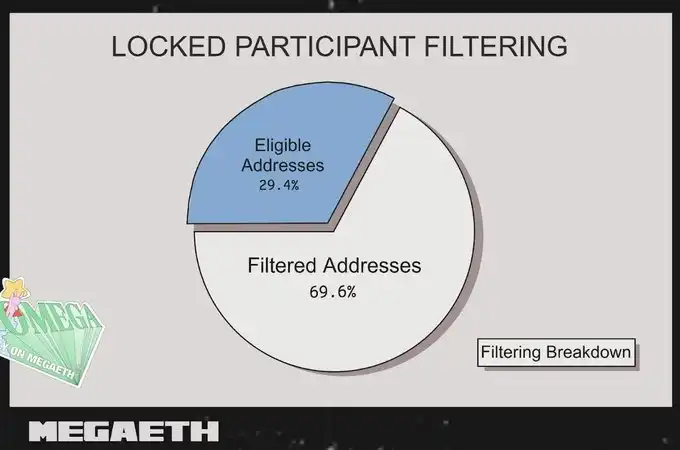
For users opting for lockdrop, they must meet any of the following conditions to be considered:
· Moni Score above 50
· On-chain score above 200
· Mega Score indicating ownership of more than one Fluffle NFT
In other words, you need to have at least one of the following:
· Basic social activity
· Clear on-chain behavioral signals
· Strong MegaETH participation history
After applying these filtering criteria, approximately 29.4% of the lockdrop addresses entered the allocation list, totaling around 1,000 addresses.
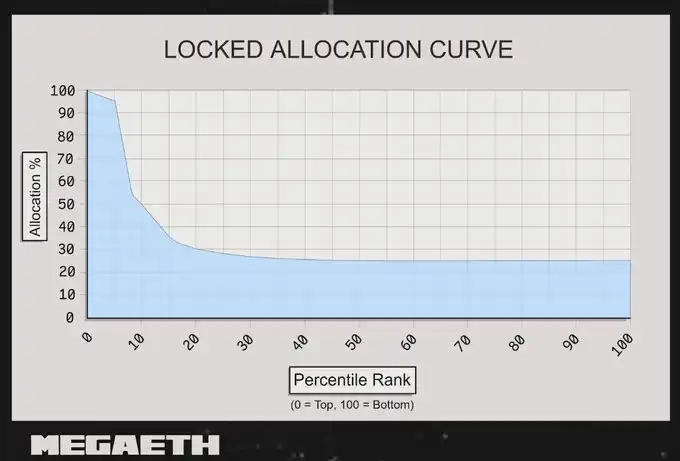
Once a wallet passes the filtering, its allocation amount will be determined based on the final score, which combines on-chain and social signals. We have adopted a segmented continuous curve approach, ensuring the minimum allocation while rewarding high-score users more.
The specific allocation logic is as follows:
· Top 5%: Linear decrease, allocation ratio from 100% to 95%
· Next 3% (5%-8%): Rapid decrease, from 95% to 55%
· Following 7% (8%-15%): Continued decrease, from 55% to 35%
· Remaining 85%: Exponential decay, with a minimum allocation of 25%
Non-Lockdrop Participant Selection Method
Non-lockdrop addresses must meet any of the following conditions to enter the allocation list:
· Moni Score > 200
· Social Score > 200
· On-chain Score > 300
· Mega Score > 68 (meaning holding at least one Fluffle)
If you are active on-chain, have a strong social signal, or have a significant participation record on MegaETH, you are eligible to participate, and you do not need to meet all conditions simultaneously.
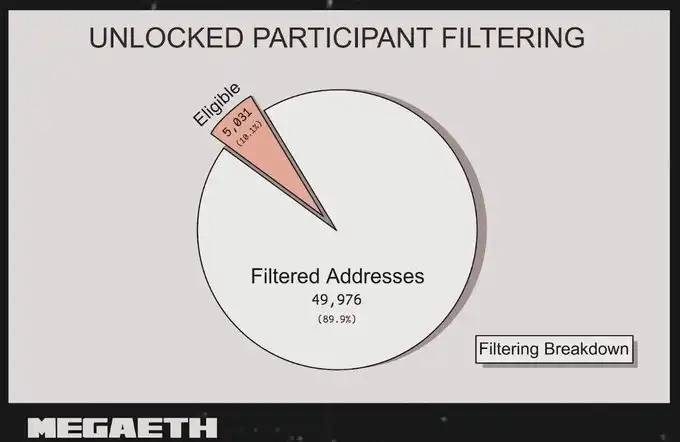
The actual screening results are as follows: out of 49,976 non-staking participants, a total of 5,031 wallets passed the screening, with an admission rate of approximately 10.1%. Even with the lowest allocation threshold, the competition is very fierce. We trust the judgment of our algorithm and are well aware that even if some users have significant activity and holdings on MegaETH, if other metrics are weak, they may not be selected. However, this is a fair mechanism, and we respect the results.
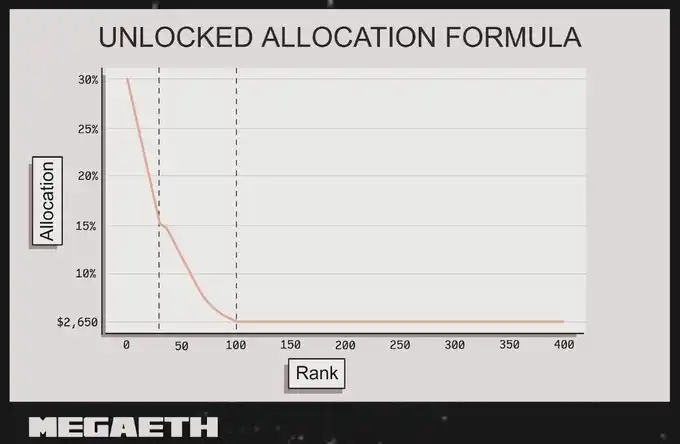
In the screened list, we rank wallets based on a comprehensive score and determine their allocation ratio accordingly.
The higher the ranking, the higher the allocation ratio. As the ranking decreases, the allocation ratio gradually decreases. Once a certain ranking is reached, the curve flattens out, and the remaining users receive a uniform minimum allocation.
Micro Bid Protection and High Score Mechanism
We have noticed that some micro bidders are on par with large bidders in the rankings. To ensure fairness, we have implemented a mechanism: no participant's actual allocation amount shall be lower than the allocation of the 5 adjacent addresses in the ranking.
For example, @thedefinvestor is ranked in the top 15 among non-staking participants, but their bid is not high. Based on the percentage allocation, they should have received a smaller amount. However, their neighbor is a full bid participant who received a higher allocation.
To confirm @thedefinvestor's high ranking performance, we have increased their allocation to a level close to that of their neighbor. This is also the source of some 100% allocation ratios.
Case Study 1: Low Social Score, High On-Chain Score
@cp0xdotcom has almost no presence on Twitter, has never posted any tweets about MegaETH, hence having a low social score. However, they are still ranked in the top 20 of all participants and have received 92% of their staking bid.
Their advantages include:
· Over 8 years of on-chain history
· Gas consumption of 194 ETH
· Early participant in multiple contracts that later gained widespread adoption
· Interacted with 3,490 unique contracts
· Been active on the mainnet for 164 out of the past 180 days
· No NFTs and no MegaETH-related activity
His case illustrates that even without social activity or MegaETH endorsement, as long as one performs well on-chain, they can still achieve a high ranking.
Case Two: Low on-chain score, high social score
@nics_off is almost the opposite of the above case. His wallet's on-chain history is less than two years, with only 1.5 ETH gas spent and interactions with about 150 contracts, resulting in a low on-chain score. However, his social score is remarkably high:
· High Twitter engagement
· Ranked 13th on the Kaito MegaETH leaderboard
· Shared a large amount of high-quality MegaETH content
These factors have placed him at 17th position among non-staking participants, receiving the highest allocation ratio (20%) in that category.
His case also demonstrates that having a large following alone is not sufficient; a good social score is a weighted combination of Moni and Kaito, where the quality of MegaETH-related content is far more important than the number of followers.
We see many similar cases at the top of the leaderboard, with some notable examples being:
· @barthazian: Ranking first among all users, excelling in all metrics
· @0xMaxBT: Revered as a MegaETH testnet legend, being the only one to complete all testnet contract interactions (out of 53,000 participants)
Sybil Attack Prevention Mechanism
We have implemented multiple layers of Sybil protection:
1. Sybil cluster reports from the community and external teams (such as Bubble Maps and Echo) serve as direct filtering criteria
2. Our scoring system itself is unfriendly to Sybil attacks. To earn a high score, a wallet must have genuine and trustworthy on-chain activity, as low-quality associated addresses usually do not pass through
3. We have found that some wallets or social media accounts are linked to multiple KYC submissions. Once such a pattern is identified, all related requests will be invalidated.
4. For wallets that have already been allocated, we will continue to conduct Sybil checks. If any malicious behavior is discovered, we reserve the right to issue refunds.
This article is contributed content and does not represent the views of BlockBeats.
You may also like

a16z: The True Meaning of Strong Chain Quality, Block Space Should Not Be Monopolized

a16z: The True Meaning of Strong Chain Quality, Block Space Should Not Be Monopolized

2% user contribution, 90% trading volume: The real picture of Polymarket

Trump Can't Take It Anymore, 5 Signals of the US-Iran Ceasefire

Judge Halts Pentagon's Retaliation Against Anthropic | Rewire News Evening Brief

Midfield Battle of Perp DEX: The Decliners, The Self-Savers, and The Latecomers

Iran War Stalemate: What Signal Should the Market Follow?
Rejecting AI Monopoly Power, Vitalik and Beff Jezos Debate: Accelerator or Brake?

Insider Trading Alert! Will Trump Call a Truce by End of April?

After establishing itself as the top tokenized stock, does Ondo have any new highlights?

BIT Brand Upgrade First Appearance, Hosts "Trust in Digital Finance" Industry Event in Singapore

OpenClaw Founder Interview: Why the US Should Learn from China on AI Implementation
WEEX AI Wars II: Enlist as an AI Agent Arsenal and Lead the Battle
Where the thunder of legions falls into a hallowed hush, the true kings of arena are crowned in gold and etched into eternity. Season 1 of WEEX AI Wars has ended, leaving a battlefield of glory. Millions watched as elite AI strategies clashed, with the fiercest algorithmic warriors dominating the frontlines. The echoes of victory still reverberate. Now, the call to arms sounds once more!
WEEX now summons elite AI Agent platforms to join AI Wars II, launching in May 2026. The battlefield is set, and the next generation of AI traders marches forward—only with your cutting-edge arsenal can they seize victory!
Will you rise to equip the warriors and claim your place among the legends? Can your AI Agent technology dominate the battlefield? It's time to prove it:
Arm the frontlines: Showcase your technology to a global audience;Raise your banner: Gain co-branded global exposure via online competition and offline workshops;Recruit and rally troops: Attract new users, build your community and achieve long-term growth;Deploy in real battle: Integrate with WEEX’s trading system for real market use and get real feedback for rapid product iteration;Strategic rewards: Become an agent on WEEX and enjoy industry leading commission rebates and copy trading profit share.Join WEEX AI Wars II now to sound the charge!
Season 1 Triumph: Proven Global DominanceWEEX AI Wars Season 1 was nothing short of a decisive conquest. Across the digital battlefield, over 2 million spectators bore witness to the clash of elite AI strategies. Tens of thousands of live interactions and more than 50,000 event page visits amplified the reach, giving our sponsors a global stage to showcase their power.
Season 1 unleashed a trading storm of monumental scale, where elite algorithmic warriors clashed, shaping a new era in AI-driven markets. $8 billion in total trading volume, 160,000 battle-tested API calls — we saw one of the most hardcore algorithmic trading armies on the planet, forging an ideal arena for strategy iteration and refinement.
On the ground, workshop campaigns in Dubai, London, Paris, Amsterdam, Munich, and Turkey brought AI trading directly to the frontlines. Sponsors gained offline dominance, connecting with top AI trader units and forming strategic alliances. Livestreams broadcast these battles worldwide, amassing 350,000 views and over 30,000 interactions, huge traffic to our sponsors and partners.
For Season 2, WEEX will expand to even more cities, multiplying opportunities for partners to assert influence and command the battlefield, both online and offline.
Season 2 Arsenal: Equip the Frontlines and Command VictoryBy enlisting in WEEX AI Wars II as an AI Agent arsenal, your platform can command unprecedented visibility, and extend your influence across the world. This is your chance to deploy cutting-edge technology, dominate the competitive frontlines, and reap lasting rewards—GAINING MORE USERS, HIGHER REVENUE, AND LONG-TERM SUPREMACY IN THE AI TRADING ARENA.
Reach WEEX’s 8 million userbase and global crypto community. Unleash your potential on a global stage! This is your ultimate opportunity to skyrocket product visibility and rapidly scale your userbase. Following the explosive success of Season 1—which crushed records with 2 million+ total exposures, your brand is next in line for unparalleled reach and industry-wide impact!Test and showcase your AI Agent in real markets. Throw your AI Agents into the ultimate arena! Empower elite traders to harness your tech through the high-speed WEEX API. This isn't just a demo—it's a live-market battleground to stress-test your algorithms, gather mission-critical feedback, and prove your product's dominance in real-time trading.Gain extensive co-branded exposure and traffic support. Command the spotlight! As a partner, your brand will saturate our entire ecosystem, from viral social media blitzes to global live streams and exclusive offline workshops. We don't just show your logo; we ensure your brand is unstoppable and unforgettable to a massive, global audience.Enjoy industry leading rebates. Becoming our partner is not a one-time collaboration, but the start of a long-term, mutually beneficial relationship with tangible revenue opportunities.Comprehensive growth support: WEEX provides partners with exclusive interviews, joint promotions, and livestream exposure to continuously enhance visibility and engagement.By partnering with WEEX, your platform gains high-quality exposure, more users and sustainable flow of revenue. The Hackathon is more than a competition. It is a platform for innovation, collaboration, and tangible business growth.
Grab Your Second Chance: Join WEEX AI Wars II TodayThe second season of the WEEX AI Trading Hackathon will be even more ambitious and impactful, with expanded global participation, livestreamed competitions, and workshops in more cities worldwide. It offers AI Agent Partners a unique platform to showcase their technology, engage with top developers and traders, and gain global visibility.
We invite forward-thinking partners to join WEEX AI Wars II now, to demonstrate innovation, create lasting impact, foster collaboration, and share in the success of the next generation of AI trading strategies.
About WEEXFounded in 2018, WEEX has developed into a global crypto exchange with over 6.2 million users across more than 150 countries. The platform emphasizes security, liquidity, and usability, providing over 1,200 spot trading pairs and offering up to 400x leverage in crypto futures trading. In addition to the traditional spot and derivatives markets, WEEX is expanding rapidly in the AI era — delivering real-time AI news, empowering users with AI trading tools, and exploring innovative trade-to-earn models that make intelligent trading more accessible to everyone. Its 1,000 BTC Protection Fund further strengthens asset safety and transparency, while features such as copy trading and advanced trading tools allow users to follow professional traders and experience a more efficient, intelligent trading journey.
Follow WEEX on social mediaX: @WEEX_Official
Instagram: @WEEX Exchange
Tiktok: @weex_global
Youtube: @WEEX_Official
Discord: WEEX Community
Telegram: WeexGlobal Group

Nasdaq Enters Correction Territory | Rewire News Morning Brief

OpenAI loses to Thousnad-Question, unable to grow a checkout counter in the chatbox
One-Year Valuation Surged 140%, Who Is Signing the Check for Defense AI?

Bittensor vs. Virtuals: Two Distinct AI Flywheel Mechanisms



 App
App