
How Does Supra Build an Integrated Future?





The Stage of Public Blockchains Is Far From Over.
Over the past year, the public blockchain space has witnessed a series of revitalizations, sparking renewed interest and discussion. The reincarnation journey led by Solana, Sui's role in the rise of the Move ecosystem, and the pre-mainnet success of Hyperliquid have all reignited the market's imagination in their own ways.
Simultaneously, usability and liquidity have reached unprecedented levels of importance in this process. Consequently, Supra, which promotes an "integrated design" and has quickly garnered significant attention, has also stepped into the spotlight.
From Oracle to Public Blockchain: Supra's Vision
If Supra is unfamiliar to you, then you may have heard of the renowned oracle project SupraOracles. Supra has evolved from SupraOracles because of the team's in-depth research and unique design in on-chain data and cross-chain capabilities. As the project's technical scope continued to expand, the team gradually realized that focusing solely on the oracle module would not fundamentally solve the pain points of blockchain applications in liquidity, randomness, security, and scalability. Thus, the vision of extending from an oracle to a truly high-throughput and highly secure L1 public blockchain began to take shape. According to the official introduction, Supra is steadfastly entering the public blockchain arena because they believe that only by deeply integrating key modules such as oracles, on-chain randomness (dVRF), and cross-chain communication at the base layer can performance and security achieve a "win-win" situation. Once oracles and automation services are unified at the L1 layer, developers will no longer need to connect to multiple networks or numerous external protocols, nor will they need to consider various cross-chain or data security risks, which greatly facilitates the implementation of applications. In pursuit of this goal, in addition to strengthening oracle capabilities, Supra has also made substantial technical preparations at the underlying blockchain and consensus layers, striving to create an "integrated future."
How Does Supra Build an Integrated Future?
The market is no longer interested in the cliché of composability like LEGO but rather values a system that is secure, reliable, and stable. "Integration" often means integrating functions from multiple layers and modules into the same network to achieve a balance between security, performance, and usability. For Supra, the core goal is to allow developers to fulfill various needs such as oracles, cross-chain communication, random numbers (dVRF), and automation on the same public blockchain, eliminating the hassle of frequent integration of external protocols or deploying sidechains. In specific terms, Supra has laid a solid technical and economic foundation for an "integrated future" through the following key modules.
Vertical Integration
In traditional blockchain projects, the underlying layer often only provides core consensus, execution, and data availability, while other functions—such as oracle, cross-chain bridge, automated network, on-chain random number generation, etc.—are handled by external third-party networks or protocols. While this approach provides flexibility, it also leads to various integration issues. Developers may need to switch between multiple networks, ensure compatibility and security audits, resulting in extended development cycles and increased security risks.
Supra, through the concept of "Vertical Integration," embeds these key functions directly into the L1 layer: sharing security guarantees in the same consensus environment, reducing cross-network call latency and vulnerability risks. For developers, this means that applications can easily call services such as random numbers, oracle data, cross-chain communication, etc., in a highly unified ecosystem without the need to repeatedly integrate with external protocols. More importantly, these services all "originate" on the same blockchain, sharing the same security mechanism at the consensus layer, greatly reducing the probability of a "weakest link" leading to systemic risk.
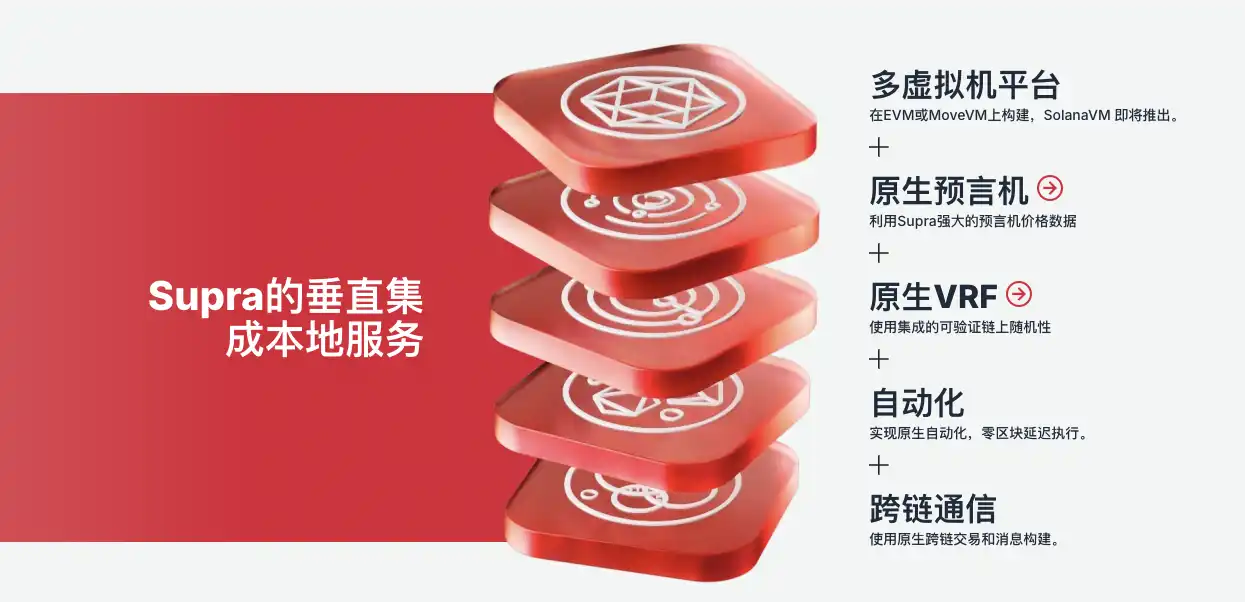
In terms of specific implementation, Supra not only provides a complete set of native cross-chain and oracle solutions but also deeply optimizes data availability and automated execution. By using its proprietary parallelized consensus protocol (Moonshot) to ensure high throughput and sub-second confirmation, Supra's Vertical Integration can bring more feasibility and security guarantees to complex multi-contract interactions, cross-chain transfers, and decentralized autonomous organization (DAO) operations as the functionality continues to expand.
Supra Containers
With the rise of blockchain application chains and Layer2 trends, more and more teams are looking to have autonomous governance models and economic systems. However, the traditional approach often requires building a separate sidechain or application chain, meaning that the project team has to bear the costs of node operation, security audits, and liquidity maintenance. Even with AVS and RaaS, for many small teams, it is still a "thankless task" and easily leads to the "walled garden effect," making it difficult to share liquidity with other applications. Not to mention the dispute between the Degen team and Conduit that led to the migration of the entire Degen L3 chain.
To address these challenges, Supra has introduced the concept of "Containers." A container is like a "microchain attached to the mainnet," where project teams can customize their token model, governance mechanism, or economic incentive scheme within the container, maintaining a relatively independent operational space. At the same time, containers and the Supra mainnet maintain a high level of interoperability: on the one hand, they can share liquidity pools and secure consensus with the mainnet, and on the other hand, containers can also leverage the main chain's built-in oracle, cross-chain communication, and other features in a "plug-and-play" manner.
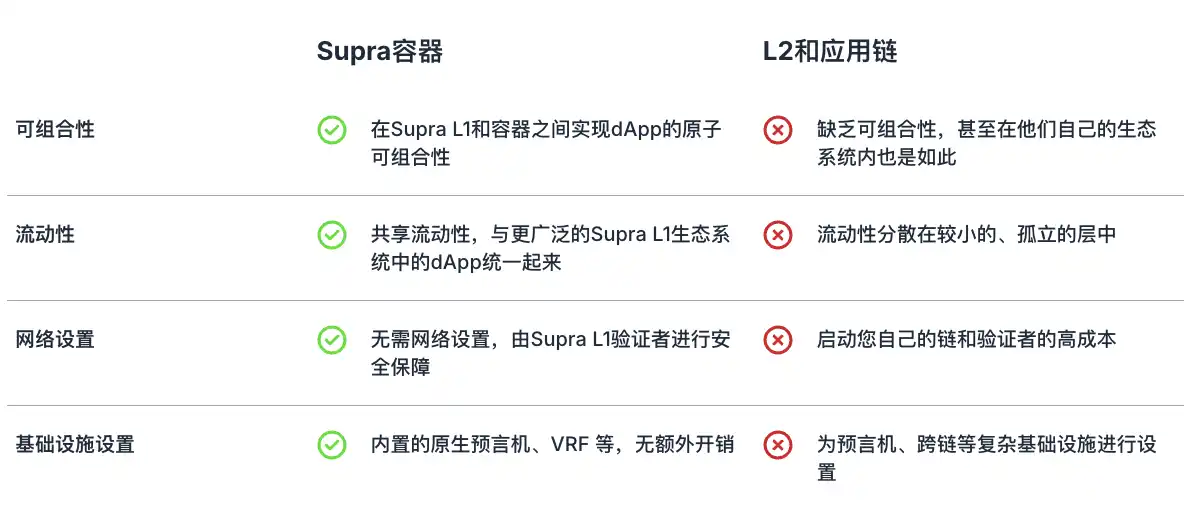
This container mode balances flexibility and security, meeting the project's pursuit of independence without splitting liquidity across multiple chains. For developers, this means they can achieve customized operation similar to an "application chain" without having to bear the heavy burden of node maintenance or security responsibilities, thus eliminating a lot of the cost of reinventing the wheel.
IntraLayer: Decentralized Autonomous Agent
Blockchain applications often require an "unattended" automatic execution method: for example, liquidation logic in a collateralized lending platform, exercise triggers in options protocols, or even random drops in games. Traditionally, these functions may rely on an external keeper network or scripts deployed by developers to monitor contract states and execute operations. While this approach is feasible, it still carries potential centralization dependencies or network failure risks, and also increases the developers' integration burden.
To address this, Supra has introduced the concept of a "Decentralized Autonomous Agent" called IntraLayer, aiming to embed Keeper/Executor-like functions directly on-chain. In other words, nodes in the network can in a decentralized manner detect trigger conditions set by the application on-chain and then automatically execute the corresponding contract logic. In this way, a dApp only needs to register its automated tasks on Supra, without handing over the logic to external scripts or centralized servers for processing.
Because both triggering and execution are done on L1 and combined with Supra's unified security and consensus mechanism, IntraLayer excels in both reliability and security. Once an application entrusts complex automation workflows to IntraLayer, it can maintain a "never-offline" self-running system with fewer manpower and resources, eliminating worries about issues with external keepers.
Proof of Economic Liquidity (PoEL) and Dynamic Function Market Maker (DFMM)
In addition to highly integrating on the technical stack, a public chain's "integration" is also reflected in the linkage between the economic model and the application ecosystem. Through the PoEL (Proof of Economic Liquidity) mechanism, Supra organically combines network security, node staking, and liquidity, encouraging quality capital to enter Supra's mainnet and liquidity pool. As a result, node security and application funding support each other, forming a "win-win" cycle.
Specifically, PoEL allows holders to stake various digital assets into the Supra network, earning corresponding rewards based on asset type and risk exposure. This not only helps the mainnet maintain better liquidity in various scenarios but also enhances the robustness of the network's consensus. With this fund aggregation effect, developers deploying new applications can more easily access liquidity and users, expanding their business scale.
Complementing PoEL is the "Dynamic Functioning Market Maker" (DFMM), which serves as the core matching mechanism provided by Supra for on-chain trading and resource exchange. Unlike traditional AMMs, DFMM places more emphasis on dynamically adjusting market-making parameters based on the network's actual needs and real-time status, thereby more effectively balancing capital utilization and liquidity distribution, reducing impermanent loss or excessive slippage. When combined with Supra's low-latency, high-throughput consensus layer, DFMM has the opportunity to support more complex DeFi scenarios, such as derivative trading and options market making. The integration of PoEL and DFMM can help new projects quickly access the mainnet's liquidity and user resources. Compared to public chain environments that are "rich in technology but lack financial incentives," Supra's financially integrated design may provide developers with more comprehensive support.
Overall, leveraging vertical integration, Moonshot consensus engine, containerized design, IntraLayer decentralized proxy, as well as a series of innovations such as PoEL and DFMM, Supra has built a highly integrated blockchain from underlying technology to economic model. For developers, this means being able to easily utilize key functions such as oracles, cross-chain, automation, and random numbers in a secure and efficient environment, without the need to introduce third-party services or deploy cumbersome cross-chain bridges. For funders and nodes, PoEL provides good returns and security for quality capital, while the dynamic market-making mechanism can drive the prosperity of more DeFi scenarios.
Tokenomics
For any public chain, the tokenomics model is crucial. Supra's token is called SUPRA, and the official statement indicates that its main uses include paying transaction fees, network staking, and applications in various scenarios such as data access. According to the official introduction, SUPRA will also play a significant role under the network's PoEL (Proof of Economic Liquidity) mechanism, encouraging more high-quality assets to enter Supra's liquidity pool to ensure the network's stability and security. PoEL encourages participants to stake various digital assets into the Supra network, receive corresponding incentive rewards, enhance node resilience to risks, and make the token not only a payment and governance tool but also a core element of network liquidity.
Team with Strong Academic Background
If the technical architecture showcases Supra's engineering prowess, then the academic background further strengthens its authority in the cutting-edge cryptography field. The project's Chief Research Officer is Dr. Aniket Kate, one of the inventors of KZG commitments and a cryptographer. The KZG commitment technology plays a key role in Ethereum's scalability roadmap and is also a crucial piece of zero-knowledge proofs. The addition of this scholarly founder has provided solid academic support for Supra's cutting-edge research and foundational innovation. According to the official introduction, the team also comprises other researchers with deep expertise in cryptography, distributed systems, decentralized storage, and other fields, enabling Supra's technical development to maintain a high level both in algorithm and implementation.
Top-tier Backing
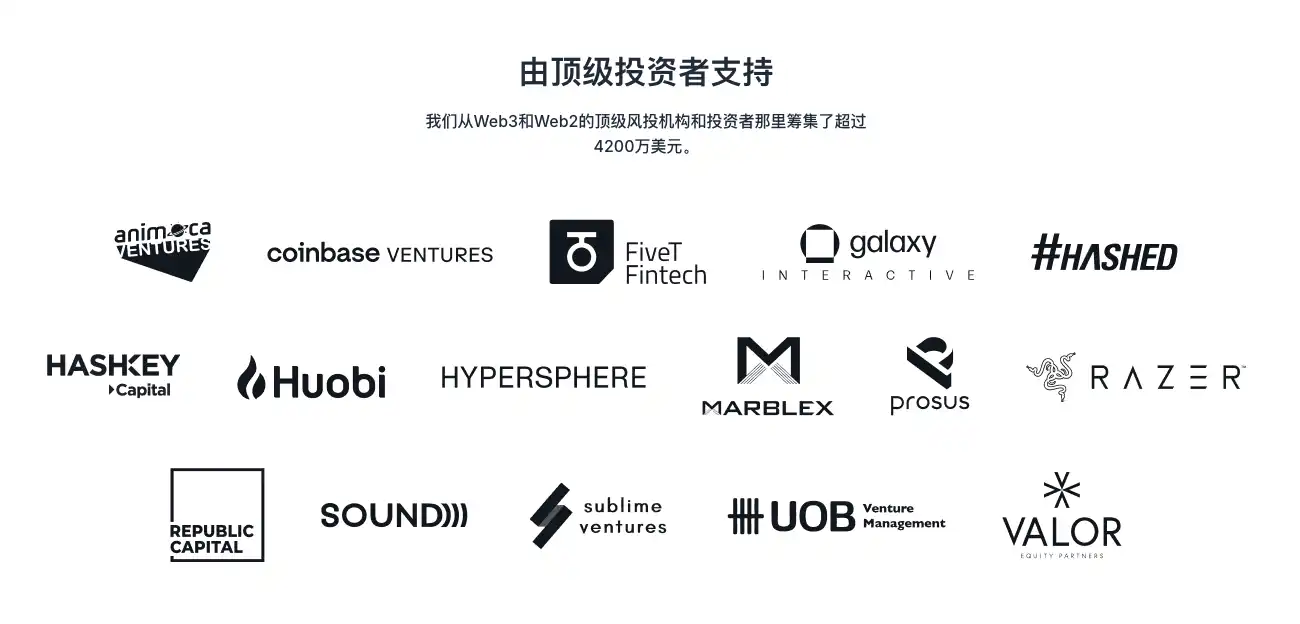
In terms of funding, Supra has already received over $42 million in funding and attracted participation from several well-known institutions, including Coinbase, Hashed, UBO, and Animoca. These investors have extensive resources and industry influence in the blockchain field, providing support for Supra's community building, ecosystem development, and future marketing efforts. Additionally, according to official sources, Supra has also partnered with many well-known projects such as Apechain and Pulme Network to offer support.
Abundant Community Activities
To promote industry development, Supra has launched a $100 million Super dApp Contest, with the team setting aside tokens worth $100 million to support top-tier dApps built on the Supra platform. All winners of the contest will receive a portion of this fund to assist in launching and succeeding in their projects.
While focusing on building core technology and a community ecosystem, Supra also places great emphasis on industry collaboration and promotion. According to official information, the team has participated in or hosted multiple blockchain summits and hackathons in 2024 and has conducted several AMAs in the community. Through these offline and online activities, Supra has not only attracted developers and community members from around the world but has also gained insights into various application scenarios' pain points through real conversations, enabling better iteration of the project roadmap.
Looking across the entire public chain landscape, a high-performance, scalable, and highly secure single-chain solution remains the ideal answer for many developers and users. However, in recent times, various implementation approaches and solutions have made the competition fierce and complex. Supra's emergence has injected new imagination into this track, as they have chosen to directly integrate at the L1 level in a full-stack manner, enabling oracles, cross-chain communication, random numbers, and automation to be natively implemented on the mainnet, aiming to simplify development costs and integration risks. As the Supra mainnet gradually matures, whether this integrated framework can truly become a new benchmark for public chains remains to be tested by more real-world applications and the community. But at least from the current design philosophy and architectural approach, Supra is embarking on a path of innovation that emphasizes both technical integration and economic linkage.
Further Reading: "Technical Guide: A Comprehensive Explanation of the Supra Blockchain Technology Stack"
You may also like

SpaceX vs Tesla vs xAI: Which Elon Musk Trade Has the Biggest Upside in 2026?

OpenAI Reveals It Has Confidentially Submitted an S-1 to the SEC, Keeping the Door Open for a Future IPO
On June 9, according to an OpenAI announcement, the company recently confidentially submitted a draft S-1 registration statement to the U.S. Securities and Exchange Commission (SEC), beginning the preliminary compliance process for a potential initial public offering. OpenAI said it chose to disclose this proactively because it expected the news might leak; however, the company has not yet set a specific listing timeline, and related arrangements may still take some time.

Latest research from 13 top universities including Cornell University: The current state, challenges, and misconceptions of the fusion of Crypto and AI
Deconstructing Anthropic: The Best AI Company, Possibly Also a Type of Organizational Invention
Apollo and Blackstone Reportedly Back $35 Billion Anthropic Chip Financing as Deal Details Remain Unclear
On June 9, according to currently available news alerts, Apollo and Blackstone Group participated in a $35 billion financing for an Anthropic “chip project.” Based on the original wording of the report, the funding has already been raised, but public information remains limited. The financing structure, use of proceeds, project entity, and whether Apollo and Blackstone participated through equity, debt, or project financing have not yet been disclosed.

Humanity Protocol Security Incident Escalates: More Than $31 Million Stolen From Related Addresses as Attacker Continues Selling H for ETH
On June 9, according to monitoring by Onchain Lens, more than $31 million has been stolen from addresses linked to Humanity Protocol, and the attack is still ongoing, with the hacker continuously swapping H tokens for ETH. Project founder Terence Kwok later confirmed the security incident on X, saying the issue involved a private key leak.

Bloomberg: As Bitcoin Weakens, Stablecoins and RWA Continue to Drive Expansion in Crypto Businesses
In June, Bloomberg reported that despite Bitcoin falling below $60,000 last week, wiping out about $235 billion in market value within seven days, and dropping close to 50% from last year’s peak, some core businesses in the crypto industry are still expanding, mainly in stablecoins, real-world asset tokenization (RWA), payments, and infrastructure. The report also noted that overall altcoin activity has contracted significantly: altcoin market capitalization has fallen from a peak of about $431 billion in November 2021 to around $170 billion, and among the tens of millions of tokens issued in recent years, fewer than 1,700 still maintain meaningful trading activity.

Galaxy Deep Research Report: How Hyperliquid's HIP-4 Upgrade Changes the Landscape of Prediction Markets?
Binance Research: RWA Market Expected to Expand Nearly 6x from Early 2025, with Public Equities and Onchain Payments Heating Up Together
In June, Binance Research said in its monthly market report that the real-world asset (RWA) market is expected to grow by about 589% from the beginning of 2025. Bond- and money market fund-related RWA expanded by about $6.5 billion, up 83% year over year, while publicly traded equity RWAs grew by about 422%. The report also noted that monthly crypto debit card transaction volume exceeded $747 million in May, up 48.6% year to date.

Japan to Assess a Framework for Yen Stablecoins and Crypto ETFs as Asia’s Compliant Payments Narrative Heats Up
Recently, according to the original report, Japan is considering the launch of yen stablecoins and cryptocurrency ETFs. Public information remains limited at this stage, and there is still no complete policy text, regulatory draft, or clear implementation timeline, so this is better characterized as a “policy discussion” rather than formal implementation. The original wording also noted that advancing stablecoin regulation in Asia is driving XRP usage and supporting growth in the XRPL ecosystem. However, based on currently available public information, there is not enough evidence to directly establish a clear causal relationship between this round of discussion in Japan and XRP or XRPL.

ZachXBT: Humanity private key leak and abnormal surge in H token should be viewed separately
On June 9, according to related disclosures, on-chain investigator ZachXBT posted an update on Humanity’s roughly $31 million security incident, saying that after further analyzing fund flows, he currently tends to believe the project team was not involved in an “inside job” or a self-staged attack. According to him, the official explanation about the private key leak was broadly accurate, but before the token unlock, the price of H had been artificially pushed higher, and the hacker later took advantage of that market environment; therefore, the private key leak and the earlier abnormal price pumping should be regarded as two separate and independent events. This reframing has shifted the market’s understanding of the nature of the incident. Earlier discussion around Humanity had focused on whether the team directly participated in the attack or used the security incident to cover up internal operations. ZachXBT’s latest remarks shift the focus from “whether it was self-theft” to “whether there were pre-unlock market structure issues.” He also questioned whether the team may have.

Morning Report | OpenAI has submitted an S-1 registration statement draft to the U.S. SEC; Morpho completes $175 million financing

Morning Report | BitMine increased its holdings by 126,971 ETH last week; trader Eugene announced his exit from the crypto market

Wang Chuan: How can one not feel anxious after the neighbor Old Wang made thirty times profit by investing in storage stocks? (Seven) - A quarter-century cycle
Cryptocurrency CEXs are flocking to sell US stocks, and traditional brokerages are facing an "uninvited guest."
$75 billion in foreign capital has fled, and South Korean retail investors have absorbed it all using leverage

Japan’s Three Megabanks Plan Joint Stablecoin Issuance in Fiscal 2026
MUFG, SMBC, and Mizuho reportedly plan to jointly issue fiat-pegged stablecoins in fiscal 2026, signaling Japan’s growing push into bank-led digital payment infrastructure.

Humanity Discloses H Token Dual-Chain Attack Details, With Losses on Ethereum and BSC Exceeding $36 Million
Humanity said the H token attack across Ethereum and BSC caused more than $36 million in losses after leaked ProxyAdmin keys enabled malicious contract upgrades and token minting.
SpaceX vs Tesla vs xAI: Which Elon Musk Trade Has the Biggest Upside in 2026?
OpenAI Reveals It Has Confidentially Submitted an S-1 to the SEC, Keeping the Door Open for a Future IPO
On June 9, according to an OpenAI announcement, the company recently confidentially submitted a draft S-1 registration statement to the U.S. Securities and Exchange Commission (SEC), beginning the preliminary compliance process for a potential initial public offering. OpenAI said it chose to disclose this proactively because it expected the news might leak; however, the company has not yet set a specific listing timeline, and related arrangements may still take some time.
Latest research from 13 top universities including Cornell University: The current state, challenges, and misconceptions of the fusion of Crypto and AI
Deconstructing Anthropic: The Best AI Company, Possibly Also a Type of Organizational Invention
Apollo and Blackstone Reportedly Back $35 Billion Anthropic Chip Financing as Deal Details Remain Unclear
On June 9, according to currently available news alerts, Apollo and Blackstone Group participated in a $35 billion financing for an Anthropic “chip project.” Based on the original wording of the report, the funding has already been raised, but public information remains limited. The financing structure, use of proceeds, project entity, and whether Apollo and Blackstone participated through equity, debt, or project financing have not yet been disclosed.
Humanity Protocol Security Incident Escalates: More Than $31 Million Stolen From Related Addresses as Attacker Continues Selling H for ETH
On June 9, according to monitoring by Onchain Lens, more than $31 million has been stolen from addresses linked to Humanity Protocol, and the attack is still ongoing, with the hacker continuously swapping H tokens for ETH. Project founder Terence Kwok later confirmed the security incident on X, saying the issue involved a private key leak.


