
Google's quantum chip Willow has been released. Will it pose a threat to Bitcoin?



Original title: "Google's quantum chip Willow is launched. Under the threat of super computing power, will it freeze the 1 million bitcoins held by Satoshi Nakamoto to ensure safety?"
Original author: Weilin, PANews
On December 10, Google introduced its latest quantum chip Willow in its official blog, which triggered another heated discussion in the crypto community on the topic of quantum computing attacks. Will quantum computing undermine the existing encryption security mechanism, especially posing a threat to mainstream cryptocurrencies such as Bitcoin?
Partly affected by the news, as of 14:20 on December 10, according to Coinglass data, a sharp crypto market pullback triggered a liquidation of $1.758 billion within 24 hours.
Google launches the latest quantum chip "Willow"
Google announced in a blog post that the "Willow" quantum chip has achieved two major achievements. First, as the number of quantum bits (qubits, the unit of measurement for quantum information) increases, Willow is able to achieve an exponential reduction in error rates, overcoming the key challenges that have been struggling to solve in the field of quantum error correction for nearly 30 years. Second, Willow completed a standard benchmark calculation in less than five minutes, while the same computing task would take even today's fastest supercomputer 10^25 years to complete, a figure far exceeding the age of the universe.
"This provides credible support for the view that quantum computing is carried out in multiple parallel universes, which is consistent with the theory that we live in a multiverse, a prediction first proposed by David Deutsch," said Hartmut Neven, founder and head of Google Quantum AI, in a blog post.
A quantum bit (qubit) is the basic unit of information and the core of quantum computing; the more qubits there are, the stronger the computing power. However, increasing the number of qubits also brings a higher risk of error. If the error rate is too high, the calculation will become unreliable and produce erroneous results, which will make it difficult for quantum technology to achieve practical large-scale applications.
On December 9, Google CEO Sundar Pichai said in an X post that Willow is an important step for Google on the road to building a "practical quantum computer" and that the technology has practical application potential in areas such as drug development, nuclear fusion energy, and battery design.
In response to Pichai's tweet, SpaceX CEO Elon Musk expressed his admiration for Google's invention. Pichai replied that they would cooperate on Starship's quantum cluster in the future.
Challenges in cryptocurrency security? Opinions vary
Does Willow pose a threat to cryptocurrency? Advances in quantum computing have been seen as a potential turning point for the crypto industry. If quantum computers can crack current encryption algorithms, they could quickly expose user funds and pose a huge risk of theft. However, opinions vary.
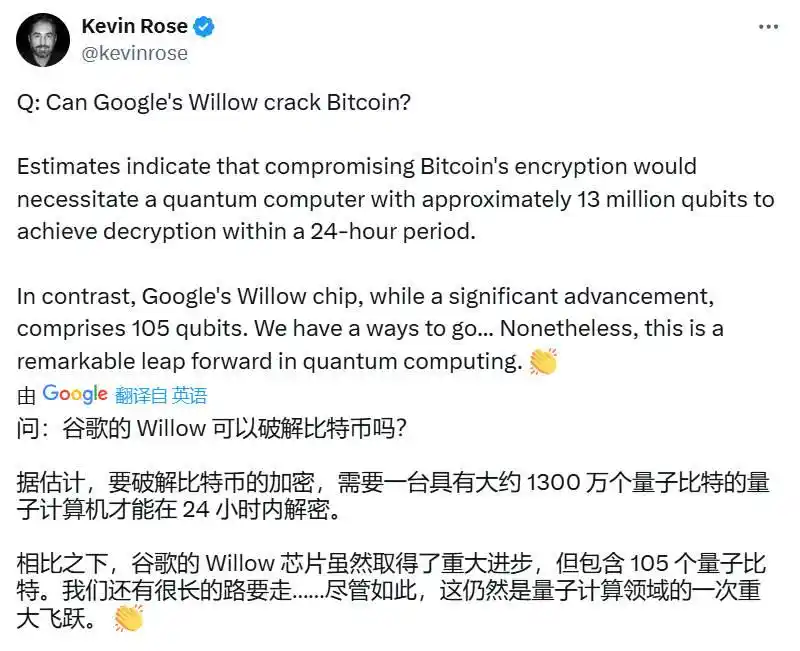
Tech entrepreneur and former Google senior product manager Kevin Rose said in a Dec. 9 X post that Willow is far from a threat to cryptocurrency at this point. Rose noted that an estimate to crack Bitcoin encryption would require a quantum computer with about 13 million qubits to complete the decryption within 24 hours. "In comparison, Google's Willow chip, while an important advance, has only 105 qubits," he said.
Avalanche founder Emin Gün Sirer said this morning that the latest developments in quantum computing are indeed amazing, but at least they do not pose a threat to the security of cryptocurrencies for now. Current quantum computing is only suitable for performing a few types of work such as digital factorization, and cannot do things like reversing one-way hash functions. The designs of mainstream blockchains, including Bitcoin and Avalanche, all have a certain degree of quantum resistance, with a short exposure time for public keys and a short computing window for attackers, so quantum computing will not threaten cryptocurrencies in the short term. In the future, when the quantum threat really comes, blockchains such as Avalanche can also quickly add quantum-resistant signatures.
Dragonfly partner Haseeb Qureshi also holds a similar view, and cited a research report from Metaculus, saying that the Shor algorithm is expected to take until around 2040 to crack the RSA key for the first time.
Further Bitcoin OG Ben Sigman also noted in his X platform post that Bitcoin users should not be concerned about the invention, saying that "crypto technology is still safe... at least for now."
Nevertheless, David Marcus, CEO of payment platform Lightspark, said he believes most people "have not yet fully understood" the significance of Google's breakthrough. Marcus pointed out that this means that "post-quantum cryptography and encryption technology need to accelerate development."
In fact, Ethereum co-founder Vitalik Buterin has proposed a way to mitigate the risks of quantum computing, explaining in a March X post that the problem can be solved with a simple hard fork. Buterin said that the blockchain would need to be hard forked, and users would need to download new wallet software, and most users would not lose funds.
Quantum computing and Bitcoin, experts suggest freezing Satoshi Nakamoto's 1 million BTC
The proof-of-work (POW) mechanism, which is crucial to Bitcoin's operation, requires miners to solve complex mathematical problems to verify transactions and ensure network security. However, quantum computing, with its unprecedented computing speed, may threaten this balance.
Quantum algorithms like the Grover algorithm are theoretically able to solve these problems faster than traditional computers. Therefore, this technology has the potential to centralize mining power, thereby undermining the decentralized concept of Bitcoin.
According to estimates by Dan A. Bard, a faculty member at the University of Kent, it will take about 27 years for the hash rate of the Bitcoin network to grow at the same rate as Moore's Law compared to the current value of quantum computing technology until a single quantum computer can completely surpass other miners in the network and thus completely control the network.
In addition, Bitcoin's elliptic curve cryptography (ECC), a key technology for protecting wallet addresses, is also at risk. Quantum computers may use Shor's algorithm to crack ECC in the future, exposing Bitcoin transactions to potential security vulnerabilities. This vulnerability particularly affects well-known early addresses, including a considerable portion of Bitcoin held by Bitcoin founder Satoshi Nakamoto.
Emin Gün Sirer mentioned above mentioned this more serious situation in his reply to Haseeb's post: "Haseeb reminded me that Satoshi's 1 million bitcoins may indeed have quantum threat issues. Early Bitcoin used a very old Pay-To-Public-Key format, which leaks the public key and gives attackers time to study it, which is the source of all crypto bounties. Modern Bitcoin wallets or modern systems such as Avalanche do not use P2P K, but it did exist in the early stages of Bitcoin. Therefore, as the quantum threat intensifies, the Bitcoin community may need to consider freezing Satoshi's 1 million bitcoins, or more generally, providing a final date and freezing all bitcoins on P2P K UTXO."
"Once the public key is made public, the Shor algorithm adjusted for ECDSA can be run on an ideal quantum computer in polynomial time (polynomial time). time) to find the public key. Traditionally, the process of finding the solution is superpolynomial and several orders of magnitude slower… Polynomial time is potentially feasible, and researchers speculate that eventually ECDSA will be cracked by quantum computers," wrote researchers at Acheron Trading.
Meanwhile, the Bitcoin community seems unlikely to move away from the Proof of Work (POW) mechanism to an alternative consensus mechanism like Proof of Stake (POS). Even cryptographer Adam Back said that PoS cryptocurrencies lack immutability, decentralization, and verifiable high production costs, highlighting their fundamental difference from Bitcoin.
"As hard currency, it is immutable, decentralized, and has a verifiable cost of production. The technical structure is designed to make it economically stable and practically difficult to modify. PoS coins do not have these characteristics, they have CEOs and dozens of competitors. Bitcoin only has one," said Back.
This resistance to change reflects the Bitcoin community's concern about and importance of responding to quantum threats. Although the threat of quantum computing has not yet been fully realized, active preventive measures remain key to protecting the Bitcoin network from future quantum attacks.
However, others, including some developers of quantum computers, believe that such concerns are unnecessary. By the time quantum computers become reliable and powerful enough to attack Bitcoin, blockchain developers will have already patched the vulnerabilities that allow them to be exploited.
You may also like

From Pump.fun to Collector Crypt: Has Solana's income throne changed hands?
Looking at Stripe's ambitions and the future of stablecoins from OUSD
Do you want to buy CRCL?
Wosh: Inflation has cooled in recent weeks, AI is reshaping the economy, and forward guidance has lost its necessity
The most secretive AI winner
Former ByteDance employee's account: How I started with two Pinduoduo hard drives and made six times the profit with Seagate to achieve financial freedom?
MiCA reshuffle begins, Binance temporarily bids farewell to the EU
How does Gate redo "buying and selling stocks" from the cryptocurrency world to the stock market?
Visa and Mastercard join 140 giants to launch a new stablecoin, but the impact on the market landscape may still be limited
Circle CEO responds to OUSD's challenge: Stablecoins are a winner-takes-all business, and we will not slow down
Argentina vs Cape Verde: When a Record-Breaking Legend Meets an Unbreakable Underdog
WEEX exclusive pre-match analysis of Argentina vs Cape Verde, exploring Messi-led Argentina’s dominance and Cape Verde’s historic defensive breakout, with a breakdown of volatility, structure, and match dynamics.
WEEX Launches Depth Chart for Spot Trading
Raising interest rates to protect STRC and selling coins to maintain credit, this time the strategy has chosen the two most expensive paths
Morning Report | Samsung announces a 265.5 trillion won investment plan, focusing on semiconductor and AI computing power data centers; Vitalik publishes an article detailing the entire technology tree behind the confusion protocol (iO) mainline
In the era of AI, what is left of Bitcoin?
NeoSoul announced plans to integrate with the OKX Agentic Wallet, promoting AI agents' participation in the on-chain economy
Why Is Bitcoin Lagging Stocks in 2026? AI Stocks, ETF Outflows, and the Nasdaq Rally Explained
What you bought on CEX is really not US stocks: Analyzing the 94% liquidation monopoly and the evaporation of equity under a five-layer pipeline
From Pump.fun to Collector Crypt: Has Solana's income throne changed hands?
Looking at Stripe's ambitions and the future of stablecoins from OUSD
Do you want to buy CRCL?
Wosh: Inflation has cooled in recent weeks, AI is reshaping the economy, and forward guidance has lost its necessity
The most secretive AI winner
Former ByteDance employee's account: How I started with two Pinduoduo hard drives and made six times the profit with Seagate to achieve financial freedom?