
 Buy Crypto
- Markets
 Futures
- Spot
- Copy Trade
- Earn
- More
ERC-8004: The Rise of Digital Assets and the Machine Economy

Original Article Title: DIGITAL ASSETS: ERC-8004 and the Rise of the Machine Economy
Original Article Author: Laurence Smith, Fintech Blueprint
Translation: Peggy, BlockBeats
Editor's Note: In the wave of AI and blockchain integration, the release of ERC-8004 marks the entrance of the machine economy into the "Trust Era." Led by the Ethereum Foundation's dAI team and Consensys, this protocol, launched in collaboration with heavyweight institutions such as MetaMask, Google, and Coinbase, provides on-chain identity, reputation, and verification mechanisms for AI agents for the first time, breaking the long-standing isolation of autonomous software from each other.
This article delves into how ERC-8004 constructs an open infrastructure for agent discovery and collaboration, and explores its potential in emerging AI crypto ecosystems such as Tempo and Thinking Machines. With over a hundred teams already starting to build, ERC-8004 is not only a technical standard but also the trust foundation of the machine economy.
The following is the original content:
ERC-8004: A Protocol Standard for Establishing Trust Among AI Agents
Last week, the Ethereum Foundation's dAI team and Consensys released the ERC-8004 protocol, which allows AI agents to discover, validate, and transact with each other. Signatories include MetaMask, Ethereum Foundation, Google, Coinbase, EigenLayer, ENS, and The Graph.
Until now, autonomous software, including robots, models, or smart contracts, has been operating independently. The emergence of frameworks such as A2A (Agent-to-Agent) and MCP (Model Context Protocol) has enabled agents to communicate with each other.
A2A provides a shared language for software agents to send structured messages; while MCP, introduced by Anthropic, allows AI models to exchange context and coordinate tasks. These two have contributed to achieving interoperability but still lack a "trust" mechanism. That is, they cannot determine a agent's true identity, whether its record is reliable, or if its output is verifiable.
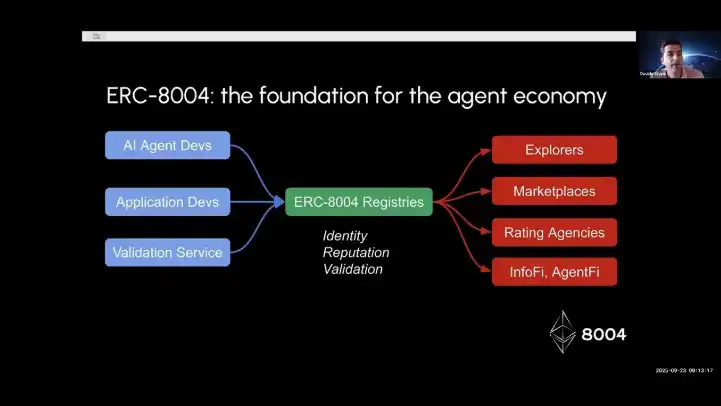
ERC-8004 introduces a set of neutral on-chain registries that address this issue through on-chain identity, reputation, and verification mechanisms.
Each agent receives a portable on-chain identity, an ERC-721 token representing a machine NFT. This token points to a registration file describing the agent's name, skills, wallet, and endpoint. Because it is standardized and based on neutral infrastructure, it can be indexed by any marketplace or browser.
Agents can leave feedback for each other, tag by task, and associate it with Proof of Economic Payment (x402 – short for EIP-402, a cryptographic receipt that binds on-chain payments to off-chain interactions). For higher trust use cases, validators can confirm outputs through hardware enclaves, proof-of-stake mechanisms, or zkML verification. In short, this is an open rating and auditing layer for autonomous agents.
This standard lays the foundation for machine-to-machine economic activity. It builds a world without human intermediaries, allowing agents to trust each other in negotiation, transactions, and collaboration. It extends the logic of disintermediation in blockchain's currency and contract space to AI agents, removing platform middlemen between them.
Reportedly, over a hundred teams are already building according to this specification.
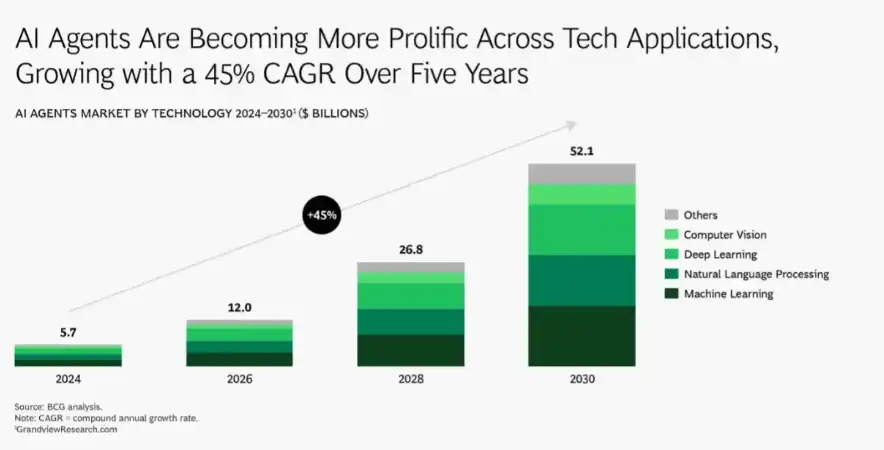
Massive Investments in AI and Crypto Infrastructure
The release of ERC-8004 comes at a time when the AI economic infrastructure is receiving massive investments. Payment-focused Layer 1 blockchain Tempo recently raised $5 billion, reaching a valuation of $50 billion; AI startup Thinking Machines, founded by former OpenAI executives, raised $20 billion, reaching a valuation of $120 billion.
We are witnessing the largest funding rounds in the history of AI and crypto convergence.
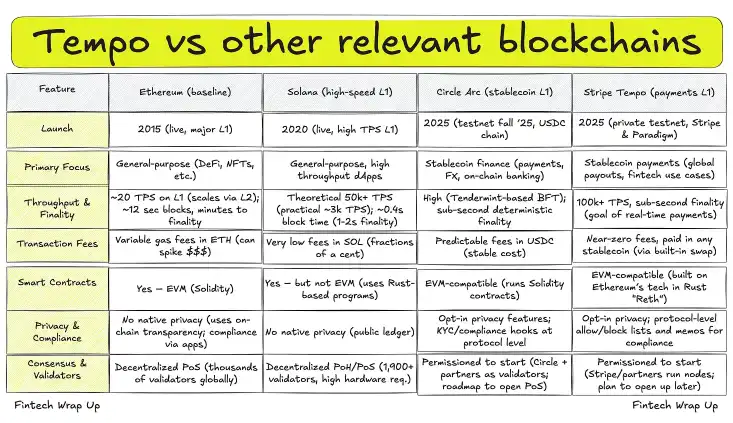
Tempo is building a closed payment network optimized for stablecoins and real-world finance. This essentially mirrors the enterprise version of Ethereum's vision: a high-throughput, low-cost global transaction settlement channel. In Tempo's world, agents can process payments at machine speeds, but its internal private ecosystem is governed by its validators and fee model.
ERC-8004 can provide an open discovery and reputation layer for this ecosystem. Tempo does not need to define which agents or merchants can transact but can integrate the ERC-8004 registry so that any verified agent with a public on-chain identity can access its payment network. This will transition Tempo from a closed settlement layer to a programmable settlement layer, achieving interoperability with the broader Ethereum agent economy.
Thinking Machines operates on a higher level. Although its ultimate goal is not yet clear, its existing products focus on training models to enhance their robustness and flexibility. This contributes to the deployment of autonomous agents on the internet that can reason, collaborate, and transact. Currently, these agents still exist in closed, vertically integrated environments.
By adopting ERC-8004, Thinking Machines can build training tools for an open economy: each model or agent can be discovered and verified on-chain, possess an ERC-721 identity token, and establish real economic reputation through x402 verified interactions. In practical terms, this means a Thinking Machines agent can contract with a data provider agent on Ethereum, pay through Tempo or another chain, and report results back to the chain without human intervention.
In essence, ERC-8004 can unlock a programmable market. It empowers autonomous agents to contract, settle, and build reputation on-chain, which is precisely what DeFi is all about serving humanity.
For fintech, the short-term impact is minimal; few companies will overnight replace APIs with agents. However, once agents can prove identity, reputation, and payment, they can handle various tasks from credit scoring to transaction execution without requiring platform intermediaries.
You may also like

Ray Dalio's new article: The world is entering a war cycle

IOSG: When Fintech Meets Crypto Native: The Next Decade of Digital Finance

They knew in advance that Trump would tweet about a ceasefire, entered with $20k, and exited with $400k.

The biggest bottleneck in DeFi development

CZ Memoir Released: Reveals a Large Amount of Industry Insider Information, Prompting Intense Rebuttal from Xu Mingxing

a16z: After securities are on the blockchain, why will intermediary institutions be replaced by code?

XRP Tokyo Is Here: What We Learn and What’s Next for XRP Price
Key Takeaways: Ripple’s 2025 XRP Tokyo event highlights a projected $33 trillion on-chain stablecoin volume by 2026. Significant…

Solana’s Future: Navigating the $285M Hack, Rug Pulls, and Milei Libra Scandal
Key Takeaways: Multiple Crises: Solana faces a $285 million hack, allegations of rug pulls, and the Milei Libra…

BTC USD Faces Tension: Markets React to Trump’s Dire Warning
Key Takeaways: Bitcoin’s price drops sharply below $70,000 amid geopolitical tensions, playing off Trump’s dramatic 8 PM ultimatum…
Bitcoin Price Surge: Ceasefire Sparks Optimism Hits $71K
Key Takeaways: After the US-Iran ceasefire announcement, Bitcoin surged beyond $71,000, marking its highest in a month. A…

Ethereum Price Forecast: Record $180 Billion Stablecoin Supply Marks Buyers’ Return
Key Takeaways: Ethereum’s stablecoin supply has surged to a record $180 billion, marking a 150% increase over the…

Emerging Evidence Links Argentina’s Milei to LIBRA Crypto Scandal
Key Takeaways: Evidence unveiled by Argentina’s federal prosecutors links President Javier Milei to the LIBRA token through call…

US Spot Bitcoin ETFs See Surge as BTC Nears $70K; LiquidChain and Layer-3 DeFi Rise
Key Takeaways: U.S. spot Bitcoin ETFs absorbed $471 million in a single day, moving BTC closer to the…

Bitcoin Price Prediction: Decoupling from Tech Stocks, Shaped by Geopolitics and AI Turmoil
Key Takeaways: Bitcoin is decoupling from tech stocks as geopolitical tensions and AI crises reshape the market, currently…

Chaos Labs Departure Leaves Aave Without Risk Management Amidst Governance Conflict
Key Takeaways: Aave, with a $50 billion TVL, is currently operating without a risk manager due to Chaos…
Grayscale Ethereum ETF Staking: A New Catalyst for $5,700?
Key Takeaways: Grayscale’s Ethereum Staking ETF introduces a yield-bearing structure that could significantly reshape investor sentiment. Ethereum’s price…

Polygon Crypto Enhances Finality Through the Giugliano Hardfork
Key Takeaways: Polygon’s Giugliano hardfork is operational on the mainnet, effectively reducing transaction finality by 2 seconds. The…

Senate’s Three-Week Deadline: Ripple XRP and the CLARITY Act’s Critical Moment
Key Takeaways: The Senate Banking Committee’s decision on the CLARITY Act in late April could define XRP’s future…


 App
App