
- Buy Crypto
- Markets
 Futures
- Spot
- Copy Trade
- Earn
- More
Bitcoin continues to plummet, will Strategy be forced to sell?

Original Title: "Bitcoin Continues Sharp Decline, MSTR Forced to Sell Becomes Focus"
Original Author: Ye Zhen, Wall Street See News
Bitcoin is undergoing a severe stress test against institutional holdings, as the price falls below a key psychological level, approaching the cost basis of major holders like MicroStrategy, the market's concern over high-leverage holders' liquidity is rapidly escalating.
Over the weekend, Bitcoin broke below the $80,000 integer mark, hitting its lowest level since April 7, 2025. This round of selling occurred against the backdrop of significant market illiquidity, further intensifying Bitcoin's recent cumulative decline of over 30%.
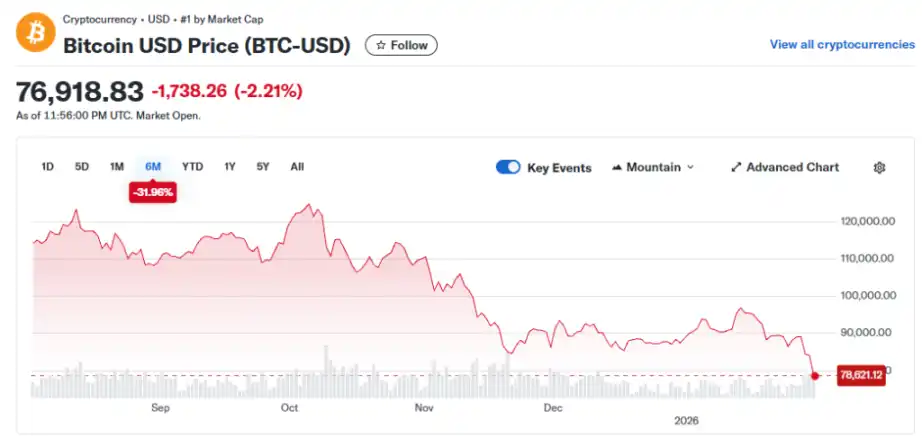
Despite the gloomy market sentiment, MicroStrategy CEO Michael Saylor posted an image with the caption "More Orange" on social media platform X on Sunday, implying continued buying. The company announced a 25 basis point increase in the dividend on its Series A Perpetual Preferred Stock (STRC) to 11.25%, aiming to attract capital at a high financing cost to maintain its Bitcoin purchase strategy. However, analysts point out that if the coin price remains stagnant or falls below its cost basis, the high dividend payout may trigger severe cash flow constraints.

Bianco Research's Macro Strategist Jim Bianco's analysis indicates that the Bitcoin market is facing a narrative exhaustion crisis. The current market structure exhibits a highly institutionalized feature, with ETF investors and MicroStrategy collectively controlling about 10% of the float, and currently overall underwater. This suggests that the once supportive "institutional entrance" narrative may flip into a significant source of selling pressure after being trapped at the peak.
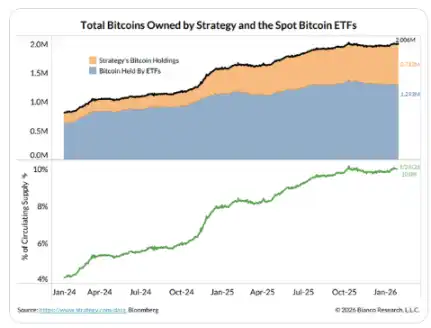
Institutional Holding Underwater Intensifies, ETFs Experience Net Outflows
Jim Bianco's analysis shows that Bitcoin is becoming highly "institutional accountized," meaning the market can now clearly observe large funds' holding costs and P/L status. Currently, MicroStrategy and 11 physical Bitcoin ETFs collectively hold about 10% of Bitcoin's float, with their combined average purchase cost at around $85,360. Based on the current price, these institutional holdings are collectively underwater by about $8,000 per coin, with a total unrealized loss of approximately $7 billion.
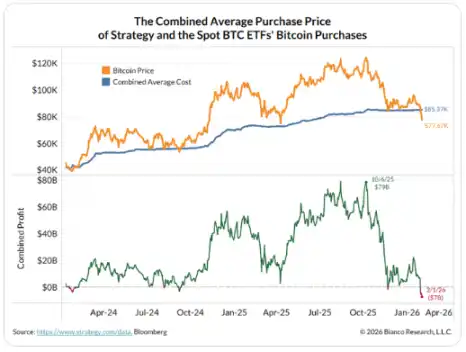
Among them, spot ETFs have become a core force influencing the supply-demand structure. Data shows that the 11 largest spot Bitcoin ETFs hold 1.29 million Bitcoins, accounting for 6.5% of the circulating supply, with a market value of approximately $115 billion. However, the average buy-in cost of these ETF investors is as high as $90,200, and the current coin price is about $13,000 lower than their cost.
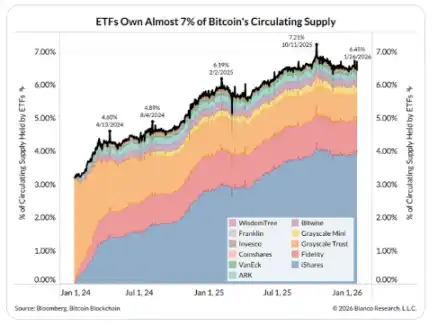
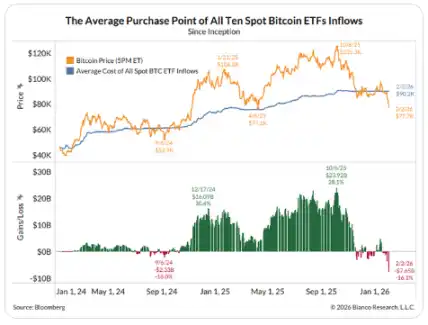
This high-level bottom fishing structure has led to a typical pro-cyclical effect. Bianco pointed out that these ETFs have seen net outflows for 10 consecutive trading days, with investors choosing to redeem during the retracement after buying in at a high level, amplifying the market's downward volatility.
MicroStrategy Safety Net Narrows, Aggressive Financing Raises Concerns
As the benchmark for corporate Bitcoin holdings, MicroStrategy's balance sheet is facing its most severe test in months. Currently, the company holds 712,647 Bitcoins with an average cost of around $76,037. With the Bitcoin trading price falling to around $78,000, the company's unrealized gains have narrowed significantly to less than 3%.
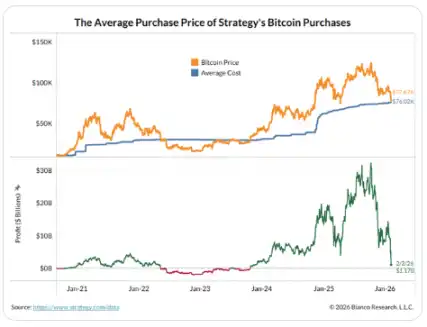
Despite the narrowing safety net, MicroStrategy has not shown signs of backing down. To fund the next phase of purchases, the company has adjusted the yield on its STRC product to 11.25%. This rate of return carries a significant premium compared to typical corporate bonds, reflecting the company's extreme capital thirst and the inherent volatility risk of its Bitcoin-centric model. Data shows that since the debut of the STRC product in November, sales of this product alone have funded the purchase of over 27,000 Bitcoins.
Analysis believes that MicroStrategy is still profitable, but its margin of error has significantly diminished. If the price continues to fall, the company will face an overall unrealized loss. Maintaining dividends at such a high cost could lead to cash flow constraints, especially when the Bitcoin price falls below its $76,000 cost "watermark," making this risk particularly acute.
Old Narrative Obsolete, Market in Urgent Need of New Catalysts
From a macro perspective, this recent plunge has intensified the market's disappointment of recent weeks. Jim Bianco believes that the real issue facing Bitcoin is the lack of a new narrative. The previously highly anticipated "Boomer Adoption" story, which the market had pinned its hopes on, has now been fully priced in and is even being debunked.
The current market structure shows that ETFs and MicroStrategy not only bought heavily and in a concentrated manner, but are currently overall underwater. Bianco points out that as long as a new, sustainable buying narrative does not emerge, the trend of outflows is likely to continue. In this scenario, what was once seen as a bullish high-level institutional holding may instead become the market's biggest source of pressure. The current issue with Bitcoin is not whether people bought in the past, but rather, at the current price level, where the next batch of buyers will come from.
You may also like

Ten Thousand Words Interpretation of STRC: Strategy for Making Money to Buy Coins New Magic

What competitive advantages are still defensible in the AI era?

For Whom the Bell Tolls, For Whom the Lobster Feeds? A Dark Forest Survival Guide for the 2026 Agent Player

Circle CEO's Latest Interview: Stablecoins Are Not Cryptocurrency

Deconstructing the Public Chain Pharos Capital Game: Is a $950 million valuation supported by assets like photovoltaics just a shell transaction under layers of betting?

a16z: AI is making everyone 10x more productive, but the true winner has yet to emerge
Why did the star Web3 project Across Protocol choose to abandon DAO?
In fact, ETH scaling is a major benefit for L2

Memories: 10 Key Contributions of the TON Core Team That Few People Knew in the Early Days

2025 South Korea CEX Listing Post-Mortem: Investing in New Coins = 70% Loss?

BIP-360 Analysis: Bitcoin's First Step Towards Quantum Immunity, But Why Only the "First Step"?

50 million USDT exchanged for 35,000 USD AAVE: How did the disaster happen? Who should we blame?

The Cryptographic Past of the Middle East

Resolving the Intergenerational Prisoner's Dilemma: The Inevitable Path of Nomadic Capital Bitcoin

Who Will Control AI? Why Decentralized AI May Be the Only Alternative to Government and Big Tech
AI has become critical infrastructure, and governments and corporations are competing to control it. Centralized development and regulation are entrenching existing power structures. The Web3 community is building a decentralized alternative — distributed compute, token incentives, and community governance — before that window closes.

Vitalik wrote a proposal teaching you how to secretly use AI large models

On the eve of the explosion of on-chain options

WEEX AI Hackathon: How Did This AI Trading Winner Succeed?
A self-taught AI trading enthusiast achieved top-10 results at the WEEX AI Hackathon. Learn about the mindset, AI tools, and lessons behind this impressive performance.


 App
App