
- Buy Crypto
- Markets
 Futures
- Spot
- Copy Trade
- Earn
- More
Binance Alpha has turned the airdrop into a "blind box" game

Original Title: "Binance Alpha Turns Airdrops into 'Blind Box' Game"
Original Author: angelilu, Foresight News
On February 10, Binance Wallet introduced the Alpha Box airdrop mechanism, where users can no longer know in advance which project's tokens they will receive. They can only "randomly draw," transforming cryptocurrency airdrops into the era of "refined operations."
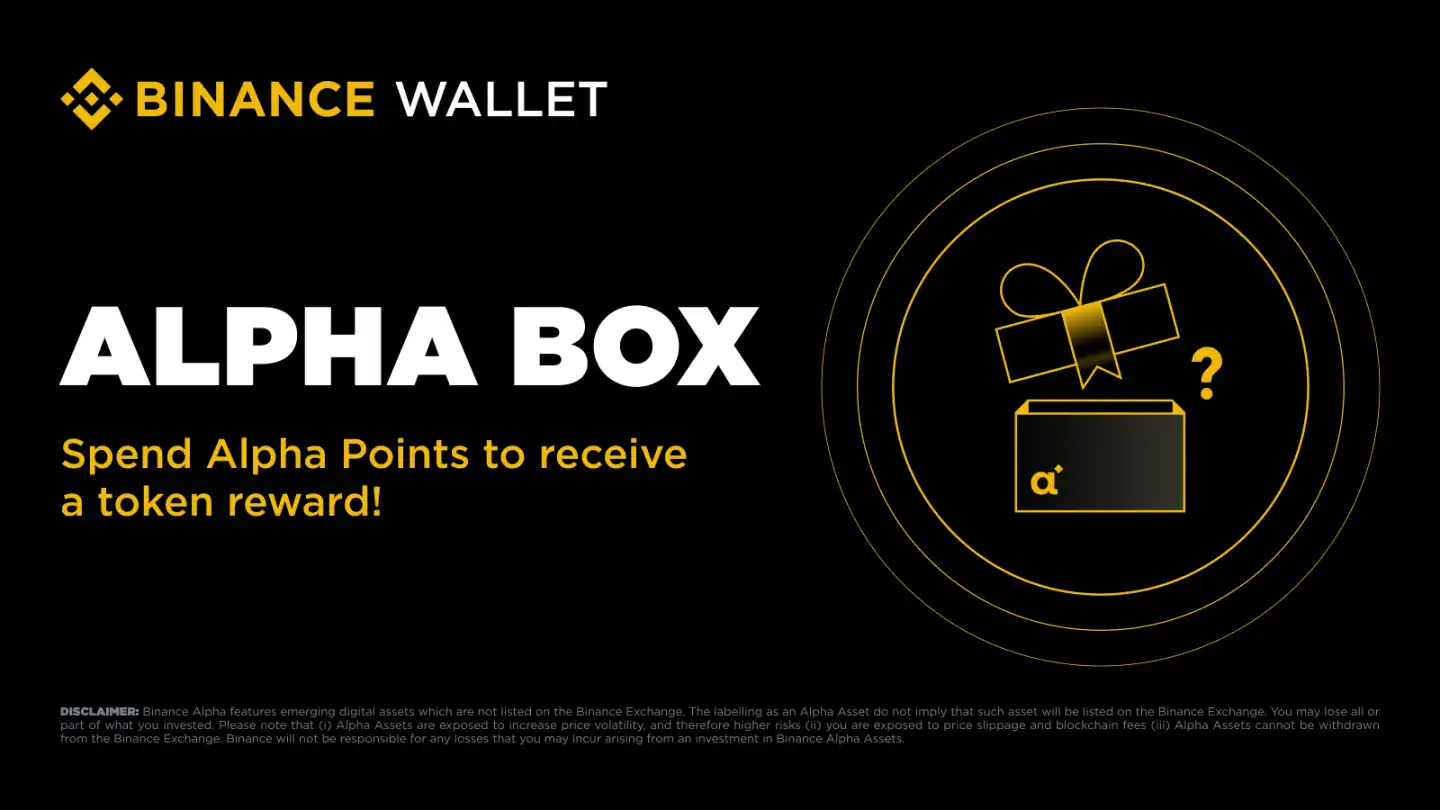
Each iteration of Binance Alpha's airdrop mechanism reshapes user behavior and project strategies. When you open the Binance Wallet to claim an airdrop, you cannot know beforehand which project's tokens you will receive. Can this "blind box" uncertainty once again attract user participation?
Alpha Box Blind Box Mechanism
According to the Binance official announcement, Alpha Box is a "novel airdrop model" that consolidates tokens from multiple projects into a single event. Each Alpha Box event may include rewards from up to 10 projects. The specific number of participating projects and rewards may vary per event.
The core mechanism involves users spending 15 Alpha points to participate, with each box containing only one type of token — you do not know which one until the moment of claiming. Users cannot choose which token to receive.
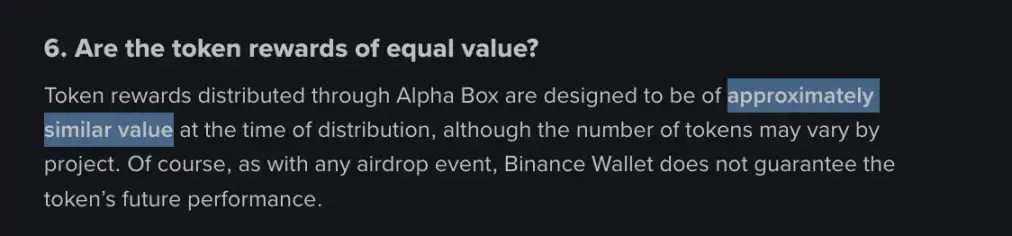
The official statement emphasizes that users will receive tokens of "approximately similar value," but the quantity of tokens from different projects may vary. However, how is "equivalent" defined? Based on the valuation provided by the project teams or based on real-time market prices? This gray area is intriguing.
The first Alpha Box event will commence on February 11, utilizing a first-come, first-served mechanism, with the points threshold automatically decreasing by 5 points every 5 minutes until the airdrop pool is depleted. This design creates a sense of urgency: do you spend a high number of points to participate now or wait for the threshold to decrease, risking it being depleted before you join?
The success of Pop Mart indeed confirms the success of blind box mechanisms. Will the tokens distributed by Binance through blind boxes produce unexpected effects? For example, the holding period for users may lengthen because of the element of "not knowing which one," making them less eager to sell.
For project teams, traditional airdrops require sending tokens directly to users' wallets, with a cost ranging from 5% to 20% of the total token supply. However, most users sell their airdropped tokens immediately, resulting in a retention rate of less than 10%. Under the Alpha Blind Box model, project teams only need to provide a token pool to Binance, and the platform takes care of user selection and distribution. The benefit is higher user quality (filtered by entry threshold), but the trade-off is that the project team loses distribution control — your tokens may be "mixed in" with tokens from several other projects, and users may not even know which project's airdrop they are participating in until they claim the tokens.
Binance Alpha's Self-Evolution: Five Rule Adjustments in One Year
On December 17, 2024, Binance Alpha was officially launched, with the initial mechanism being relatively simple: users accumulate points by holding assets and trading, with points calculated on a 15-day rolling basis. However, Binance soon realized that the rules needed ongoing adjustments.
On May 13, 2025, the first major reform took place: the introduction of a points consumption mechanism. Previously, users only needed to accumulate points to "freely" participate in the airdrop; now, they must consume points to claim their airdrop — consuming 15 points each time. This seemingly simple change fundamentally shifted points from "the more you accumulate, the better" to a deflationary model of "accumulation also involves spending."
On June 6, 2025, the second adjustment occurred: transaction range restriction. Only tokens from the Binance wallet or Binance spot market could accrue Alpha points. This was a precise strike against "wash trading arbitrage" — some found they could accumulate points by wildly trading low-value coins on other DEXs, so Binance directly closed off that avenue.
On June 19, 2025, the third adjustment was made: the introduction of a two-stage airdrop system. The first stage was only open to accounts that reached a high threshold X, and in the second stage, the threshold was lowered to Y (Y<X) on a first-come, first-served basis. This design catered to both "point whales" and gave ordinary users a glimmer of hope.
In September 2025, the fourth adjustment was implemented: new coin trading received a 30-day points boost. In the first 30 days of a new coin's listing, trading volume could earn 2-4 times the points. This is a typical "liquidity incentive" — when a new coin most needs liquidity, users receive the highest points rewards.
On February 10, 2026, the fifth adjustment was made: the introduction of the Alpha Box blind box mechanism. This time, it was not just an adjustment but a complete model innovation.
The one-year five-change rule adjustment has exposed Binance's strategy: How to find a balance between "attracting user participation" and "preventing carpet bombing arbitrage"? The answer is—continuously trial and error, continuously adjust.
User Voting with Their Feet
Why change? Data is more persuasive than any narrative. According to Alpha123 platform data, the number of Binance Alpha users has dropped from nearly 500,000 in November 2025 to about 200,000 in January 2026, a drop of over 60%.
The introduction of blind box mechanism may be another attempt by Binance to address this dilemma. Will changing "certainty" to "randomness" reactivate user participation enthusiasm?
The first Alpha Box event on February 11 will test the answer to this question. A sophisticated experiment on user curation, value allocation, and ecosystem governance is just beginning.
You may also like

Resolving the Intergenerational Prisoner's Dilemma: The Inevitable Path of Nomadic Capital Bitcoin

Who Will Control AI? Why Decentralized AI May Be the Only Alternative to Government and Big Tech
AI has become critical infrastructure, and governments and corporations are competing to control it. Centralized development and regulation are entrenching existing power structures. The Web3 community is building a decentralized alternative — distributed compute, token incentives, and community governance — before that window closes.

Vitalik wrote a proposal teaching you how to secretly use AI large models

On the eve of the explosion of on-chain options
WEEX AI Hackathon: How Did This AI Trading Winner Succeed?
A self-taught AI trading enthusiast achieved top-10 results at the WEEX AI Hackathon. Learn about the mindset, AI tools, and lessons behind this impressive performance.

One Balance to Rule Them All: Gravitas' On-Chain Prime Broker Ambition

That person who cashed out at the NFT peak is now selling a new shovel in the OpenClaw craze

Inter-generational Prisoner's Dilemma Resolution: The Nomadic Capital and Bitcoin's Inevitable Path

Upstream and downstream are starting to fight, all for the sake of everyone being able to "Lobster"

Circle and Mastercard Announce Partnership, the Next Stage for the Crypto Industry Belongs to Payments

From 5 Mao per kWh of Chinese electricity to a $45 API export: Tokens are rewriting currency units

Why is OpenAI playing catch-up to Claude Code instead?

Vitalik wrote a proposal teaching you how to secretly use AI large models

The doubling of Circle's stock price and the paradigm shift of stablecoins

Key Market Information Discrepancy on March 13th - A Must-See! | Alpha Morning Report

On-Chain Options Explosion.ActionEvent

《Time》 Magazine Names Anthropic as the World's Most Disruptive Company
Predictions market gains mainstream traction in the US, Canada, Claude launches Chart Interaction feature, What's the English community talking about today?
Resolving the Intergenerational Prisoner's Dilemma: The Inevitable Path of Nomadic Capital Bitcoin
Who Will Control AI? Why Decentralized AI May Be the Only Alternative to Government and Big Tech
AI has become critical infrastructure, and governments and corporations are competing to control it. Centralized development and regulation are entrenching existing power structures. The Web3 community is building a decentralized alternative — distributed compute, token incentives, and community governance — before that window closes.
Vitalik wrote a proposal teaching you how to secretly use AI large models
On the eve of the explosion of on-chain options
WEEX AI Hackathon: How Did This AI Trading Winner Succeed?
A self-taught AI trading enthusiast achieved top-10 results at the WEEX AI Hackathon. Learn about the mindset, AI tools, and lessons behind this impressive performance.


 App
App