
 Buy Crypto
- Markets
 Futures
- Spot
- Copy Trade
- Earn
- More
Arthur Hayes Breaks Down Debt, Buybacks, and Money Printing: The Ultimate Dollar Liquidity Loop

Original Title: Hallelujah
Original Author: Arthur Hayes, Co-Founder of BitMEX
Original Translation: Bitpush News
Introduction: The Political Incentive and the Inevitability of Debt
Praise be to Satoshi, the existence of time and the rule of compound interest, independent of individual identity.
Even for governments, there are only two ways to fund expenses: using savings (taxation) or issuing debt. For a government, savings are equivalent to taxation. It is well known that taxation is not popular among the people, but spending is. Therefore, when providing welfare to both plebeians and patricians, politicians prefer issuing debt. Politicians always lean towards borrowing from the future to guarantee their current reelection, as when the bill comes due, they are likely not in office.
If due to officials' incentive mechanisms, all governments are "hard-coded" to prefer issuing debt rather than raising taxes to provide welfare, the next key question is: how do purchasers of US Treasuries finance these purchases? Do they use their own savings/capital or do they finance through borrowing?
Answering these questions, especially against the backdrop of the "Pax Americana," is crucial for our prediction of future dollar currency creation. If the marginal buyers of US Treasuries finance their purchases through borrowing, then we can observe who is lending to them. Once we know the identity of these debt financiers, we can determine if they are creating money out of thin air (ex nihilo) to lend or if they are using their own capital for lending. If after answering all questions, we find that the financiers of the Treasuries are creating money during lending, then we can draw the following conclusions:
Government-issued debt will increase the money supply.
If this assertion holds, then we can estimate the upper limit of credit that the financiers can issue (assuming there is a limit).
These questions are important because my argument is this: if government borrowing continues to grow as forecasted by Too Big to Fail (TBTF) Banks, the US Treasury, and the Congressional Budget Office, then the Federal Reserve's balance sheet will also expand. If the Federal Reserve's balance sheet grows, it is a boon for dollar liquidity, ultimately driving up the prices of Bitcoin and other cryptocurrencies.
Next, we will answer these questions one by one and evaluate this logical puzzle.
Question Time
Will President Trump Use Tax Cuts to Finance the Deficit?
No. He recently extended the 2017 tax cut policy with the "Red Camp" Republicans.
Is the U.S. Treasury Borrowing to Fill the Federal Deficit and Will Continue to Do So in the Future?
Yes.
The following are estimates from large bankers and U.S. government institutions. As seen, they predict a deficit of around $2 trillion and finance it through $2 trillion in borrowing.
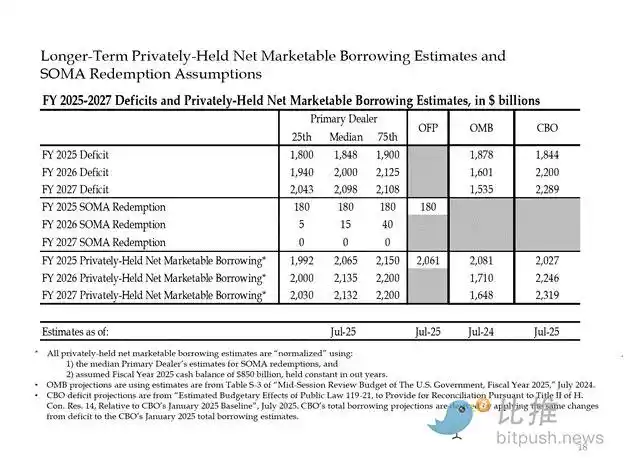
Given that the answer to both previous questions is "yes," then:
Annual Federal Deficit = Annual Treasury Issuance
Next, we will analyze the main purchasers of Treasury bonds and how they fund their purchases.
Debt-Eating "Waste"
Foreign Central Banks
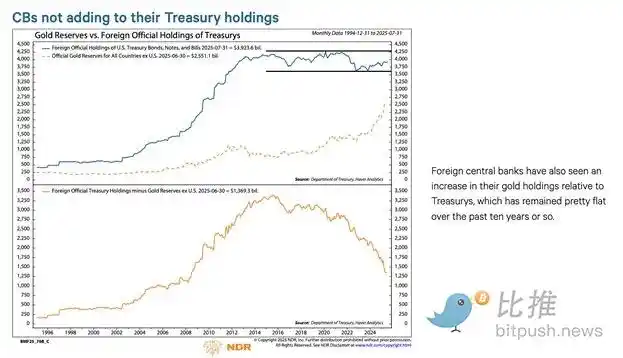
If the "Land of the Free" is willing to pilfer funds from Russia (a nuclear power and the world's largest commodity exporter), then any foreign holder of U.S. Treasuries cannot be assured of safety. Foreign central bank reserve managers, aware of the risk of expropriation, would rather buy gold than U.S. treasuries. Therefore, since Russia invaded Ukraine in February 2022, gold prices have truly skyrocketed.
2. U.S. Private Sector
According to data from the U.S. Bureau of Labor Statistics, the personal saving rate in 2024 is 4.6%. In the same year, the U.S. federal deficit accounts for 6% of GDP. Given that the deficit is larger than the savings rate, the private sector cannot be the marginal buyer of Treasury bonds.
3. Commercial Banks
Are the four major currency center commercial banks heavily purchasing U.S. Treasuries? The answer is yes.
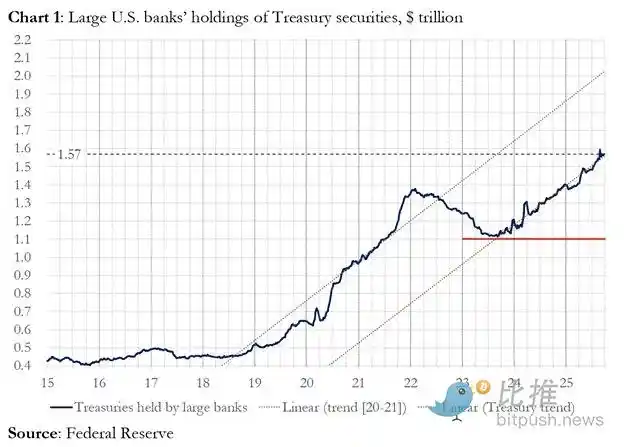
In the 2025 fiscal year, the four major central banks purchased approximately $300 billion worth of US treasuries. In the same fiscal year, the Treasury Department issued $1.992 trillion in US treasuries. While these buyers are undoubtedly significant purchasers of treasuries, they are not the ultimate marginal buyers.
4. Relative Value (RV) Hedge Funds
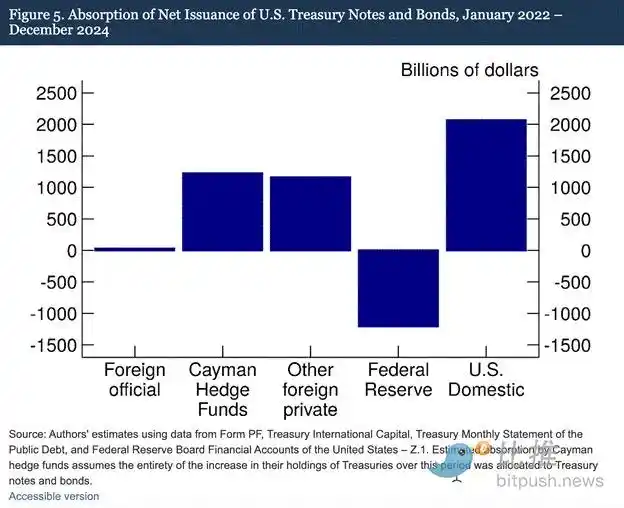
RV funds are marginal buyers of government bonds, a fact acknowledged in a recent Federal Reserve document.
Our findings indicate that Cayman Islands hedge funds are increasingly becoming marginal foreign buyers of US treasuries and bonds. As shown in Figure 5, from January 2022 to December 2024—a period during which the Federal Reserve reduced its balance sheet by allowing maturing US treasuries to roll off—Cayman Islands hedge funds net purchased $1.2 trillion in treasuries. Assuming these purchases were all in treasuries and bonds, they absorbed 37% of the net issuance of treasuries and bonds, nearly equivalent to the sum of all other foreign investor purchases.
RV Fund Trading Mechanism:
· Buy spot treasury bonds
· Sell corresponding treasury bond futures contracts
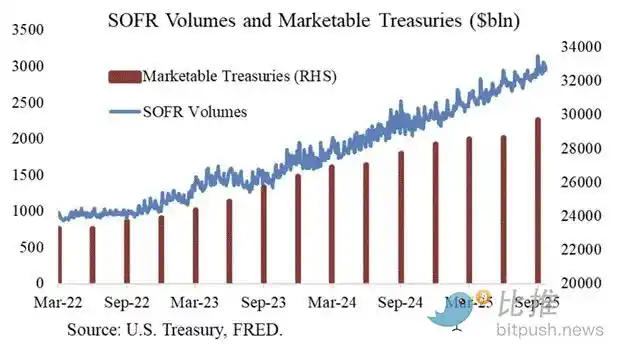
Special thanks to Joseph Wang for providing the chart. SOFR trading volume serves as a proxy measure of RV fund participation in the treasury market. As you can see, the growth in debt issuance corresponds to an increase in SOFR trading volume. This indicates that RV funds are marginal buyers of treasuries.
RV funds engage in this trade to earn a small spread between the two instruments. Due to the minuscule size of this spread (measured in basis points; 1 basis point = 0.01%), the only way to make money is to finance the treasury purchases.
This leads us to the most crucial part of this article: understanding the Federal Reserve's next move—how do RV funds finance their treasury purchases?
Part Four: Repurchase Market, Implicit Quantitative Easing, and Dollar Creation
The RV Fund finances its Treasury purchases through a repurchase agreement (repo). In a seamless transaction, the RV Fund uses the purchased Treasury securities as collateral to borrow overnight cash, then settles the Treasury in cash using this borrowed amount. If cash is plentiful, the repo rate will trade at a level below or exactly at the Upper Federal Funds Rate Cap. Why?
How the Fed Manipulates Short-Term Rates
The Fed has two policy rates: the Upper Federal Funds Rate and the Lower Federal Funds Rate; currently at 4.00% and 3.75%, respectively. To forcefully keep the effective short-term rate (SOFR, i.e., Secured Overnight Financing Rate) within this range, the Fed deploys the following tools (sorted by rate from low to high):
· Overnight Reverse Repurchase Facility (RRP): Money Market Funds (MMFs) and commercial banks deposit cash here overnight, earning interest paid by the Fed. Incentive Rate: Lower Federal Funds Rate.
· Interest on Reserves Balances (IORB): Commercial banks earn interest on excess reserve balances held at the Fed. Incentive Rate: Between the Upper and Lower limits.
· Standing Repo Facility (SRF): Allows commercial banks and other financial institutions to pledge eligible securities (mainly U.S. Treasuries) and receive cash from the Fed when cash is tight. Essentially, the Fed prints money in exchange for collateral securities. Incentive Rate: Upper Federal Funds Rate.
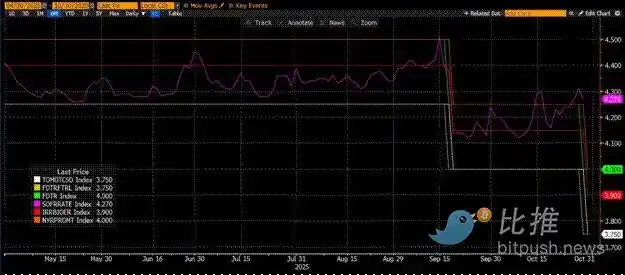
Relationship among the three:
Lower Federal Funds Rate = RRP < IORB < SRF = Upper Federal Funds Rate
SOFR (Secured Overnight Financing Rate) is the Fed's target rate, representing a composite rate of various repo transactions. If the SOFR transaction price trades above the Upper Federal Funds Rate, it indicates a systemic cash crunch, triggering significant issues. Once there is a cash crunch, SOFR will spike, and the highly leveraged fiat financial system will seize up. This is because if marginal liquidity providers can't roll their liabilities near the predictable Federal Funds Rate, they will suffer massive losses and stop providing liquidity to the system. No one will buy Treasuries because they can't obtain cheap leverage, causing the U.S. government to be unable to finance at an affordable cost.
Exit of Marginal Liquidity Providers
What is causing the SOFR transaction price to exceed the upper limit? We need to examine the marginal cash providers in the repo market: Money Market Funds (MMFs) and commercial banks.
· Money Market Fund (MMF) exodus: The goal of MMFs is to earn short-term interest with minimal credit risk. Previously, MMFs would withdraw funds from RRP and redirect them to the repo market because RRP < SOFR. However, now, due to the highly attractive yield of short-term Treasury bills, MMFs are withdrawing funds from RRP and lending to the US government instead. The RRP balance has been reduced to zero, and MMFs have essentially exited the cash supply of the repo market.
· Commercial banks' constraints: Banks are willing to provide reserves to the repo market because IORB < SOFR. However, the ability of banks to provide cash depends on whether their reserves are sufficient. Since the Fed began quantitative tightening (QT) in early 2022, banks' reserves have decreased by trillions of dollars. Once the balance sheet capacity shrinks, banks are forced to charge higher rates to provide cash.
Starting in 2022, both marginal cash providers, MMFs and banks, have less cash to supply to the repo market. At some point, neither is willing or able to provide cash at a rate below or equal to the federal funds rate upper limit.
Meanwhile, the demand for cash is rising. This is because both former President Biden and current President Trump continue to spend lavishly, requiring more issuance of Treasury bonds. The marginal buyers of Treasury bonds, RV funds, must fund these purchases in the repo market. If they cannot obtain daily funding at a rate below or slightly below the federal funds rate upper limit, they will stop buying Treasuries, and the US government will not be able to finance itself at affordable rates.
SRF Activation and Stealth QE
Due to a similar incident in 2019, the Fed established the SRF (Standing Repo Facility). As long as acceptable collateral is provided, the Fed can provide unlimited cash at the SRF rate (i.e., the federal funds rate upper limit). Therefore, RV funds can rest assured that no matter how tight cash may be, they can always get funding at the worst-case scenario—the federal funds rate upper limit.
If the SRF balance is above zero, we know that the Fed is cashing the politicians' checks with freshly printed money.
Treasury Issuance = Increase in Dollar Supply
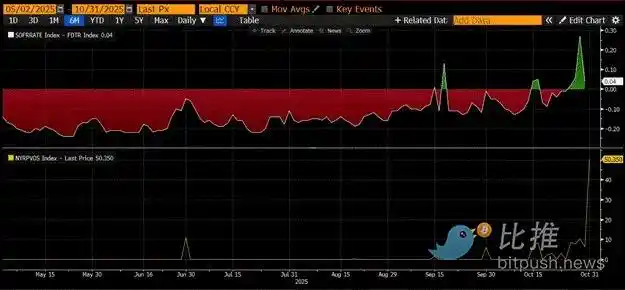
The top panel in the chart above shows the difference (SOFR - Federal Funds Rate Ceiling) . When this difference approaches zero or is positive, cash is tight. During these periods, SRF (bottom panel, in billions of dollars) is used non-trivially. Using the SRF can help borrowers avoid paying a higher, less manipulated SOFR rate.
Stealth QE: The Fed has two ways to ensure there is enough cash in the system: one is by creating bank reserves through buying bank securities, known as Quantitative Easing (QE). The other is by freely lending to the repo market through SRF.
QE is now a "dirty word," commonly associated with money printing and inflation. To avoid being accused of triggering inflation, the Fed will strive to claim that its policy is not QE. This means that the SRF will become the primary channel for money printing into the global financial system, rather than creating more bank reserves through QE.
This can only buy some time. However, eventually, the exponential expansion of Treasury issuances will force repeated use of the SRF. Remember, Treasury Secretary Buffalo Bill Bessent not only needs to issue $2 trillion annually to fund the government but also needs to roll over trillions in maturing debt.
Stealth QE is about to begin. While I don't know the exact timing, if the current money market conditions persist, with a mountain of Treasury issuance, the SRF balance as the lender of last resort must grow. As the SRF balance grows, the global supply of USD fiat will also expand. This phenomenon will reignite the Bitcoin bull market.
Part Five: Current Market Stagnation and Opportunities
Before the onset of Stealth QE, we must control capital. Expect the market to continue to be volatile, especially until the U.S. government shutdown concludes.
Currently, the Treasury borrows money through debt auctions (USD liquidity negative), but has not spent this money (USD liquidity positive). The Treasury General Account (TGA) balance is about $150 billion above the $850 billion target, and this additional liquidity will only be released into the market once the government reopens. This liquidity siphon effect is one of the reasons for the current weakness in the crypto market.
Given the upcoming four-year cycle anniversary of Bitcoin's all-time high in 2021, many mistakenly interpret this period of market weakness and fatigue as the top and sell their holdings. Of course, provided they were not "deaded" in the altcoin rug pull a few weeks back.
But that's a misconception. The operating logic of the US dollar money market does not lie. This corner of the market is shrouded in obscure terms, but once you translate these terms into "printing money" or "destroying money," you can easily understand how to grasp the trend.
You may also like

PUMP Valuation Breakdown: On-chain Data Disproves the "Fake Volume" Theory, Where Does the Real Discount Come From?

Tiger Research: What AI services do cryptocurrency companies offer?

The war not only drives up oil prices but also causes Circle's stock price to soar

When agents become consumers, who will rewrite the underlying logic of internet commerce?

AI Agents in Action Summit: March 31, Hong Kong Cyberport, focusing on the deep waters of AI implementation

29 Days In, What Are America’s Options on Iran?

Flash Crash Down 97%+ with Ongoing Unlocking, WLD Completes $65 Million Off-chain Funding: Who Is Still Buying?

Bitcoin for Real Estate? Fannie Mae Teams Up with Coinbase to Launch Crypto Mortgage
Tether Hires Big Four Auditor, USDT Enters First Attestation Phase

Google AI Paper Destroys $900B Storage Stock, Accused of Faking Experiment
Evaporate $2 Trillion, U.S. Stocks See Worst Start in 4 Years, Why is the Market Bearish?

The speed at which AI discovers vulnerabilities has surpassed the speed at which it patches vulnerabilities.

AI Crypto Trading Bot Explained: Aurora's Multi-Factor Strategy in WEEX Hackathon
Aurora demonstrates how structured, multi-agent AI Trading systems can deliver more adaptive and resilient performance in the WEEX AI Trading Hackathon.

Cyber Taoist Fortune Teller: Fake Taoist, AI Fortune Telling, and Northeastern Metaphysics History

Bloomberg: Stablecoin Payments Emerge as Crypto VC's Newest Favorite Thing
BeatSwap is evolving towards a full-stack Web3 infrastructure, covering the entire lifecycle of IP rights.
BeatSwap, a global Web3 Intellectual Property (IP) infrastructure project, is attempting to overcome the current fragmentation limitations of the Web3 ecosystem, building a full-stack system that covers the entire lifecycle of IP rights.
Currently, most Web3 projects are still in the stage of functional fragmentation, often focusing only on a single aspect, such as IP asset tokenization, transaction functionality, or a simple incentive model. This structural dispersion has become a key bottleneck hindering the industry's scale application.
BeatSwap's approach is more integrated, integrating multiple core modules into the same system, including:
· IP authentication and on-chain registration
· Authorization-based revenue sharing mechanism
· User-engagement-driven incentive system
· Transaction and liquidity infrastructure
Through the above integration, the platform builds an end-to-end closed-loop path, allowing IP rights to complete a full cycle of "creation, use, and monetization" within the same ecosystem.
BeatSwap is not limited to existing crypto users but is attempting to take the global music industry as a starting point, actively creating new market demand. Its core strategies include:
Exploring and incubating music creators (Artist discovery)
Building a fan community
Igniting IP-centric content consumption demand
The current global music industry is valued at around $260 billion, with over 2 billion digital music users. This means that the potential market corresponding to the tokenization and financialization of IP far exceeds the traditional crypto user base.
In this context, BeatSwap positions itself at the intersection of "real-world content demand" and "on-chain infrastructure," attempting to bridge the structural gap between content production and financial flow.
BeatSwap's upcoming core product "Space" is scheduled to launch in the second quarter of 2026. This product is defined as the SocialFi layer in the ecosystem, aiming to directly connect creators with users and achieve deep integration with other platform modules.
Key designs include:
A fan-centric interactive mechanism
Exposure and distribution logic based on $BTX staking
User paths connected to DeFi and liquidity structures
Thus, a complete user behavior loop is formed within the platform: Discovery → Participation → Consumption → Rewards → Trading
$BTX is designed to be a core utility asset within the ecosystem, rather than just a simple incentive token, with its value directly tied to platform activity and IP use cases.
Main features include:
· Yield distribution based on on-chain authorized actions
· Value reflection based on IP usage and user engagement dynamics
· Support for staking and DeFi participation mechanisms
· Value growth driven by ecosystem expansion
With the increased frequency of IP use, the utility and value support of $BTX will enhance simultaneously, helping alleviate the "disconnect between value and utility" issue present in traditional Web3 token models to some extent.
Currently, $BTX has been listed on several mainstream exchanges, including:
Binance Alpha
Gate
MEXC
OKX Boost
As the launch of "Space" approaches, BeatSwap is actively pursuing more exchange listings to further enhance liquidity and global accessibility, laying a foundation for future market expansion.
BeatSwap's goal is no longer limited to the traditional Web3 narrative but aims to target over 2 billion digital music users and a trillion KRW-scale content market.
By integrating content creators, users, capital, and liquidity into a blockchain framework centered around IP rights, BeatSwap is striving to build a next-generation infrastructure focused on "IP tokenization."
BeatSwap integrates IP authentication, authorization distribution, incentive mechanism, transaction system, and market construction to establish a unified structure that bridges the full lifecycle path of IP rights.
With the launch of the Q2 2026 "Space," the project is expected to become a key infrastructure connecting content and finance in the IP-RWA (Real World Assets) track.

Mag 7 Evaporates $2 Trillion | Rewire News Morning Edition



 App
App