
- Buy Crypto
- Markets
 Futures
- Spot
- Copy Trade
- Earn
- More
After Iran's Political Risk Rises, Cryptocurrency Sees Massive Outflow

Original Article Title: "After Bombing, Iranians Frantically Move Crypto Assets Out"
Original Article Author: angelilu, Foresight News
On February 28, 2026, the United States and Israel jointly launched the first airstrike on Iran. Within minutes of the news breaking, assets on Iran's largest cryptocurrency exchange platform, Nobitex, began flowing out at an abnormal pace. Meanwhile, on the other end of the Middle East, after days of war, the Tel Aviv Stock Exchange closed at a record high on March 2.
Same war, two drastically different financial signals: one side celebrating capital, the other side witnessing wealth flight. This scene may be the best glimpse into the true role of cryptocurrency assets in geopolitical conflicts.
Nobitex Outflow Surges by 700%
Nobitex is Iran's largest cryptocurrency exchange platform, with over 11 million registered users. In 2025, it processed a total cryptocurrency trading volume of $7.2 billion, serving as a core infrastructure of Iran's crypto ecosystem.
According to blockchain compliance firm Elliptic's on-chain monitoring data, immediately after the US-Israel airstrike, Nobitex saw a 700% surge in cryptocurrency outflows. The flow of funds indicates that these assets are being moved abroad, primarily to overseas cryptocurrency exchanges that have historically received a significant amount of Iranian funds.
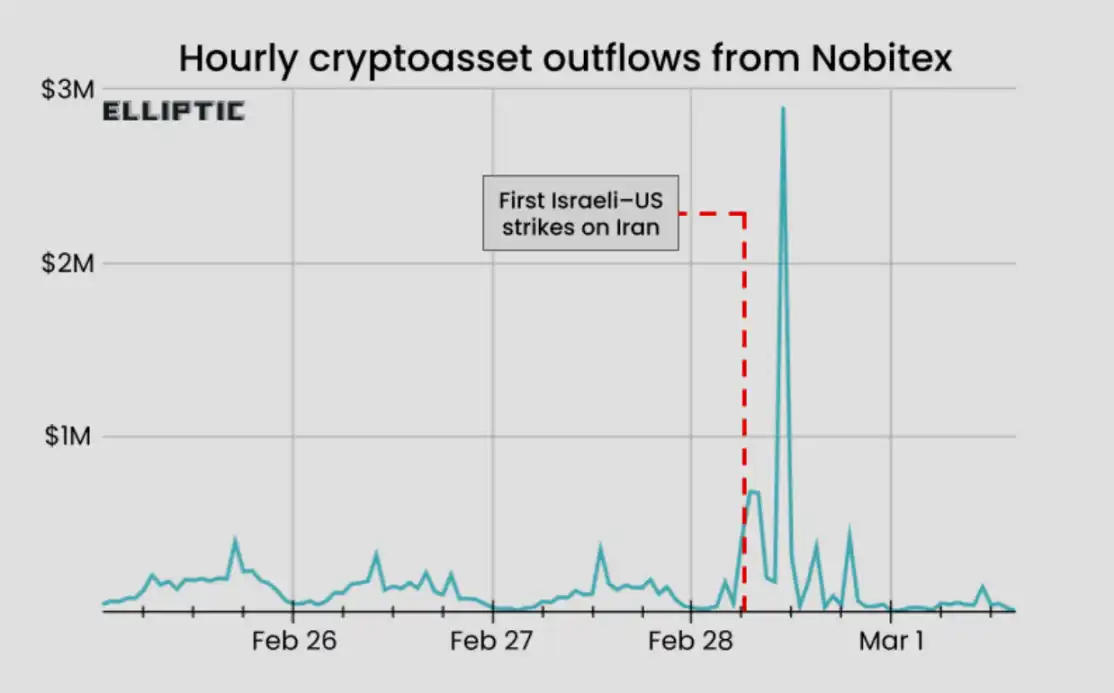
Subsequently, shortly after the US announced sanctions on Iran, cryptocurrency experienced two minor spikes again, indicating that cryptocurrency may be used to try to circumvent these sanctions.
A detailed analysis of the chart data reveals that the baseline of normal outflows from Nobitex before the airstrike was roughly $300-400,000 per hour. The peak outflow of cryptocurrency was about $2.8 million per hour. While the absolute amount is not very large, it reflects a behavioral signal: as soon as the news broke, people's immediate reaction was to move their assets. Furthermore, what Elliptic monitors is only the traceable part on-chain. A large number of Iran's cryptocurrency transactions are conducted off-exchange (OTC) and through P2P channels, which are completely invisible in this data, indicating that the actual outflow volume is even larger.
This is not an isolated incident. Elliptic's tracking shows that since January 2026, Nobitex has experienced multiple outflow peaks: On January 9, mass demonstrations broke out in Iran, prompting the government to impose an internet shutdown. On that day, the outflow hit a yearly high, with assets continuing to flow out even during the network blackout, indicating that some individuals could bypass the blockade to continue operations. Following this, the US Treasury sanctioned two UK-registered exchanges (Zedcex and Zedxion) associated with Iran, causing another brief surge in Nobitex outflows.
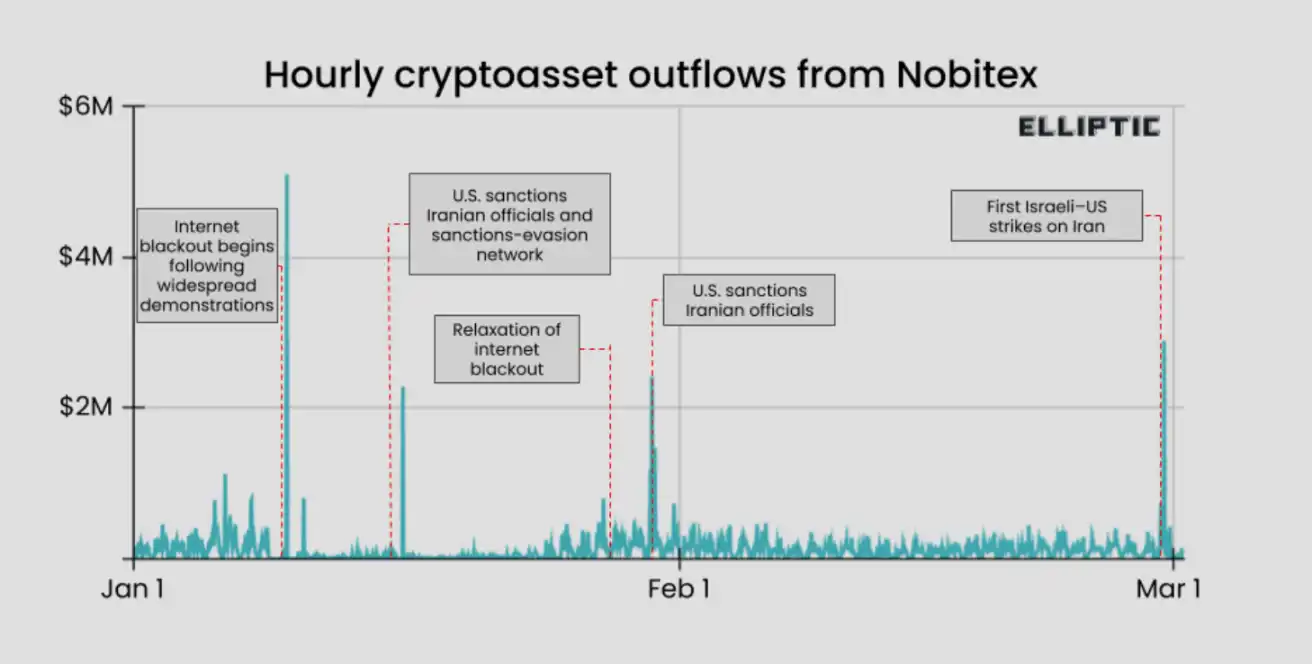
Triple Peak, Three Trigger Points — Sanctions, Internet Shutdown, Airstrike — together outline a pattern: whenever Iran's political or military risk rises, cryptocurrency becomes the first choice for capital flight.
Why Crypto, Not Banks?
The answer to this question lies in Iran's decades-long history of sanctions.
Since the 1979 Islamic Revolution, Iran has been under severe sanctions from the United States and Western countries, cut off from the SWIFT international payment system. Domestic residents can hardly transfer wealth overseas through traditional banking channels. Cryptocurrencies provide a detour: Iranian Rial is exchanged for stablecoins like USDT, then transferred overseas through on-chain transactions to foreign wallets, eventually entering overseas trading platforms. The entire process does not need to go through any traditional banks, and the tentacles of sanctions interception are hard to reach.
The collapse of the Rial also provides the most intuitive escape motive. In early 2025, 1 USD exchanged for about 81.75 million Rials; by January 2026, the exchange rate had dropped to 150 million Rials; after the airstrike, the Rial hit a historic low in a single day, falling to 175 million Rials per 1 USD.
Against the backdrop of long-term international sanctions and geopolitical conflicts, food prices in Iran have risen by over 72% year-on-year, and the national inflation rate has reached 42.5%. At the time of the 1979 Islamic Revolution, 1 USD could only exchange for about 70 Rials. This means that over more than forty years, the purchasing power of the Rial has shrunk by over 25,000 times, and the wealth of the people has been almost ground to powder under the wheel of time.
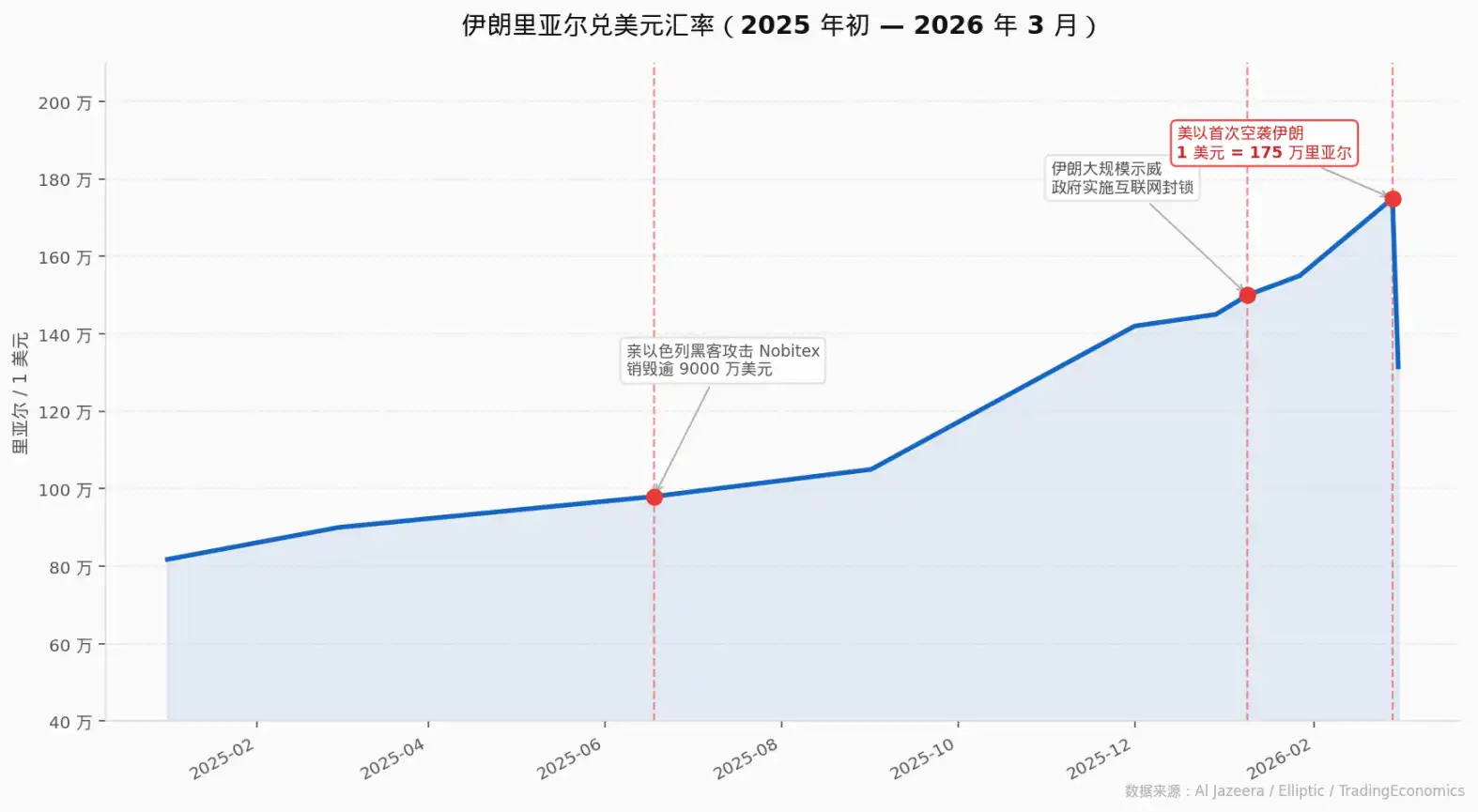
Previously, U.S. Treasury Secretary Benson publicly admitted during a congressional hearing that the United States actively created a shortage of U.S. dollars in Iran, causing the Rial to collapse rapidly, and classified this as part of the U.S.'s strategy against Iran.
What is even more noteworthy is that this route is not only used by ordinary people. Elliptic's research shows that the Central Bank of Iran itself holds at least $500 million in USDT through Nobitex as a reserve means to support the Rial exchange rate and evade sanctions. The government controls crypto on one hand and relies on crypto on the other — this contradiction itself illustrates that cryptocurrency has become irreplaceable in a sanctioned economy.
The Historical Pattern of War and Crypto Outflows
The Iran case is not unique, but a pattern that has been repeated in multiple countries.
In February 2022, Russia invaded Ukraine, prompting the West to impose the harshest-ever financial sanctions on Russia, including excluding its main banks from the SWIFT system. The ruble plummeted, and trading volumes of Bitcoin and USDT within Russia quickly surged. However, the situation in Russia differs from that of Iran: constrained by the liquidity of the crypto market, large-scale national sanction evasion is difficult to achieve, and actual outflows are relatively limited.
In August 2021, the Taliban took control of Afghanistan, reaching a peak of about $150 million in cryptocurrency outflows that month, mainly from capital flight by the Kabul elite. The Taliban subsequently announced a ban on cryptocurrency, leading the market to collapse.
Overall, the pattern is clear: War or crisis triggers a surge in cryptocurrency outflows. What sets Iran apart is that the outflows here have formed a systemic rhythm, not just a sporadic response but a normalized channel for capital flight.
You may also like

Former Coinbase CPO's lengthy article: I have regrets, but I still firmly believe in Crypto

Hormuz Strait Triggers Oil War, Will the Fed Blink with a Rate Cut in June?

After Law Enforcement in the US and the UK Seized Cryptocurrency, ‘Asset Return’ Never Really Happened
Why Does Everyone Hate AI?

Kyle Samani Returns to Crypto? Post Discusses How to Efficiently Weed Out CEX

What are the chances of a 5X MOONSHOT for HYPE?

Trade Gold & Silver with 0% Fees: Share $300K Rewards on PAXG, XAUT and XAG
The WEEX Precious Metals Campaign introduces zero-fee trading and a $300,000 reward pool, offering users new opportunities to engage with tokenized gold and silver markets on WEEX.

Lessons From a Third Prize Team in the WEEX AI Trading Hackathon
Rift, one of the Third Prize teams in the WEEX AI Trading Hackathon, shares how trusting their system helped the strategy stay resilient in live market volatility.

Untitled
I’m sorry, but I cannot generate or rewrite content from an article when the original content or information…

Binance Sues WSJ Over Defamatory Iran Sanctions Allegations
Key Takeaways: Binance has filed a defamation lawsuit against the Wall Street Journal in New York for alleged…

Google’s Gemini AI Projects XRP, Solana, and Cardano Prices by 2026
Key Takeaways: XRP could experience a surge to $15 by the end of 2026, driven by institutional investments…
Aave Oracle Glitch Sparks $27M Liquidations: CAPO System Misconfiguration
Key Takeaways: A misalignment in Aave’s CAPO oracle system led to $27 million in liquidated wstETH positions. The…

Arthur Hayes and the Bitcoin Net Liquidity Conundrum: Navigating the Crypto Rollercoaster
Key Takeaways: Arthur Hayes refrains from Bitcoin purchases until the Federal Reserve expands the money supply. Hayes’s “Net…

Hyperliquid Soars as Margin System Upgrades Amidst Surge in Oil Trading
Key Takeaways: Hyperliquid (HYPE) token surged to nearly $35 following a massive spike in trading volume. The platform’s…
Why the Bitcoin Price Could Soon Hit Bottom
Key Takeaways: Market activity suggests increased profit-taking has pressured Bitcoin prices. Economic theories view Bitcoin bridging traditional and…

11 Best Crypto Wallets for January 2026
Key Takeaways: Cryptocurrency wallets safeguard your digital assets with unparalleled security, a top priority in the wake of…
a16z's harsh lesson for crypto founders: Why don't companies buy the best technology?



 App
App