
- Buy Crypto
- Markets
 Futures
- Spot
- Copy Trade
- Earn
- More
Advertisement on American Primetime TV Feels Like a Scam

This year's "American Spring Festival" Super Bowl, as usual, captured plenty of eyeballs. The game itself, Mr. Beast's million-dollar puzzle-solving challenge, the halftime show... An originally American-exclusive sports event that, backed by numerous entertainment factors, managed to attract global attention.
Before we begin, let's first experience the liveliness of the American Spring Festival from a first-person perspective:

(Video Source: https://www.tiktok.com/t/ZP89Vvjyr/)
In such a high-density of attention, three incidents that went viral happened to align perfectly with our expectations for the prediction market: an insider who bet on the halftime show's guest performer with a perfect win rate on the prediction market Polymarket, a "die-hard fan" who was arrested on-site, and a covertly filmed video of a popular internet celebrity that went viral through the prediction market, only to be revealed as a marketing stunt.
The "Perfect Win Rate" in the Prediction Market: New Account Achieves High Win Rate Predicting Halftime Show Lineup
Approximately 48 hours before the Super Bowl kickoff, nearly $80,000 was deposited into a newly registered account on the prediction market Polymarket. Subsequently, the account concentrated all funds to bet on events related to the halftime show's guest performers and song lineup, covering predictions such as Lady Gaga performing and Travis Scott not performing, among others, totaling 19 betting transactions.
After the halftime show, out of these 19 bets, 17 were correct, resulting in a profit of $17,600. A new account, heavily invested in a single event, achieved an almost perfect win rate. This far exceeds mere luck.
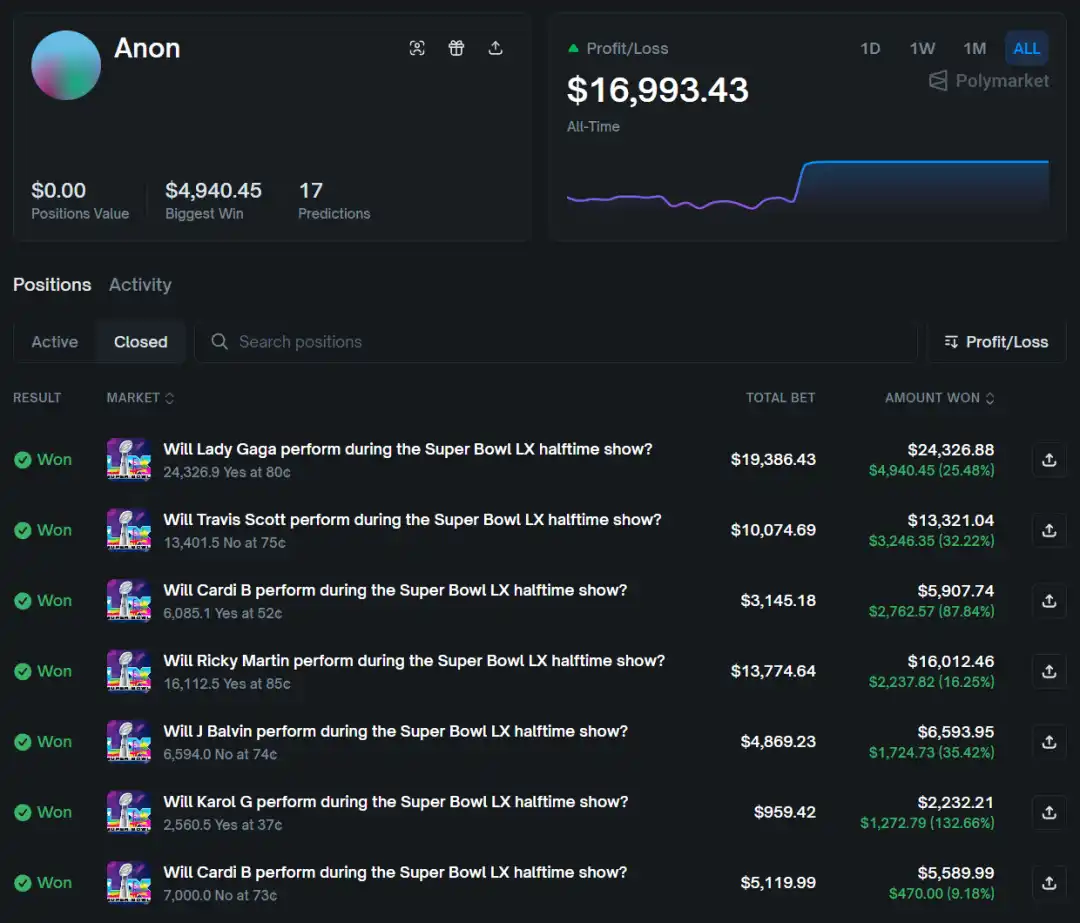
Due to the halftime show at the Super Bowl being long-term planned and produced by Roc Nation, the community quickly began speculating that the account owner likely had access to insider information, possibly even having ties to the production team. In this event with a trading volume exceeding ten million dollars, while ordinary traders were still blindly speculating, this insider might have been holding the program schedule in one hand and locking in profits early with a phone in the other.
However, the anonymity of the blockchain also means that this claim remains mere speculation. This transaction has also become another classic example of defining the prediction market as a platform where insiders capitalize on information asymmetry.
Trader Bets on "Field Invasion" and Then Invades the Field
If insider trading is profiting from information disparity in the shadows, then the operation of a "fan" during a game is a publicly staged sunlit scheme. He is also the protagonist in the video at the beginning of our article.
During the fourth quarter of the game, a shirtless fan climbed over the fence and ran onto the Super Bowl field, with the full attention of the cameras and TV broadcast focusing on this uninvited guest in an instant. His bare chest was covered in body paint, with "Trade in the blind spot" written on the front and his account ID "@fxalexg" and the advertisement "Trade with Athena" on the back.

From stepping onto the field to being tackled by security, he ran on the field for a total of 30 seconds. The advertised price for a 30-second ad spot during the Super Bowl is $7 million.
It wasn't until the audience pulled out their phones to search for his account that they realized this "fan" was no ordinary spectator but a trader — Alex Gonzalez. The message on his body was essentially a mobile advertisement.
What's even more intriguing is that, according to Sportscasting, Gonzalez had conducted a similar operation as early as 2024. At that time, he bet $5,000 that "someone will invade the field during the Super Bowl," rushed onto the field during the game, and ultimately made a profit of about $110,000; after deducting bail and legal fees, his net profit was still about $70,000.
Meaning, he not only created an event on the field but may have also bet in the prediction market that he would create the event.
When the odds are high enough, some people no longer predict the future but instead actively create it. This is also the most extreme and ironic expectation we have for the prediction market.
"Leaked" Video of Influencer Betting Millions of Dollars Was Actually a Marketing Stunt
Another video from this year's Super Bowl that went viral on the internet came from top influencer Logan Paul — in the footage, his phone screen was displaying Polymarket's betting interface as he was betting a million dollars on which team would win. The video was blurry, with a tilted angle, resembling a candid shot by a backseat audience member.
Shortly after this 12-second "leaked" video spread, the Polymarket official account retweeted it, and the heat and traffic came as expected. However, this transaction never appeared in our PolyBeats feed dedicated to monitoring prediction market trades.
Through in-depth research, it has been found that the so-called 'Million Dollar Bet' never took place. What seemed to be a highly explosive and voyeuristically satisfying 'behind-the-scenes look' was nothing but a carefully orchestrated marketing stunt: back in December 2025, Logan Paul joined the venture capital firm Anti Fund as a partner, a firm that was one of the investors in Polymarket's Series B funding round in 2025.
When a globally anticipated sports event is combined with prediction markets, advertising markets, and traffic markets, the boundaries of the game are no longer limited to the two competing teams. Beyond odds, there is also exposure pricing; beyond the spread, there is narrative design.
Driven by money and attention, each 'explosive moment' we see flooding our social media feeds may not be a spur-of-the-moment decision but rather the result of months-long planning.
You may also like

Who Will Control AI? Why Decentralized AI May Be the Only Alternative to Government and Big Tech
AI has become critical infrastructure, and governments and corporations are competing to control it. Centralized development and regulation are entrenching existing power structures. The Web3 community is building a decentralized alternative — distributed compute, token incentives, and community governance — before that window closes.

Vitalik wrote a proposal teaching you how to secretly use AI large models

On the eve of the explosion of on-chain options

WEEX AI Hackathon: How Did This AI Trading Winner Succeed?
A self-taught AI trading enthusiast achieved top-10 results at the WEEX AI Hackathon. Learn about the mindset, AI tools, and lessons behind this impressive performance.

One Balance to Rule Them All: Gravitas' On-Chain Prime Broker Ambition

That person who cashed out at the NFT peak is now selling a new shovel in the OpenClaw craze

Inter-generational Prisoner's Dilemma Resolution: The Nomadic Capital and Bitcoin's Inevitable Path

Upstream and downstream are starting to fight, all for the sake of everyone being able to "Lobster"

Circle and Mastercard Announce Partnership, the Next Stage for the Crypto Industry Belongs to Payments

From 5 Mao per kWh of Chinese electricity to a $45 API export: Tokens are rewriting currency units

Why is OpenAI playing catch-up to Claude Code instead?

Vitalik wrote a proposal teaching you how to secretly use AI large models

The doubling of Circle's stock price and the paradigm shift of stablecoins

Key Market Information Discrepancy on March 13th - A Must-See! | Alpha Morning Report

On-Chain Options Explosion.ActionEvent

《Time》 Magazine Names Anthropic as the World's Most Disruptive Company
Predictions market gains mainstream traction in the US, Canada, Claude launches Chart Interaction feature, What's the English community talking about today?

500 Million Dollars, 12 Seconds to Zero: How an Aave Transaction Fed Ethereum's "Dark Forest" Food Chain
Who Will Control AI? Why Decentralized AI May Be the Only Alternative to Government and Big Tech
AI has become critical infrastructure, and governments and corporations are competing to control it. Centralized development and regulation are entrenching existing power structures. The Web3 community is building a decentralized alternative — distributed compute, token incentives, and community governance — before that window closes.
Vitalik wrote a proposal teaching you how to secretly use AI large models
On the eve of the explosion of on-chain options
WEEX AI Hackathon: How Did This AI Trading Winner Succeed?
A self-taught AI trading enthusiast achieved top-10 results at the WEEX AI Hackathon. Learn about the mindset, AI tools, and lessons behind this impressive performance.


 App
App