
- Buy Crypto
- Markets
 Futures
- Spot
- Copy Trade
- Earn
- More
A nearly 20% one-day plunge, how long has it been since you last saw a $60,000 Bitcoin?

Original Article Title: "Nearly 20% Single-Day Plunge, How Long Has It Been Since You Saw a $60,000 Bitcoin?"
Original Article Author: jk, Odaily Planet Daily
In the past 24 hours, the cryptocurrency market has experienced the most severe sell-off of the year, with major coins collectively plunging over 15%, and panic sentiment spreading.
According to OKX data, the BTC price plummeted to a low of $60,000, with a 24-hour maximum drop of 18%, currently trading at around $63,150; Ethereum fell below $2,000, dropping to a low of $1,744, currently trading at $1,860, a 24-hour drop of 13.7%; Solana fell below $70, dropping to a low of $67, with a 24-hour plunge of 19%. The mainstream coins have all dropped by over 12%.
Major Assets Suffer Heavy Losses
According to the latest CoinGecko data, as of the time of writing, the Bitcoin price is reported at $63,576, a 13.3% plunge in the last 24 hours, this time yesterday Bitcoin was still at $73,311. Bitcoin's market value has evaporated by over $160 billion, and the 24-hour trading volume has surged to $142.4 billion, indicating intensified market panic selling.
Ethereum has suffered a more severe blow, with the price dropping to $1,848, a steep 14.3% decline in 24 hours. This is the first time Ethereum has dropped below the psychological level of $1,900 since April 2025. Ethereum's market value has shrunk to $224 billion, with a 24-hour trading volume of $61.5 billion.
Other mainstream coins have not been spared either. BNB dropped to $611, a 12.4% decline, with a market value shrinking to $83.3 billion. Solana plummeted by 14.0% to $79, with a market value falling below $45 billion. Altcoins such as XRP and Cardano saw widespread declines of over 15%.
Record Market Liquidation Scale
This round of plunge has triggered a large-scale liquidation. According to Coinglass data, the total market liquidation amount in the past 24 hours exceeded $26.6 billion, with long positions accounting for as high as 87%. The single-day liquidation scale ranks 10th in history, second only to the sell-off triggered by the tariff crisis in April 2025.
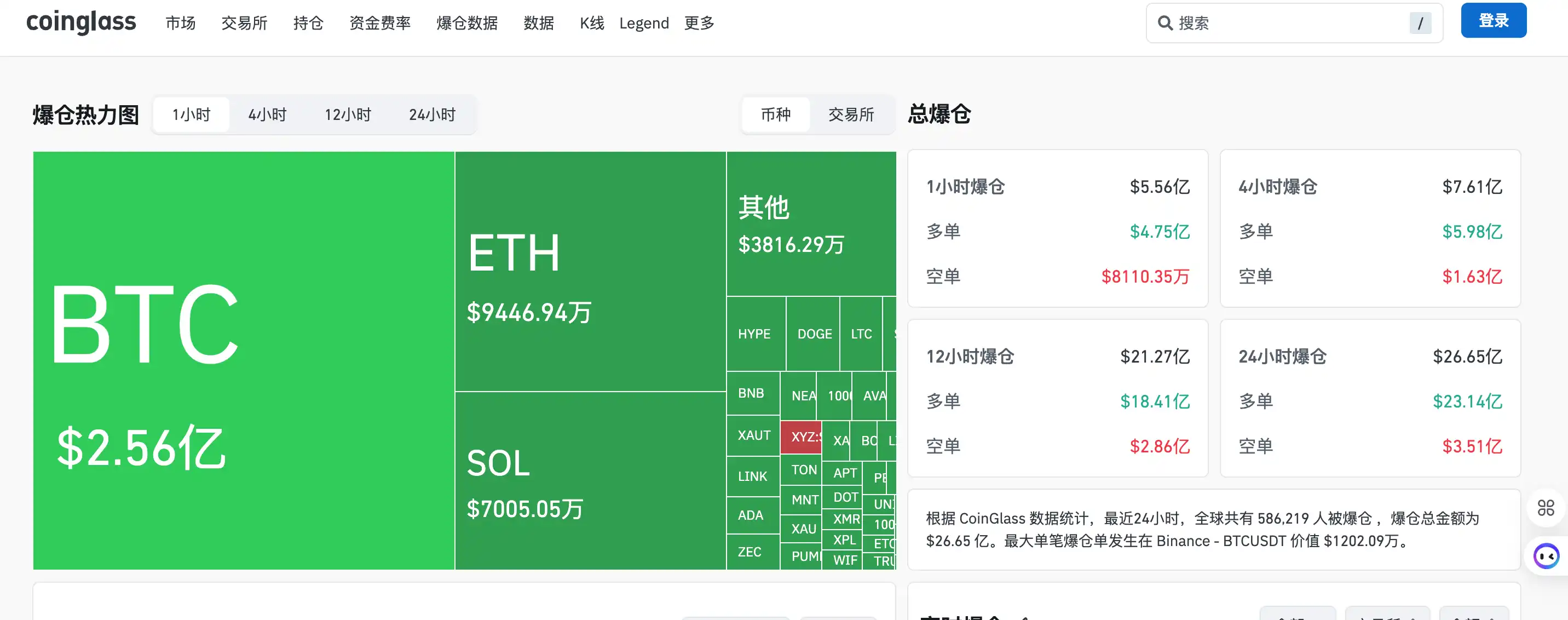
More than 580,000 traders were liquidated in this recent crash, and the cascading liquidations intensified the market's downward pressure, creating a vicious cycle.
Multiple Factors Combine to Trigger Panic
The recent crash was not caused by a single factor but rather the result of multiple bearish factors resonating together. During the previous selloff, the market was concerned about the hawkish stance of Kevin Warsh, the nominee for the new Federal Reserve Chair. Warsh is believed to pursue a stricter inflation control policy than Powell, implying a longer period of high interest rates. Meanwhile, the US Dollar Index saw a strong rebound, directly suppressing dollar-denominated risk assets. Historical data shows a significant negative correlation between Bitcoin's price and the US Dollar Index, with a strong dollar typically leading to a sell-off of crypto assets. The continued outflow of institutional funds further exacerbated the market pressure. According to data from The Block, the US Bitcoin spot ETF saw a net outflow of $272 million on February 4, and the Ethereum spot ETF experienced a $252 million fund withdrawal on January 30. The large-scale exodus of institutional investors indicates a sharp decline in market risk appetite.
Future Market Outlook
The market generally expects continued consolidation in the short term, making a V-shaped reversal unlikely. Key reasons include the structural weakness of altcoins, retail investor risk aversion, and the market's high sensitivity to news. Many altcoins have dropped by over 20%, are structurally bearish, and continue to face selling pressure from retail investors. Retail investors, after suffering significant losses, are generally risk-averse, leading to a decline in speculative demand. Additionally, the market is extremely sensitive to geopolitical news such as trade relations and changes in monetary policy.
Facing the current market environment, investors are advised to strictly manage risks, avoid over-leveraging, and set reasonable stop-loss levels. Investors should focus on high-quality projects, choosing projects with strong fundamentals and practical use cases. Maintaining a long-term perspective is also crucial; historical data shows that the crypto market is cyclical, with recovery following each major downturn. Finally, during periods of panic, be wary of emotional trading, avoid chasing rallies, and rationally assess the market situation.
You may also like

2025 South Korea CEX Listing Post-Mortem: Investing in New Coins = 70% Loss?

BIP-360 Analysis: Bitcoin's First Step Towards Quantum Immunity, But Why Only the "First Step"?

50 million USDT exchanged for 35,000 USD AAVE: How did the disaster happen? Who should we blame?

The Cryptographic Past of the Middle East

Resolving the Intergenerational Prisoner's Dilemma: The Inevitable Path of Nomadic Capital Bitcoin

Who Will Control AI? Why Decentralized AI May Be the Only Alternative to Government and Big Tech
AI has become critical infrastructure, and governments and corporations are competing to control it. Centralized development and regulation are entrenching existing power structures. The Web3 community is building a decentralized alternative — distributed compute, token incentives, and community governance — before that window closes.

Vitalik wrote a proposal teaching you how to secretly use AI large models

On the eve of the explosion of on-chain options

WEEX AI Hackathon: How Did This AI Trading Winner Succeed?
A self-taught AI trading enthusiast achieved top-10 results at the WEEX AI Hackathon. Learn about the mindset, AI tools, and lessons behind this impressive performance.

One Balance to Rule Them All: Gravitas' On-Chain Prime Broker Ambition

That person who cashed out at the NFT peak is now selling a new shovel in the OpenClaw craze

Inter-generational Prisoner's Dilemma Resolution: The Nomadic Capital and Bitcoin's Inevitable Path

Upstream and downstream are starting to fight, all for the sake of everyone being able to "Lobster"
Circle and Mastercard Announce Partnership, the Next Stage for the Crypto Industry Belongs to Payments

From 5 Mao per kWh of Chinese electricity to a $45 API export: Tokens are rewriting currency units

Why is OpenAI playing catch-up to Claude Code instead?

Vitalik wrote a proposal teaching you how to secretly use AI large models

The doubling of Circle's stock price and the paradigm shift of stablecoins
2025 South Korea CEX Listing Post-Mortem: Investing in New Coins = 70% Loss?
BIP-360 Analysis: Bitcoin's First Step Towards Quantum Immunity, But Why Only the "First Step"?
50 million USDT exchanged for 35,000 USD AAVE: How did the disaster happen? Who should we blame?
The Cryptographic Past of the Middle East
Resolving the Intergenerational Prisoner's Dilemma: The Inevitable Path of Nomadic Capital Bitcoin
Who Will Control AI? Why Decentralized AI May Be the Only Alternative to Government and Big Tech
AI has become critical infrastructure, and governments and corporations are competing to control it. Centralized development and regulation are entrenching existing power structures. The Web3 community is building a decentralized alternative — distributed compute, token incentives, and community governance — before that window closes.


 App
App