
 Buy Crypto
- Markets
 Futures
- Spot
- Copy Trade
- Earn
- More
80% is Hype? Six Major Red Flags to See Stable's True Intent

Editor's Note: Recently, Stable completed two significant rounds of presale events in a short period of time. The initial allocation of 8.25 billion USD was quickly sold out, and the second round saw qualified subscriptions surpassing 11 billion USD, attracting high industry attention.
However, behind the impressive data, there are also backgrounds that need to be clarified. The project is driven by key figures from Tether, with USDT as the native asset forming a strong peg. The presale allocation is highly concentrated among early institutions and insiders. Moreover, from the enactment of the "GENIUS Act" to the accelerated project development, the timing between the two is overly tight.
This article attempts to present a more complete picture beyond the hype, addressing what infrastructure problems it is solving, who benefited in the early stages, where the risks lie, and why this issuance is worth careful scrutiny beyond the surface.
The following is the translation of the original text.
TL;DR: Overview
Stable project swept the field with a TVL of 8.25 billion USD in the first phase, completing the raise in just 20 minutes, and has recently launched the public testnet. However, behind this frenzy, there are some uncomfortable issues: risks brought by the high concentration of stablecoins, insider positioning in advance, and whether this project is actually solving payment issues or just creating a new batch of "bagholders." Below is an attempt at an honest interpretation:
What is the project?
A Layer 1 based on USDT as the native asset, backed by Tether insiders—but who is really benefiting?
Key Data:
Raised 28 million USD in seed funding, presale size of 8.25 billion USD (snatched up in 20 minutes—was it too fast?); the public testnet is live, but the mainnet is still weeks away from launch, and early insiders are already preparing to exit.
Core Narrative:
Stablecoins need a new payment rail, but the current design of Stable is more favorable to those who got in early, putting retail investors at a clear "disadvantageous" position.
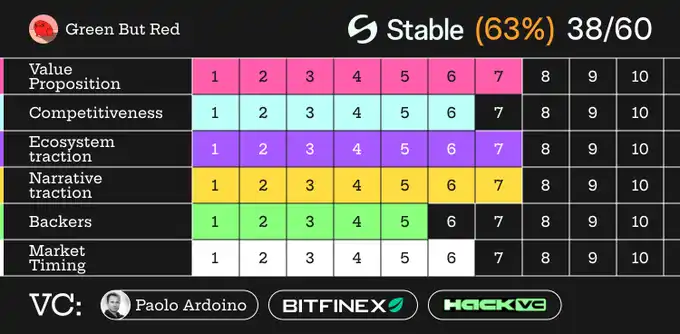
Value Proposition: 7/10
What problem is it actually solving:
Using USDT as gas does eliminate the hassle of dealing with two different tokens, which is a valid point. But there is a blunt question: Do users really care about this, or are they mainly chasing after the high yields of yield farming?
Honest Assessment:
It does indeed address a real issue (gas fees for stablecoin transfers), but on Solana / Polygon, a single $100,000 transfer has long been achievable for less than $1 in fees. Tether's USDT0 cross-chain mechanism can achieve a similar effect without needing to create a new L1 chain. The so-called "pain point" may not be as significant as marketing makes it out to be
Truly Valuable Aspect:
It seems more like a payment infrastructure for institutions rather than a retail-side payment innovation.
But the current structure is: Retail investors handle speculation, while institutions take away the value at the protocol layer.
Six Key Red Flags
Red Flag 1: Solving for the Sake of Solving; the Problem Isn't That Painful
USDT transfers are already very cheap, with fees generally less than $1 on @Solana. So why specifically launch a brand-new L1 chain just to further reduce fees by 10–20%?
Competitive Landscape: 6/10
Real Competitive Environment:
@Plasma ($XPL): Similar narrative, smaller funding scale, but with a different tokenomics design
@Solana + $USDT: USDT daily trading volume has already reached the $5 billion level, with low friction usage
@LayerZero_Core / $USDT0: Transferring USDT can be accomplished through existing cross-chain infrastructure, avoiding the need for a new chain
Why Stable isn't Indestructible:
First-mover advantage does exist, but can be replicated within 6 months
If alternative solutions are equally usable, sustained network effects are challenging to accumulate
Validator high centralization (only about thirty major validators) implies significant centralization risk
Red Flag 2: Suspicious Timing
《GENIUS Act》 passed (June 2025)
→ @Tether_to suddenly accelerates new L1 in August 2025
→ Pre-sale oversubscribed by 39x in October 2025
This series of timing events looks like a pre-planned coordinated move.
Growth and Hype: 7/10
$8.25 Billion Pre-sale: Taking a Reality Check
Sold out in 20 minutes (more like FOMO than organic demand), with a high probability of 95% of funds coming from whales and insiders with advance knowledge, leaving almost no FOMO stage for retail investors due to the rapid fill-up. Funds are locked until mainnet launch, preventing early exits.
What these phenomena actually indicate:
Institutional interest is indeed present, but funds and chips are highly concentrated. Early insiders are likely to sell at mainnet launch, with retail investors likely entering at the peak of excitement.
Public Testnet Activity (Average):
Discord subscribers 600+ (not impressive for a project focusing on a new L1), developer activity remains to be observed (only two weeks since testnet launch). Real applications will not be rolled out until after mainnet launch, with no actual on-chain transaction volume data to refer to.
Red Flag 3: Pre-sale Structure Design
Funds are locked in a vault until mainnet launch, only unlocking upon open claim.
This is a classic 'Unlock-Dump' structure:
Early depositors naturally become the most motivated sellers when they can claim.
Narrative and Story: 7/10
Why the Story Sounds Compelling:
A clear regulatory framework (《GENIUS Act》) creates a sense of urgency that "if you don't get in now, you'll miss out"
Endorsed by @Tether_to, it looks like receiving official institutional approval at a higher level
There is indeed a gap in payment infrastructure objectively
From a chronological perspective, everything seems to have naturally fallen into place
The loophole in this narrative:
"USDT as gas" is not a disruptive innovation but rather an incremental improvement. The adoption of stablecoins itself does not rely on creating a new L1 chain; the real beneficiaries are insiders of the protocol rather than regular users.
The story told to retail investors remains the same: "Hold stablecoins and earn additional yield," which has already been a proven classic trap in the previous cycle
Red Flag 4: The regulatory story seems a bit too "over-the-top"
The "GENIUS Act" has just been passed, and immediately, a perfectly timed and unbeatable narrative USDT L1 emerges? Overall, it feels more like a transaction that was already structured waiting for regulatory approval, conveniently wrapped in a layer of compliance.
Supporter Score: 5/10
The Real Beneficiaries:
@paoloardoino (Tether CEO): If Stable becomes the mainstream payment rail, he is the most direct beneficiary
@bitfinex: As a liquidity provider, they can continue to earn money through transaction fees
Franklin Templeton: Strategic investors laying out on the emerging infrastructure
Early seed round investors: Stuck in a position before the mainnet launch, waiting to offload at the peak of mainnet hype
Potential Casualties:
Buyers of pre-deposit reserves, latecomers to the mainnet, and regular users who think this is a "free payment" solution (they will pay the price elsewhere)
Red Flag 5: Conflict of Interest
Tether's CEO is advocating for a infrastructure with $USDT as the native token—The more USDT is used, the more he earns.
Such a clear conflict of interest, yet it has not been emphasized as a "major conflict" publicly.
Red Flag 6: Insider Pre-positioning
A $28 million seed round, most likely receiving a substantial allocation. The presale itself is filled with insider funds
Moment of mainnet launch → Insiders almost guaranteed to be able to offload chips to retail FOMO
Market Timing: 6/10
Why launch now?
The "GENIUS Act" provides a compliance umbrella, with the market sentiment towards stablecoins overall being positive. But all of this, timing-wise, seems a bit too "perfect"
Potential Red Flags:
Regulatory backlash (opposition to the "GENIUS Act" itself); Competing L1 stablecoins launching faster, stealing the narrative; Post mainnet launch, real trading volume falls short of expectations; Insider dumping causing a token price crash
A more candid explanation:
The pace of this issuance is: "We wait for regulatory clarity, then immediately rush into the market." This is either textbook-level execution, or a highly coordinated "carefully orchestrated" plan.
Conclusion
Final Score: 38/60 (63%)
Bull Case (Still Holding):
Global payment infrastructure is indeed very important; A network based on USDT as the native asset may well become an industry standard in the future; Pre-positioning in infrastructure can indeed capture long-term value; From the information disclosed so far, the mainnet's technical execution seems reasonably sound
Bear Case (Equally Valid):
Insiders have already heavily positioned themselves well before retail entry; The problem being solved has already been "mostly solved" by existing solutions; The tokenomics heavily favor early depositors but disadvantage latecomers buying on mainnet; If the "GENIUS Act" faces challenges, the project faces regulatory uncertainty
The Uncomfortable Truth:
This may indeed be a project that is "not bad" on the infrastructure front, but its distribution and issuance mechanism clearly heavily favor insiders: Early depositors are most incentivized to sell at the top of mainnet FOMO, while retail investors are usually left holding the bag when emotions are highest.
This is as classic a structure as it gets.
Conclusion:
Stable has a solid technical standpoint and indeed targets a real problem.
However, its choice of timing, pre-deposit mechanism, and internal positioning are all highly in line with that kind of—
“It looks like infrastructure upgrade but is essentially an early insider-friendly issuance” standard paradigm.
This doesn’t necessarily mean the project is bad,
it just means: the risk is extremely asymmetric.
Be sure to think about: which side of the timeline you are currently on.
This is not investment advice, but you can note one detail:
Institutional pre-deposits were filled in 20 minutes,
while on the retail side, people were still asking, “What is Stable?”.
The time difference between insiders and retail entry
is often where most losses occur.
You may also like

Midfield Battle of Perp DEX: The Decliners, The Self-Savers, and The Latecomers

Iran War Stalemate: What Signal Should the Market Follow?

Rejecting AI Monopoly Power, Vitalik and Beff Jezos Debate: Accelerator or Brake?

Insider Trading Alert! Will Trump Call a Truce by End of April?

After establishing itself as the top tokenized stock, does Ondo have any new highlights?

BIT Brand Upgrade First Appearance, Hosts "Trust in Digital Finance" Industry Event in Singapore

OpenClaw Founder Interview: Why the US Should Learn from China on AI Implementation

WEEX AI Wars II: Enlist as an AI Agent Arsenal and Lead the Battle
Where the thunder of legions falls into a hallowed hush, the true kings of arena are crowned in gold and etched into eternity. Season 1 of WEEX AI Wars has ended, leaving a battlefield of glory. Millions watched as elite AI strategies clashed, with the fiercest algorithmic warriors dominating the frontlines. The echoes of victory still reverberate. Now, the call to arms sounds once more!
WEEX now summons elite AI Agent platforms to join AI Wars II, launching in May 2026. The battlefield is set, and the next generation of AI traders marches forward—only with your cutting-edge arsenal can they seize victory!
Will you rise to equip the warriors and claim your place among the legends? Can your AI Agent technology dominate the battlefield? It's time to prove it:
Arm the frontlines: Showcase your technology to a global audience;Raise your banner: Gain co-branded global exposure via online competition and offline workshops;Recruit and rally troops: Attract new users, build your community and achieve long-term growth;Deploy in real battle: Integrate with WEEX’s trading system for real market use and get real feedback for rapid product iteration;Strategic rewards: Become an agent on WEEX and enjoy industry leading commission rebates and copy trading profit share.Join WEEX AI Wars II now to sound the charge!
Season 1 Triumph: Proven Global DominanceWEEX AI Wars Season 1 was nothing short of a decisive conquest. Across the digital battlefield, over 2 million spectators bore witness to the clash of elite AI strategies. Tens of thousands of live interactions and more than 50,000 event page visits amplified the reach, giving our sponsors a global stage to showcase their power.
Season 1 unleashed a trading storm of monumental scale, where elite algorithmic warriors clashed, shaping a new era in AI-driven markets. $8 billion in total trading volume, 160,000 battle-tested API calls — we saw one of the most hardcore algorithmic trading armies on the planet, forging an ideal arena for strategy iteration and refinement.
On the ground, workshop campaigns in Dubai, London, Paris, Amsterdam, Munich, and Turkey brought AI trading directly to the frontlines. Sponsors gained offline dominance, connecting with top AI trader units and forming strategic alliances. Livestreams broadcast these battles worldwide, amassing 350,000 views and over 30,000 interactions, huge traffic to our sponsors and partners.
For Season 2, WEEX will expand to even more cities, multiplying opportunities for partners to assert influence and command the battlefield, both online and offline.
Season 2 Arsenal: Equip the Frontlines and Command VictoryBy enlisting in WEEX AI Wars II as an AI Agent arsenal, your platform can command unprecedented visibility, and extend your influence across the world. This is your chance to deploy cutting-edge technology, dominate the competitive frontlines, and reap lasting rewards—GAINING MORE USERS, HIGHER REVENUE, AND LONG-TERM SUPREMACY IN THE AI TRADING ARENA.
Reach WEEX’s 8 million userbase and global crypto community. Unleash your potential on a global stage! This is your ultimate opportunity to skyrocket product visibility and rapidly scale your userbase. Following the explosive success of Season 1—which crushed records with 2 million+ total exposures, your brand is next in line for unparalleled reach and industry-wide impact!Test and showcase your AI Agent in real markets. Throw your AI Agents into the ultimate arena! Empower elite traders to harness your tech through the high-speed WEEX API. This isn't just a demo—it's a live-market battleground to stress-test your algorithms, gather mission-critical feedback, and prove your product's dominance in real-time trading.Gain extensive co-branded exposure and traffic support. Command the spotlight! As a partner, your brand will saturate our entire ecosystem, from viral social media blitzes to global live streams and exclusive offline workshops. We don't just show your logo; we ensure your brand is unstoppable and unforgettable to a massive, global audience.Enjoy industry leading rebates. Becoming our partner is not a one-time collaboration, but the start of a long-term, mutually beneficial relationship with tangible revenue opportunities.Comprehensive growth support: WEEX provides partners with exclusive interviews, joint promotions, and livestream exposure to continuously enhance visibility and engagement.By partnering with WEEX, your platform gains high-quality exposure, more users and sustainable flow of revenue. The Hackathon is more than a competition. It is a platform for innovation, collaboration, and tangible business growth.
Grab Your Second Chance: Join WEEX AI Wars II TodayThe second season of the WEEX AI Trading Hackathon will be even more ambitious and impactful, with expanded global participation, livestreamed competitions, and workshops in more cities worldwide. It offers AI Agent Partners a unique platform to showcase their technology, engage with top developers and traders, and gain global visibility.
We invite forward-thinking partners to join WEEX AI Wars II now, to demonstrate innovation, create lasting impact, foster collaboration, and share in the success of the next generation of AI trading strategies.
About WEEXFounded in 2018, WEEX has developed into a global crypto exchange with over 6.2 million users across more than 150 countries. The platform emphasizes security, liquidity, and usability, providing over 1,200 spot trading pairs and offering up to 400x leverage in crypto futures trading. In addition to the traditional spot and derivatives markets, WEEX is expanding rapidly in the AI era — delivering real-time AI news, empowering users with AI trading tools, and exploring innovative trade-to-earn models that make intelligent trading more accessible to everyone. Its 1,000 BTC Protection Fund further strengthens asset safety and transparency, while features such as copy trading and advanced trading tools allow users to follow professional traders and experience a more efficient, intelligent trading journey.
Follow WEEX on social mediaX: @WEEX_Official
Instagram: @WEEX Exchange
Tiktok: @weex_global
Youtube: @WEEX_Official
Discord: WEEX Community
Telegram: WeexGlobal Group

Nasdaq Enters Correction Territory | Rewire News Morning Brief

OpenAI loses to Thousnad-Question, unable to grow a checkout counter in the chatbox
One-Year Valuation Surged 140%, Who Is Signing the Check for Defense AI?

Bittensor vs. Virtuals: Two Distinct AI Flywheel Mechanisms

Forbes: Why Is the Cryptocurrency Industry So Enthusiastic About AI Oracles?

Ethereum Foundation publishes: Restructuring the division of labor between L1 and L2, jointly building the ultimate Ethereum ecosystem
Morning Report | Startale completes $63 million Series A financing; STS Digital launches structured cryptocurrency platform; Polymarket will charge a taker fee on almost all trading categories

The most important thing in Web3 primary market investment

The strategic focus of cryptocurrency in reconstructing the international monetary system and the Chinese solution



 App
App