
$100 Duel: Prediction Market vs Meme, Which Opportunity is Greater?

Original Article Title: Choosing Between Prediction Markets and Meme Coins.
Original Article Author: Baheet
Original Article Translation: Deep Tide TechFlow
In a recent post, I posed a question: with starting capital of only $100, which offers more opportunities for traders—trading Memecoin (via the Pumpfun platform) or prediction markets?
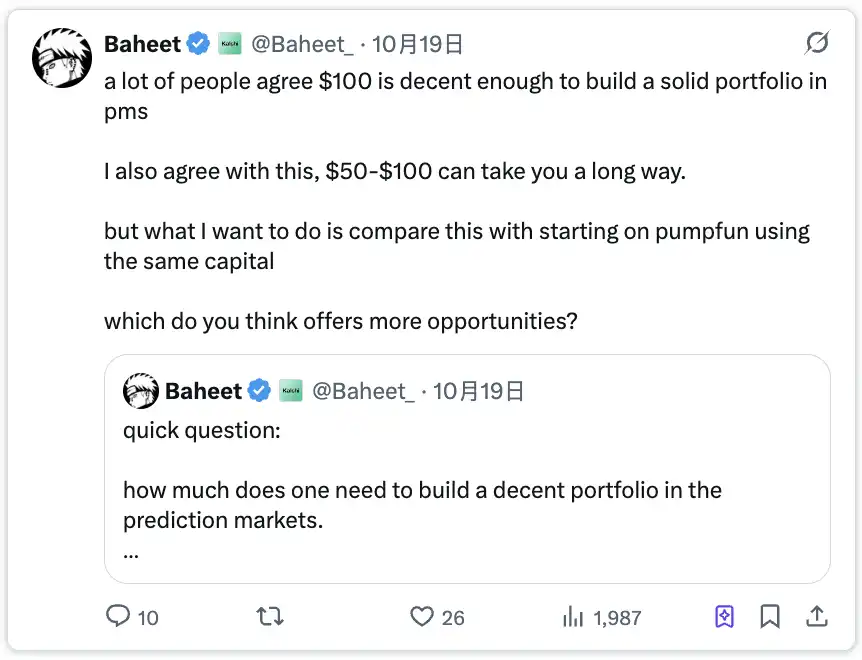
In my view, this is akin to comparing a game of chess to a casino slot machine: both may yield handsome returns, but one rewards strategy while the other relies on chaos and luck.
Next, we will delve into an analysis based on feasibility, risk, reward, advantages, and the impact of capital.
Market Mechanism
Prediction Markets
Prediction markets are structured prediction tools; top platforms like @Kalshi and @Polymarket allow users to trade based on the outcome of specific, verifiable events, such as election results, economic data releases, or specific price movements.
The price of contracts on prediction markets reflects the market's perception of the probability of a particular event occurring. For example, a contract priced at $0.80 indicates an 80% probability of the "yes" outcome.
Furthermore, these markets are highly regarded for their "wisdom of the crowd" effect, where the collective knowledge of participants leads to remarkably accurate predictions, something the Memecoin space cannot replicate.
The value of prediction market contracts is tied to verifiable real-world events. This underlying factor gives prediction markets a certain legitimacy, which is a core difference from Memecoin.
MemeCoin Trading on Pumpfun
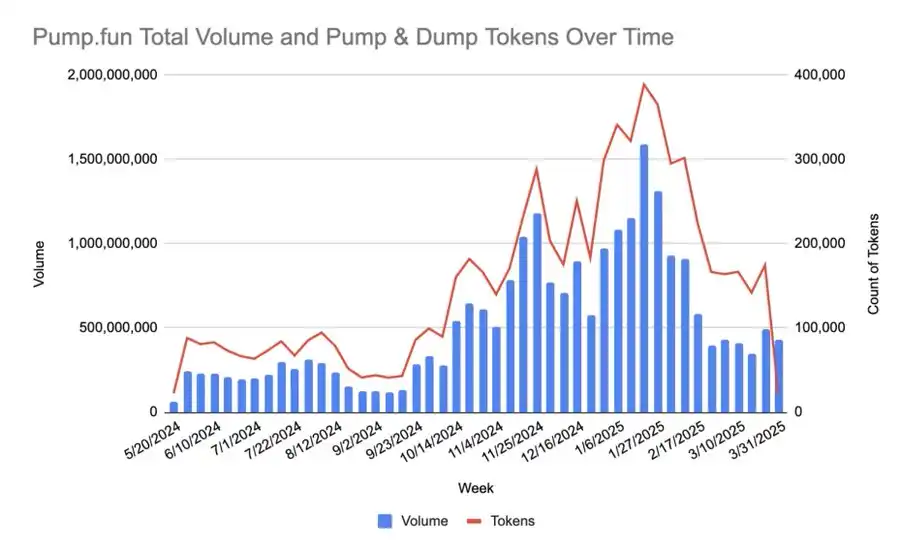
The Pumpfun platform allows users to swiftly create and trade new tokens via a bonding curve, causing prices to surge rapidly as more buyers join in. This low barrier to entry has attracted a plethora of untested new Meme projects.
The lifecycle of Memecoin typically follows a predictable yet chaotic pattern. After reaching a certain market cap, the token gets deployed to a decentralized exchange (such as @Raydium) and usually goes through an initial "pump" phase.
In fact, data from May 2025 shows that the majority of tokens fail after their initial issuance.
A report by @Solidus_Labs revealed that out of 7 million tokens launched on Pumpfun, 98.6% were classified as either "rug pulls" or manipulative projects.
Accessibility
Both markets are very friendly to small amounts of capital, with virtually no barriers to entry.
On the Polymarket platform, you can participate with as little as $10 in capital, for example, by betting on events such as elections or cryptocurrency price movements.
If you have $50-100, you can even diversify your investment across 5-10 events and optimize your bet sizing with a better strategy.
Pumpfun has a lower entry price, with the cost of creating a Memecoin being around 0.02 SOL (approximately $3 to $4 at current prices), and purchasing only requires loose change from your Solana wallet.
Initial trades typically happen at a smaller market cap, around $4,000, so $50 to $100 can get you a significant share early on.
Aside from network fees, there is no formal minimum requirement, making it ideal for "wild trading."
Risk, Reward, and Reality
Prediction markets are known for their quantifiable risks; the risk is explicit and tied to the outcome of an event. While a trader may lose their entire investment on a single contract, they can clearly understand the odds and event criteria from the start.
With thorough research, the potential rewards can be very high. Although these returns may not be as eye-catching as the price spikes of Memecoins, they are typically more sustainable and based on information-driven decisions.
Common risks in prediction markets include traders misjudging probabilities or insufficient market liquidity, but if only a small portion of the portfolio is wagered, full bankruptcy is contained and rare.
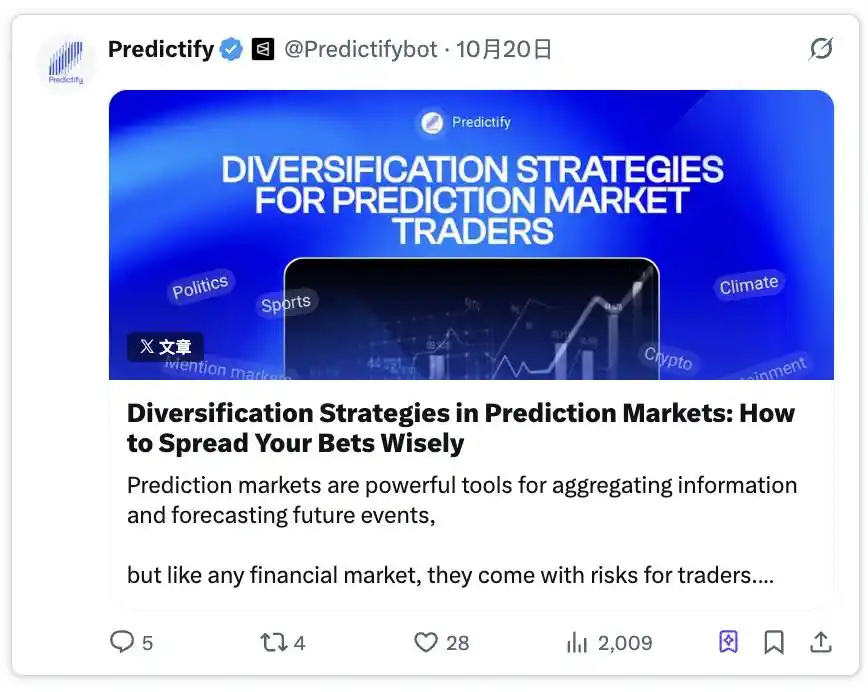
For most traders, a diversified prediction market investment portfolio offers a more structured way to engage in high-risk trading with more predictable outcomes.
Here is a quality article from @Predictifybot on how to diversify a prediction market investment portfolio:
Finally, due to the presence of the Commodity Futures Trading Commission (CFTC, responsible for regulating Kalshi), participants benefit from an additional layer of oversight and protection, reducing the risk of fraud and manipulation.
On the other hand, the Memecoin ecosystem is rife with scams, manipulation, and highly volatile price swings. Projects may exit scam, developers may rug pull liquidity, rendering the tokens in investors' hands worthless.
The value of a Memecoin is based on hype and social sentiment rather than any fundamental utility, making it highly susceptible to social media trends and "insider" trading.
While many people hope for significant, life-changing returns, the reality is that such success is very rare. Most participants either lose money or see minimal gains.
What Can $100 Do?
Effectively utilizing small capital (like $100) in prediction markets and Pumpfun requires highly specialized and fundamentally different strategies.
I believe the best strategy in prediction markets is to find events mispriced due to information asymmetry, but this is nearly impossible to apply to Pumpfun Memecoins.
Prediction Markets: Leveraging Information Asymmetry
A $100 capital cannot move the needle in prediction markets, so your strategy must act like a savvy analyst. Your advantage lies in discovering information the market collectively overlooks.
How It Works:
1. Identify Information Gaps: Market odds are based on the collective information of all traders. Low-volume markets may lack enough participants to truly function efficiently, offering an advantage to small capital traders.
2. Utilize Overlooked Expertise: If you possess specialized knowledge few in the market have, you can leverage that information. For example, in-depth understanding of local elections, specific technological developments, obscure legal cases, or match outcomes.
3. Focus on Low-Liquidity Markets: Larger liquidity markets are typically more efficient, but small capital can concentrate on smaller, less-traded markets where odds may not yet reflect all available information.
As a small-scale capital trader, your role is an information arbitrageur, and your goal is to find market inefficiencies caused by incomplete information.
Pumpfun: Survival of the Funnest
The concept of information asymmetry on Pumpfun is entirely different and more challenging to exploit. It involves less rational odds and relies more on insider information.
How It Works:
1. Insider Information is Key: In Pumpfun, information asymmetry is typically disadvantageous for regular traders. The creator of a Memecoin holds complete information and has many tools to manipulate trading.
2. Social and Emotional Leverage: The most potent "information" in this market is the viral potential of a cryptocurrency. Founders control the initial marketing, often relying on influencers and social media strategies to create FOMO.
3. Information Asymmetry: There is an advantage here. If you join the Solana meme community or seize an opportunity before a token's meteoric rise. However, the asymmetry is fleeting, with surges lasting from minutes to hours, and 97% of traders making less than $1,000 in profit.
Unlike prediction markets, there is no real probability here, only collective FOMO.
The strategy is simple: it's either serendipity or exit! Your Memecoin strategy involves only $100, as follows:
1. Seize Opportunities: DYOR (Do Your Own Research) and quickly get into new tokens, hoping to be part of the initial momentum.
2. Utilize Professional Tools: Many traders use bots to monitor new token listings and market activities to gain a few seconds of an edge.
3. Manage Risk Through Caution: Keep a close eye on price charts, spot signs of "developer dumps," and be ready to sell immediately.
On Pumpfun, your $100 is not used to exploit information asymmetry but is immersed in a market where information is weaponized by more powerful players. Your success has little to do with analysis and relies more on luck, timing, and avoiding falling victim to manipulative schemes.
Final Thoughts
At the end of the day, whether to engage in prediction markets or Memecoin trading on Pumpfun depends on the trader's risk preference.
While both offer the potential for high returns, they achieve this through fundamentally different mechanisms.
Prediction markets provide verifiable outcomes and potential regulatory oversight, offering a more structured and information-based approach to high-risk speculation.
On the other hand, Memecoin trading is more like gambling in a high-risk, unregulated casino where one may experience massive profits, but the risk of loss is significant due to scams and extreme volatility.
Here is an excellent post from @tradefoxintern discussing why prediction markets are poised to replace Memecoin:
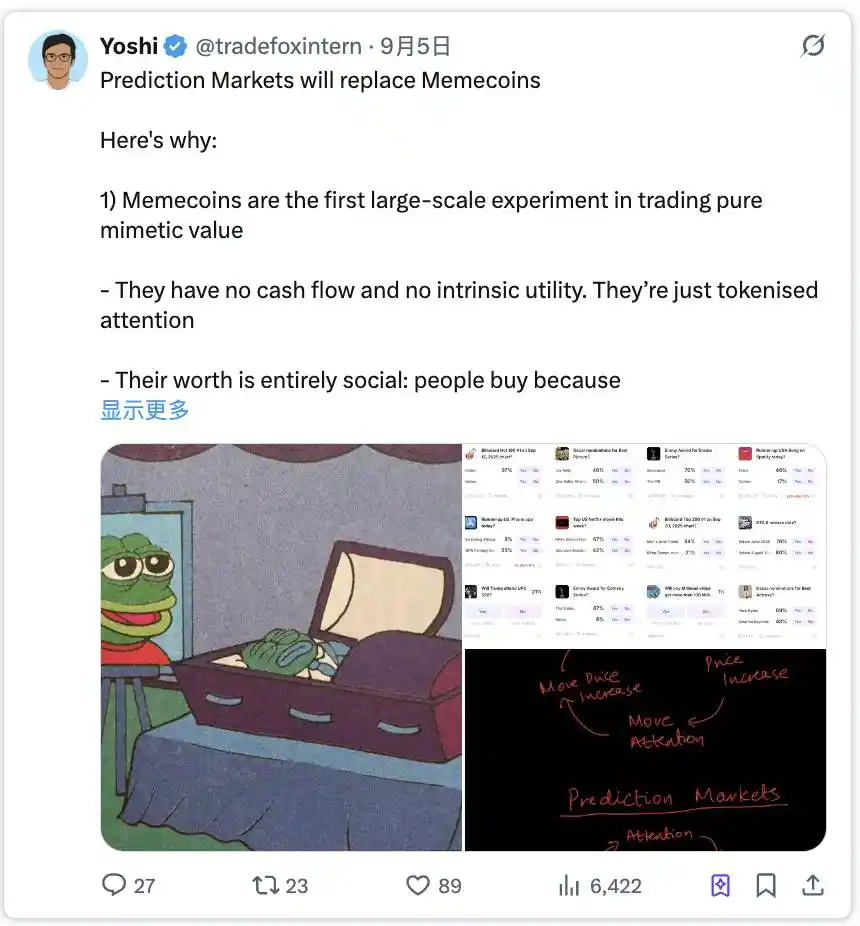
Therefore, for those who prefer a more calculated, research-driven approach, prediction markets are the clear choice.
For those seeking massive, lottery-like returns and willing to navigate through thousands of scams, Pumpfun remains an option.

John Wang: Remember my words, the scale of the prediction market will be 10 times that of Memecoin!
You may also like

A valuation of 8 billion dollars, doubling in 8 months! What makes the crypto-friendly bank Erebor Bank stand out?
340 billion valuation: Li Yanhong's largest IPO, a seat in Kunlunxin's shares is hard to come by
Stablecoins are the "royalists" of the crypto world: Open USD brings the old currency system into play
Cape Verde 2-3 Argentina: The Underdog Team That Stunned the World in Defeat
Cape Verde's run ended in a 3-2 defeat to Argentina, but their journey — three unbeaten draws, one heroic goalkeeper, and a fight that pushed the defending champions to the brink — is the kind of story markets recognize too: small caps can rattle blue chips long before anyone expects it.
Semiconductor stocks plummet, yet Anthropic wants to create a 2nm chip
Where is Zhao Changpeng's billion-dollar investment going? YZi Labs' investment landscape fully revealed
Ethereum Foundation Report: A Basic Guide to Ethereum for Governments and Financial Institutions
A pre-announced harvesting case: After the cryptocurrency price dropped by 99%, the public chain Saga exited to transform into AI
When American giants collectively "defect" from Chinese AI models
BIS Report Compliance Observation: The Real Risks of Stablecoins, Not Just "Depegging"
Portugal 2-1 Croatia: Ronaldo's 20-Year Knockout-Stage Drought Ends With a Debt Finally Collected
Portugal beat Croatia 2-1 in the 2026 global football championship's knockout rounds as Ronaldo scored his first-ever knockout-stage goal, Gonçalo Ramos struck a stoppage-time winner, and VAR ruled out a late equalizer for offside.
Bitcoin Price Prediction July 2026: Will BTC Recover to $70K or Drop Below $55K?
A South Korean company that learned the strategy of hoarding coins, from a bull market to delisting?
WEEX API Broker Program: Turn Your Trading Platform Into a Revenue Engine
How to choose between buying discounted ETH, Bitmine, and SharpLink?
Wosh: Inflation has cooled in recent weeks, AI is reshaping the economy, and forward guidance has lost its necessity
From Pump.fun to Collector Crypt: Has Solana's income throne changed hands?
Dan Bin's latest speech: Don't miss out on a great era
A valuation of 8 billion dollars, doubling in 8 months! What makes the crypto-friendly bank Erebor Bank stand out?
340 billion valuation: Li Yanhong's largest IPO, a seat in Kunlunxin's shares is hard to come by
Stablecoins are the "royalists" of the crypto world: Open USD brings the old currency system into play
Cape Verde 2-3 Argentina: The Underdog Team That Stunned the World in Defeat
Cape Verde's run ended in a 3-2 defeat to Argentina, but their journey — three unbeaten draws, one heroic goalkeeper, and a fight that pushed the defending champions to the brink — is the kind of story markets recognize too: small caps can rattle blue chips long before anyone expects it.
Semiconductor stocks plummet, yet Anthropic wants to create a 2nm chip
Where is Zhao Changpeng's billion-dollar investment going? YZi Labs' investment landscape fully revealed